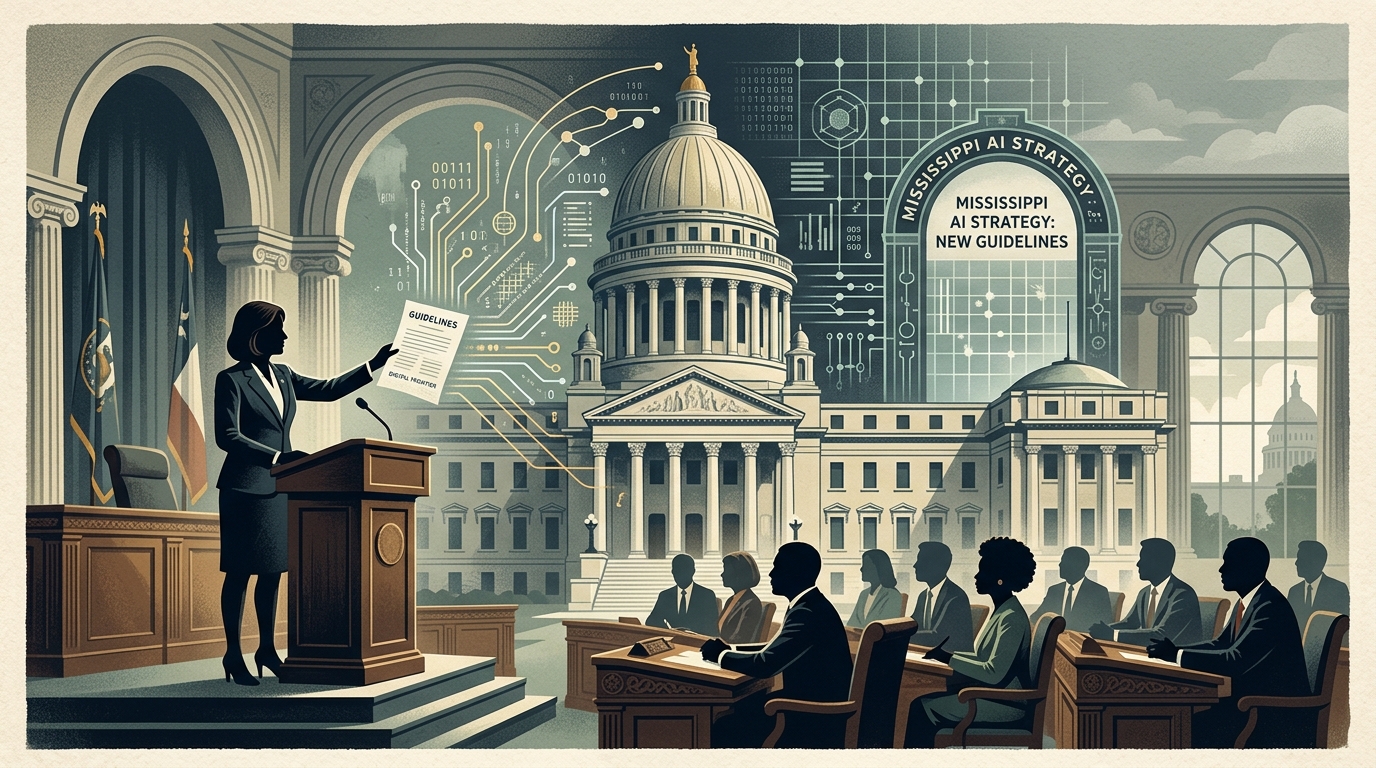
In an era where Artificial Intelligence (AI) is fundamentally reshaping the landscape of public administration, the state of Mississippi has decided to take the reins of its own digital destiny. Governor Tate Reeves recently announced the release of a comprehensive guide for the use of Artificial Intelligence, marking a pivotal moment for the Magnolia State. This move is not merely a bureaucratic addition but a strategic positioning in a world where federal legislation often lags behind the breakneck speed of technological evolution.
The guide, drafted in collaboration with technology and public policy experts, aims to provide a clear roadmap for state agencies. As we find ourselves in mid-2026, the need for such frameworks is more urgent than ever, as Large Language Models (LLMs) and automated decision-making algorithms have already begun to integrate into critical infrastructure, ranging from healthcare to taxation.
The Philosophy of 'Responsible Innovation'
The central philosophy of Mississippi's guide focuses on what Governor Reeves terms "responsible innovation." The document emphasizes the protection of citizens' personal data, ensuring that the use of AI does not lead to privacy breaches or unfair discrimination. In Mississippi, a state with a strong sense of community but also historical challenges, ensuring that technology works for the citizen and not against them is of vital importance.
The guide includes specific guidelines for algorithmic transparency. State agencies are now encouraged to disclose when they are using AI systems to provide services or make decisions that affect residents' lives. This level of accountability is essential for building trust between the government and the public, especially in a period where misinformation and deepfakes pose a daily threat to social cohesion.
Security and Cyber-Defense at the Forefront
One of the most critical pillars of the new guide is cybersecurity. As AI-driven attacks become increasingly sophisticated, Mississippi seeks to fortify its systems. The guide mandates strict auditing protocols for every new AI application adopted by the state. This is not just about protecting data; it is about ensuring the very functionality of the state against foreign interference or malicious actors who might exploit vulnerabilities in automated systems.
Furthermore, the framework promotes the continuous education of public employees. The logic is simple: technology is only as effective as the people who operate it. Through seminars and certification programs, the state aims to create a workforce that can leverage AI tools to reduce bureaucracy and improve efficiency without ignoring the inherent ethical risks. This human-centric approach is designed to demystify AI for those on the front lines of public service.
The Political Dimension and the Road Ahead
Reeves' decision to move forward with this initiative carries significant political weight. In a divided Washington, where discussions on AI regulation often stall in partisan gridlock, states are assuming the role of "laboratories of democracy." Mississippi, following the lead of other states like Virginia and Utah, demonstrates that local governance can be more flexible and effective in addressing technological challenges than a centralized federal approach.
However, critics point out that a "guide" is not the same as a "law." Without the power of legislative enforcement, there is a risk that these guidelines will remain mere suggestions rather than mandates. The challenge for Mississippi in the coming months will be translating these principles into practice and ensuring that private companies partnering with the state comply with the same high standards. In conclusion, Governor Reeves' initiative represents a significant first step, but the true test will lie in its implementation and the state's ability to adapt to a technology that changes almost daily. Mississippi is no longer just watching the AI revolution; it is attempting to govern it.