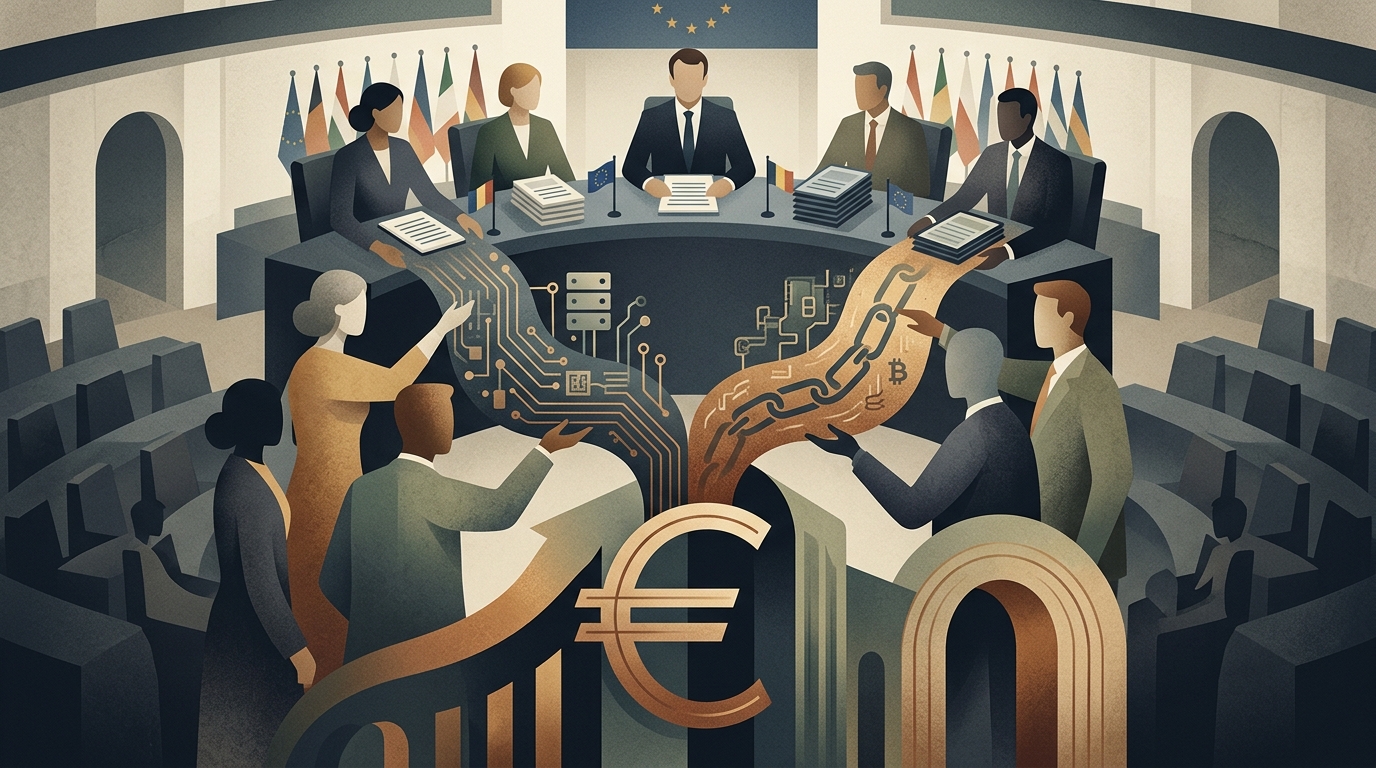
In a move set to redraw the power lines between Brussels and Silicon Valley, French President Emmanuel Macron has laid the cornerstone for a new European financial architecture. His proposal, aimed at establishing a €2 trillion budget for the European Union, is not merely an accounting exercise but an existential declaration for the continent's autonomy. At the heart of this initiative lies the imposition of new taxes on Big Tech companies and the cryptocurrency sector—moves intended to decouple the common budget from the national contributions of member states.
Targeting Digital Wealth and the Logic of 'Own Resources'
For decades, the EU budget has relied heavily on contributions from member states based on their Gross National Income. Macron, however, argues that this model is outdated and politically fragile. His proposal introduces the concept of "own resources" on an unprecedented scale. Tech giants like Google, Amazon, and Meta, which often exploit international tax loopholes to shift profits to low-tax jurisdictions, are now firmly in the crosshairs. The French President is proposing a unified European digital services tax that would flow directly into Brussels' coffers.
Simultaneously, the cryptocurrency market, which until recently enjoyed a status of relative tax immunity in Europe, is being called upon to contribute. With the full implementation of the MiCA (Markets in Crypto-Assets) regulation, the EU now possesses the regulatory framework, and Macron seeks to complement it with a fiscal dimension. The logic is straightforward: if Europe provides the infrastructure and legal certainty for the digital economy, it must also benefit from the value created within it.
Defense, AI, and the Green Transition: The Price of Sovereignty
Why does the EU need €2 trillion? The answer lies in the geopolitical challenges of 2026. The necessity for a robust European defense industry, independent of the fluctuations of American foreign policy, requires massive investment. Furthermore, the Artificial Intelligence (AI) race has left Europe in a trailing position. Macron envisions a European "DARPA" funded by these new resources to create European Large Language Models (LLMs) and supercomputing infrastructure.
- Funding joint European defense procurement.
- Subsidies for domestic semiconductor production and critical raw materials.
- Accelerating the Green Deal to meet 2030 targets.
- Strengthening social cohesion in regions hit by deindustrialization.
The French government contends that without these resources, Europe will become a mere "consumer" of technology developed in the US and China, losing control over its data and values.
"Sovereignty is not a word; it is a budget,"Macron reportedly stated in a recent meeting with European leaders, emphasizing that economic power is the only guarantee of political freedom.
Reactions and the Diplomatic Minefield
Macron's plan, however, is not without its detractors. The so-called "frugal" Northern countries, led by the Netherlands and Germany, remain wary of any move that could lead to a "transfer union." While the idea of taxing Big Tech is popular among voters, transferring this power to Brussels is seen by many as a loss of national sovereignty.
Furthermore, Washington's reaction is expected to be fierce. The US has traditionally viewed digital taxes as a form of discrimination against American firms. At a time when trade relations are already strained, the imposition of such taxes could trigger a new round of tariffs on European products, from French wine to German cars. Macron is betting that the US's need for a strong ally in Europe will outweigh Silicon Valley's interests, but the risk remains high.
In conclusion, the €2 trillion budget proposal is a litmus test for the future of the EU. If successful, Europe will gain the financial means to become a true global player. If it fails, it risks remaining a bureaucratic giant with feet of clay, unable to protect its interests in an increasingly competitive world.