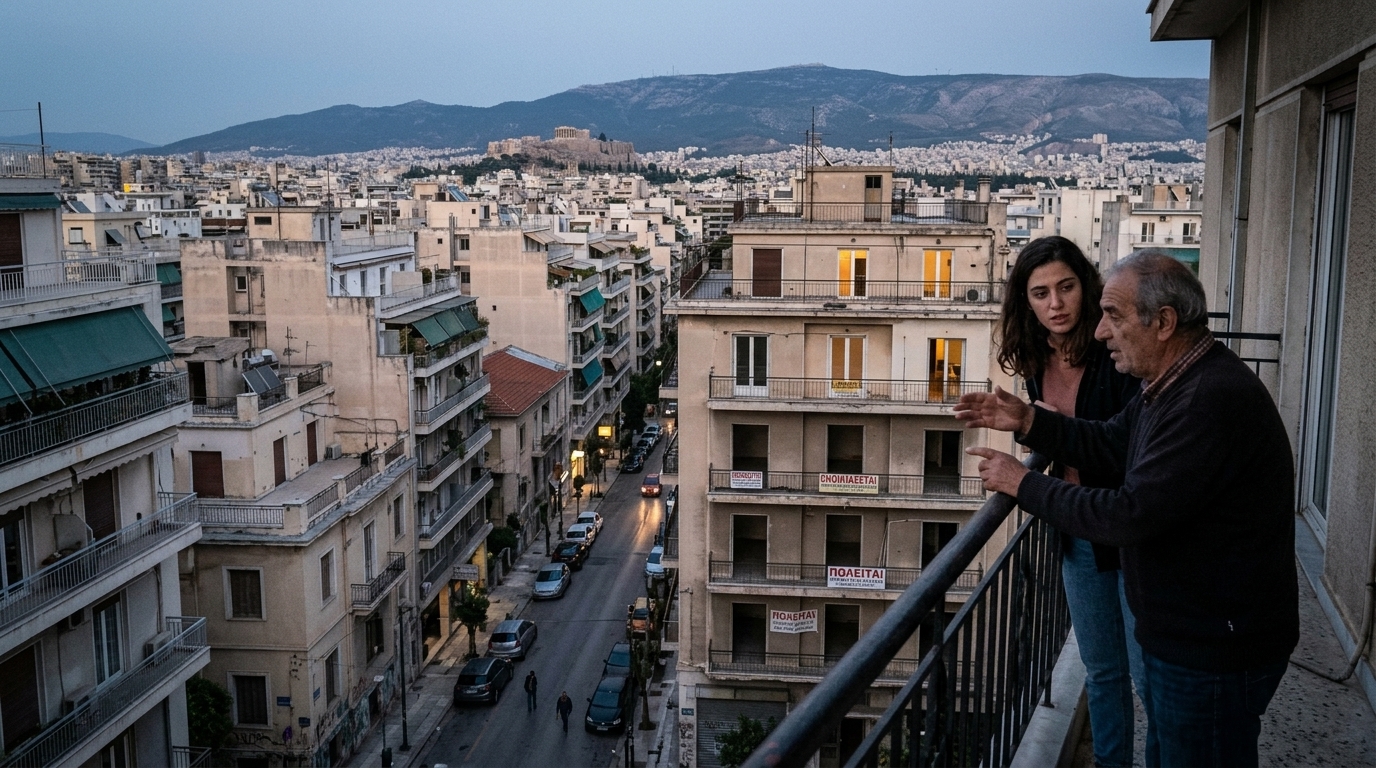
Greece in 2026 faces a paradox that threatens its social fabric: while thousands of young people and families are unable to find affordable housing, approximately 800,000 properties remain closed and unused across the country. The National Strategy for Housing Policy 2026-2035, recently unveiled, is not merely a wish list but an attempt at structural restructuring of the real estate market, using tools that were until recently considered "taboo" for the Greek economy.
The National Price Index: Ending Opacity
A central pillar of the new strategy is the creation of a National Index of Property Prices and Rents. Until now, pricing in the Greek market was often based on subjective estimates or inaccurate listings on real estate websites. The new index, powered by real-time data from Taxisnet and the Hellenic Cadastre, will provide a crystal-clear picture of actual transaction prices per neighborhood. This transparency is not just for public information; it is the prelude to the implementation of more drastic measures.
With this index, the state gains the ability for the first time to identify areas of "overheating" and intervene in a targeted manner. The discussion about rent caps, although sparking reactions among property owners, is now officially on the table for specific categories of housing and vulnerable social groups, following the example of cities like Berlin and Barcelona.
The Gamble of 800,000 Vacant Homes
The most ambitious part of the plan concerns the mobilization of 800,000 vacant homes. This is a massive building stock that remains off the market due to age, legal entanglements, or the financial inability of owners to renovate. The government is moving toward a package of "bold" incentives, which includes:
- Full exemption from rental income tax for 3 to 5 years for those who open closed apartments and make them available for long-term lease.
- Renovation subsidies through the "Renovate - Rent" program, with increased cost coverage percentages, provided the property remains on the market for at least seven years.
- Tax penalties or increased ENFIA (Property Tax) for properties that remain closed in high-demand areas without justification, a measure expected to trigger intense political controversy.
"Housing is not a luxury; it is a fundamental right. The state must correct the distortions of a market that has left its citizens at the mercy of speculative capital," states the introduction of the strategy.
"Spiti Mou II" and Social Counter-offer
The success of the first "Spiti Mou" (My Home) program led to the design of its second phase, with expanded income criteria and an increased budget. "Spiti Mou II" aims to cover not only young people up to 39 but also couples up to 50, recognizing that the housing crisis is now hitting middle age as well. Simultaneously, the model of "Social Counter-offer" (Social Housing) is being put into motion. The state grants unused public land and buildings to construction companies, which undertake the construction of modern housing. In return, a significant percentage of the apartments will be available at extremely low rents to beneficiaries with social criteria.
The Implementation Challenge
Despite the rational design, the challenges remain immense. Greek bureaucracy, time-consuming property transfer procedures, and the shortage of labor in the construction sector are significant hurdles. Furthermore, the impact of short-term rentals (Airbnb style) continues to push rents upward, despite existing restrictions. The new strategy provides for even stricter limits on rental days per year in saturated areas, such as Koukaki and Pangrati, essentially turning short-term rentals into a secondary economic activity.
In conclusion, the National Strategy 2026-2035 is an admission that the "invisible hand" of the market has failed to regulate the housing issue in Greece. The transition to a model of a regulated market with strong state incentives and disincentives is the last hope to prevent the full ghettoization of urban centers and the further demographic collapse of the country.