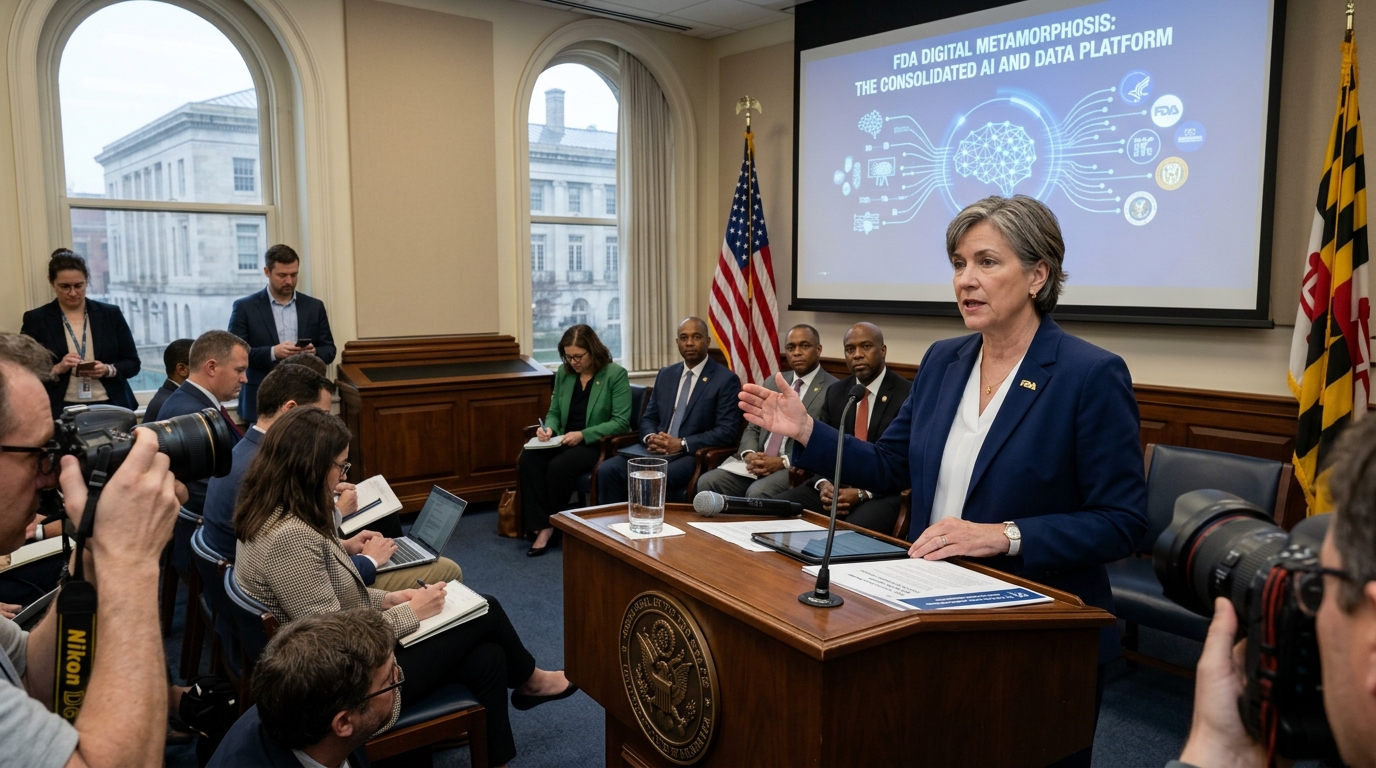
In a move that signals the dawn of a new era for regulatory science, the U.S. Food and Drug Administration (FDA) has announced the launch of its updated, consolidated data and Artificial Intelligence (AI) platform. This development, the culmination of a multi-year digital transformation initiative, is far more than a mere technical patch; it represents a fundamental shift in how the state oversees public health in the 21st century.
The Architecture of Consolidation
For decades, the FDA operated within a fragmented environment where different centers—such as the Center for Drug Evaluation and Research (CDER) and the Center for Devices and Radiological Health (CDRH)—maintained their own isolated data silos. The new platform dismantles these barriers, creating a unified 'data lake' that allows for the seamless flow of information across the entire agency.
Utilizing cloud-native technologies, the FDA can now manage vast volumes of data from clinical trials, adverse event reports, and genomic analyses at speeds that were unimaginable just a few years ago. This integration is critical, as modern medicine becomes increasingly interdisciplinary, requiring experts from various fields to collaborate on the same datasets simultaneously.
AI as a Regulatory Catalyst
At the heart of the new platform are integrated Artificial Intelligence and Machine Learning algorithms. These tools are designed to assist FDA scientists in identifying patterns within thousands of pages of clinical trial documentation. By employing Natural Language Processing (NLP), the platform can automatically summarize clinical findings, flag potential risks, and compare new data against historical records of similar compounds.
This does not imply that AI will replace human judgment. On the contrary, it functions as a 'digital assistant' that liberates reviewers from the arduous task of manual data cross-referencing, allowing them to focus on high-level decision-making regarding drug safety and efficacy. The acceleration of the approval process, particularly for drugs targeting orphan diseases, is expected to be substantial.
Post-Market Surveillance and Patient Safety
One of the most promising aspects of the new platform is the enhancement of post-market surveillance. Through the analysis of Real-World Evidence (RWE), the FDA will now be able to identify rare side effects much faster than in the past. The platform can interface with electronic health records and insurance databases, analyzing trends in real-time.
"Our ability to see the forest and not just the trees in drug safety is undergoing a radical change," stated an official from the Office of Digital Transformation.
This proactive approach has the potential to save lives by allowing the agency to issue warnings or withdraw products before a localized observation escalates into a full-blown public health crisis.
Challenges: Ethics, Bias, and Transparency
Despite the optimism, the deployment of AI at a regulatory level raises serious questions. Algorithmic transparency is the primary concern: how can we be certain that AI does not bake in biases that could disproportionately affect specific demographic groups? The FDA has committed to using 'Explainable AI' (XAI), ensuring that every recommendation generated by the system can be traced and scientifically justified.
Furthermore, data security remains a top priority. In an era of increasing cyber threats, concentrating such sensitive information into a consolidated platform makes the FDA a high-value target. The use of advanced encryption and Zero Trust architecture is baked into the platform's design to prevent breaches and maintain the integrity of proprietary pharmaceutical data.
Conclusion
The FDA’s new platform serves as a blueprint for regulatory bodies worldwide, including the European Medicines Agency (EMA). As biotechnology and digital health converge, the need for a regulator that speaks the 'language of data' is imperative. The success of this venture will be judged not by the complexity of its algorithms, but by its ability to strengthen public trust in science and deliver safer treatments more rapidly to those who need them most.