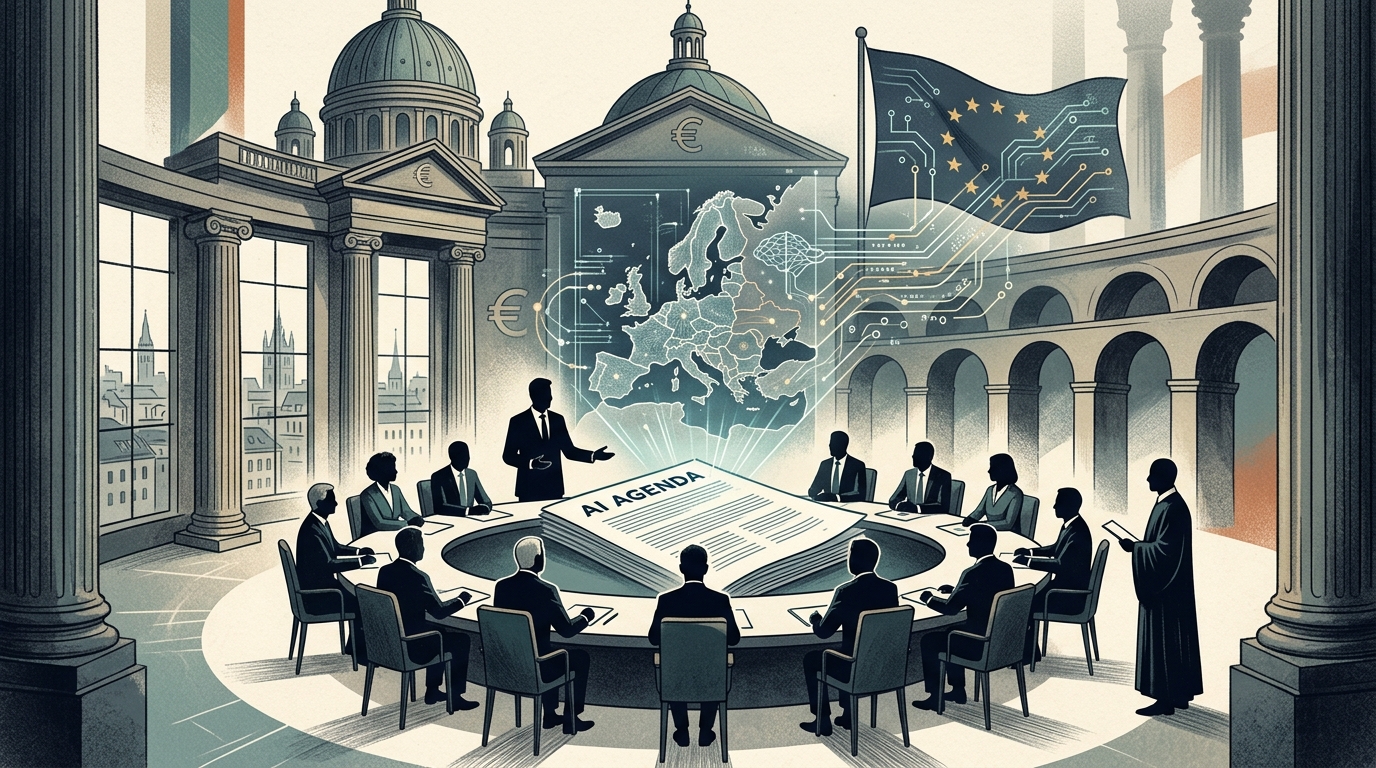
In an era where geopolitical power is increasingly measured in flops and model parameters rather than just traditional economic indicators, the Eurozone is attempting a bold pivot. Eurogroup President Kyriakos Pierrakakis has submitted a comprehensive proposal to institutionalize a permanent agenda for Artificial Intelligence (AI), cybersecurity, and technological sovereignty. This move is not merely a technical adjustment but a profound recognition that the economic viability of the euro is inextricably linked to digital acceleration.
The Productivity Paradox and the European Lag
For decades, Europe has struggled with the ghost of low productivity compared to the United States and China. Pierrakakis' proposal addresses this structural issue, arguing that AI is not an isolated sector of the economy, but the operating system upon which the future of industry, services, and public administration will be built. During his presentation, the Eurogroup President emphasized that Europe can no longer be confined to the role of a "regulator" via the AI Act; it must evolve into a "producer" and an "investor."
The permanent agenda envisions a mechanism for coordinating national investments to avoid the fragmentation of resources. With the cost of training Large Language Models (LLMs) skyrocketing into the billions of euros, no single European country can compete with American tech giants alone. The proposal suggests leveraging common financial instruments to support European supercomputing clusters and create an ecosystem for "Sovereign AI."
Cybersecurity: The New Defense Line of the Euro
One of the most compelling aspects of the proposal is the link between cybersecurity and financial stability. Pierrakakis argued that a systemic cyberattack on the Eurozone’s banking infrastructure could cause more damage than a classic financial crisis. Consequently, the permanent agenda includes tightening security protocols and investing in quantum encryption technologies to protect the digital euro and cross-border transactions.
- Creation of a "European Digital Resilience Fund" to protect critical infrastructure.
- Common stress tests for the resilience of financial institutions against AI-driven attacks.
- Coordinated action to combat disinformation targeting financial markets.
The Political Economy of Technological Sovereignty
Pierrakakis' proposal is not without its political hurdles. The Eurogroup discussion highlighted traditional divides between the "frugal" North and the South regarding the funding of such initiatives. However, the momentum seems to be shifting. The need for strategic autonomy, especially following the geopolitical upheavals of recent years, has convinced even the most skeptical that dependence on foreign technological infrastructure constitutes an existential risk.
"Technological sovereignty is not isolationism; it is the ability to choose our own future without it being dictated by algorithms developed outside our borders," Pierrakakis stated pointedly.
At the heart of the agenda is also the upskilling of the workforce. The Eurogroup is considering incentives for companies investing in employee reskilling, ensuring that the transition to an AI-driven economy does not lead to social fractures. The proposal includes the creation of a European framework for "responsible automation," ensuring that the benefits of increased productivity are diffused throughout society and not just concentrated in a few technological hubs.
Conclusion: Towards a Digital Stability Pact?
Kyriakos Pierrakakis’ initiative marks the transition from a Europe that merely observes developments to a Europe that seeks to co-shape them. If the proposal is adopted in its entirety, the Eurogroup will cease to be just a forum for discussing deficits and debt, and will become the headquarters for the continent's digital survival. The challenge now shifts to implementation: can member states overcome national silos to build a truly unified digital market? In the age of exponential technology, time is not on our side.