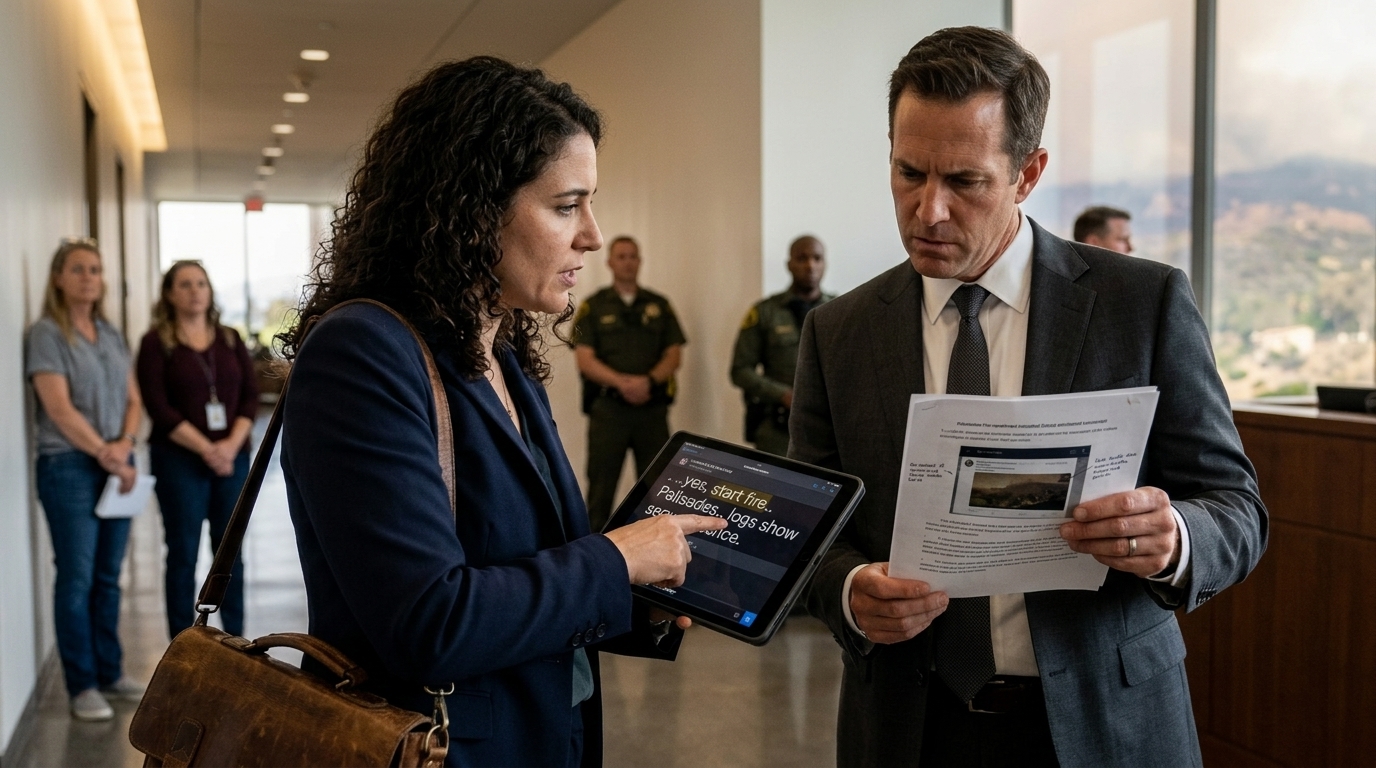
On New Year's Day 2025, a catastrophic wildfire tore through the Palisades hills of Los Angeles, leaving behind ashes and a legal battle poised to redefine the future of digital surveillance. At the center of the trial of Jonathan Rinderknecht, accused of arson, were not just traditional pieces of evidence—such as iPhone location data or security camera footage—but something far more intimate: his ChatGPT conversation logs.
The use of ChatGPT logs as evidence represents a critical turning point. For prosecutors, the queries the defendant submitted to the AI were a "mirror of his mind," revealing clear intent and preparation. For civil liberties advocates, however, this move signals the end of the privacy of thought, turning our digital assistants into permanent witnesses for the prosecution.
The Anatomy of a Digital Premeditation
According to court documents, Rinderknecht allegedly used ChatGPT to inquire about wind conditions in the Palisades area on New Year's Eve, as well as the ignition properties of certain chemicals. Prosecutors argued that these searches were not coincidental but part of a methodical plan to cause maximum destruction. OpenAI, the company behind ChatGPT, complied with search warrants, handing over full transcripts of the user's interactions.
This "digital confession" differed from a simple Google search. While a search engine provides links, interacting with a Large Language Model (LLM) is more akin to a dialogue. Users often lay out scenarios, ask for clarifications, and "build" an idea through the interaction. In the Palisades case, the prosecution used the structure of these dialogues to convince the court that Rinderknecht had full awareness of the consequences of his actions.
The Legal Thriller and the Third-Party Doctrine
The trial ultimately ended in a mistrial, as jurors could not reach a unanimous decision on whether the ChatGPT queries proved guilt beyond a reasonable doubt or merely represented morbid curiosity. However, the court's admission of this evidence is rooted in a controversial legal principle: the "Third-Party Doctrine."
Under this doctrine, citizens have no "reasonable expectation of privacy" for information they voluntarily share with third parties, such as banks or tech companies. In the age of AI, this means every thought typed into a chatbox belongs to the company and, by extension, is accessible to authorities. Legal analysts warn that this creates a "chilling effect," where individuals may fear exploring ideas or asking questions, lest their digital musings be used against them in a future courtroom.
The Ethical Dimension: AI as a Witness
The Palisades case highlights a new reality: artificial intelligence is no longer just a productivity tool, but a permanent recorder of human intent. As technology ethics experts note, the ease with which authorities can access this data undermines the relationship of trust between humans and machines.
- Intent vs. Action: Can a question to a bot be considered a preparatory act for a crime?
- Corporate Responsibility: Should OpenAI and Google be required to warn users that their "private" chats can become public records?
- The Future of Criminal Investigation: Will AI log analysis become the new "digital DNA"?
As society integrates AI into every facet of life, legal protections for this data remain desperately behind technological progress. The Rinderknecht case is only the beginning of a long series of legal battles that will determine whether our minds remain the final sanctuary of privacy or if they have been surrendered to the servers of Silicon Valley.
The Broader Implications for Digital Forensics
The mistrial does not negate the precedent set by the use of these logs. In fact, it provides a roadmap for future prosecutions. We are entering an era where "pre-crime" detection, once the stuff of science fiction, is being facilitated by our own digital footprints. If an AI can predict what we might do based on our queries, and a prosecutor can use those queries to prove we did it, the boundary between thought and deed becomes dangerously blurred.
"We are no longer just searching for information; we are thinking out loud with an entity that never forgets and always complies with a subpoena." — Legal Analyst, Palisades Trial.
The challenge for the 2026 legal system is to balance the need for justice in devastating cases like the Palisades fire with the fundamental right to a private mental life. Without clear legislative guardrails, the very tools meant to augment our intelligence may become the most potent weapons used against our freedom.