

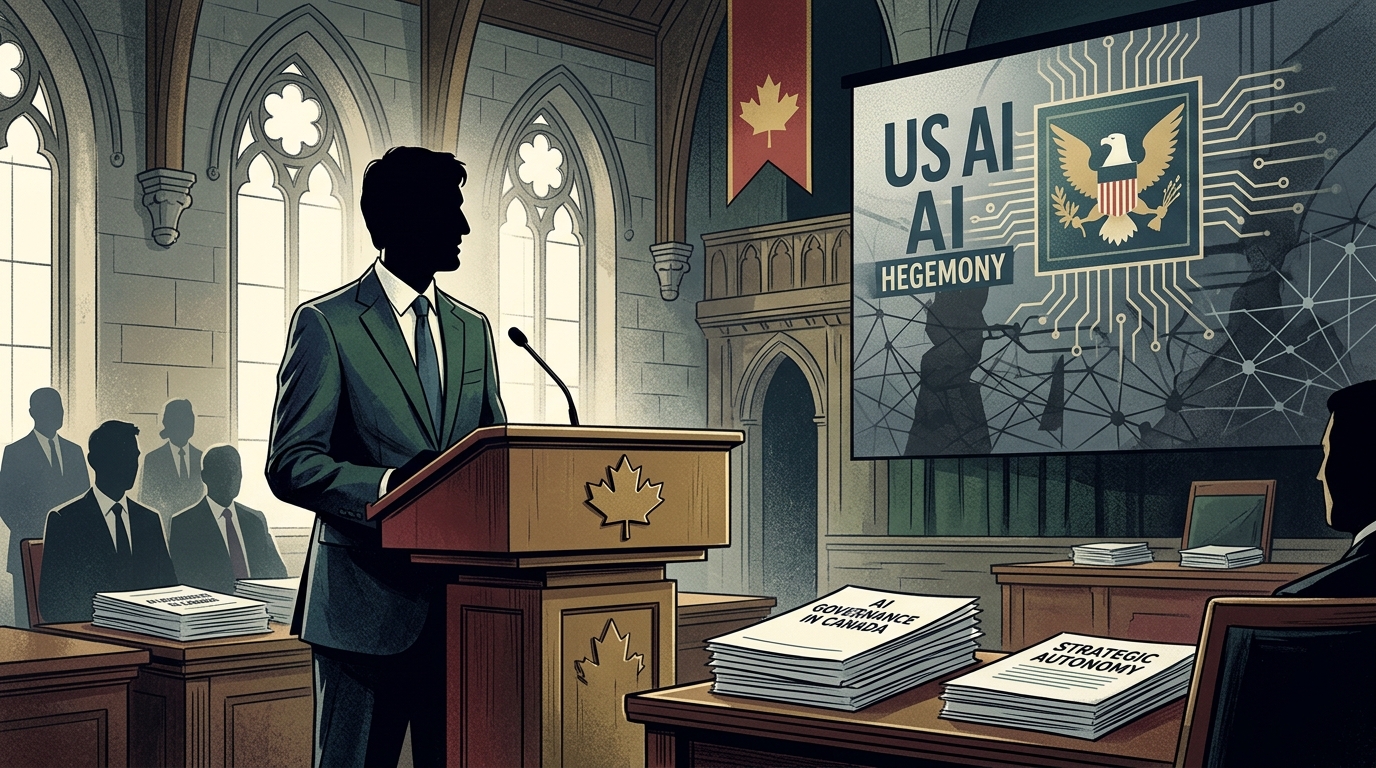
In a landmark speech in Ottawa, Canadian Prime Minister Mark Carney placed "digital sovereignty" at the heart of the geopolitical agenda. The catalyst was the U.S. government's recent decision to impose export restrictions and access limitations on Anthropic’s latest artificial intelligence models, citing national security concerns. For Carney—a man who built his reputation managing systemic risks as a central banker—this move serves as a stark warning: over-reliance on a single provider, or a single nation, is a strategic error of the highest order.
The Anthropic Lesson and the 'Single Option' Trap
Anthropic, which by mid-2026 has solidified its position as the primary challenger to OpenAI at the apex of foundation models, found itself entangled in U.S. Department of Commerce regulations. New restrictions prevent full access to advanced model capabilities in countries that do not meet specific "security alignment" criteria. Although Canada remains a stalwart ally, the uncertainty injected into Canadian businesses and research institutions was enough to trigger Carney’s vocal response.
"You’ll hear me say this over and over again: It is never a good idea to have one option," the Prime Minister stated. This sentiment extends beyond Anthropic or Microsoft; it targets the entirety of the American tech ecosystem. Carney argued that AI is no longer a mere commercial product but a fundamental utility, akin to the power grid or telecommunications. If access to this utility can be unilaterally severed or throttled by a foreign power, then Canada's national autonomy is effectively compromised.
The Strategy for Sovereign AI
Canada boasts one of the world's most vibrant AI ecosystems, with pioneers like Yoshua Bengio and Geoffrey Hinton having laid the groundwork decades ago. However, a lack of domestic compute capacity and the dominance of American cloud providers have left the nation vulnerable. Carney proposed a new national strategy centered on three pillars: building state-backed data centers, bolstering domestic open-source models, and forging strategic alliances with the European Union and Japan.
This approach aims to create an "alternative path" that does not depend on the whims of the administration in Washington. According to Carney, U.S. protectionism in the AI sector, while perhaps understandable in the context of competition with China, creates collateral damage among allies. "Our friends in the U.S. must understand that Western security is strengthened when we are all technologically robust, not when we are all customers of a handful of Silicon Valley firms," he emphasized.
Geopolitical Fallout and the Future of Alliances
Canada's stance reflects a broader global trend. From France and Germany to Saudi Arabia, nations are racing to develop their own "Sovereign AI." The U.S. move to restrict Anthropic is viewed by many as the opening salvo of an "AI Cold War," where technology is no longer freely diffused but used as a tool for diplomatic and economic leverage.
For Carney, the solution is not isolationism, but diversification. His government is already exploring funding for a large-scale national model trained on Canadian data and hosted on Canadian soil. Simultaneously, he is encouraging Canadian banks and industries to adopt open-source solutions, which offer greater resilience against external constraints. The challenge is immense, as the cost of compute remains prohibitive for most states, but the alternative of total dependency now appears more dangerous than ever.
Conclusion: The Awakening of the Allies
Mark Carney’s warning signals a new phase in U.S.-Canada relations and the global technological landscape. As Artificial Intelligence becomes the engine of the 21st-century economy, the question of "who controls the code" becomes the most significant political question of our time. Canada, led by a technocrat who understands the power of infrastructure, seems determined not to leave its future in the hands of another nation's algorithms, no matter how friendly that nation may be.





