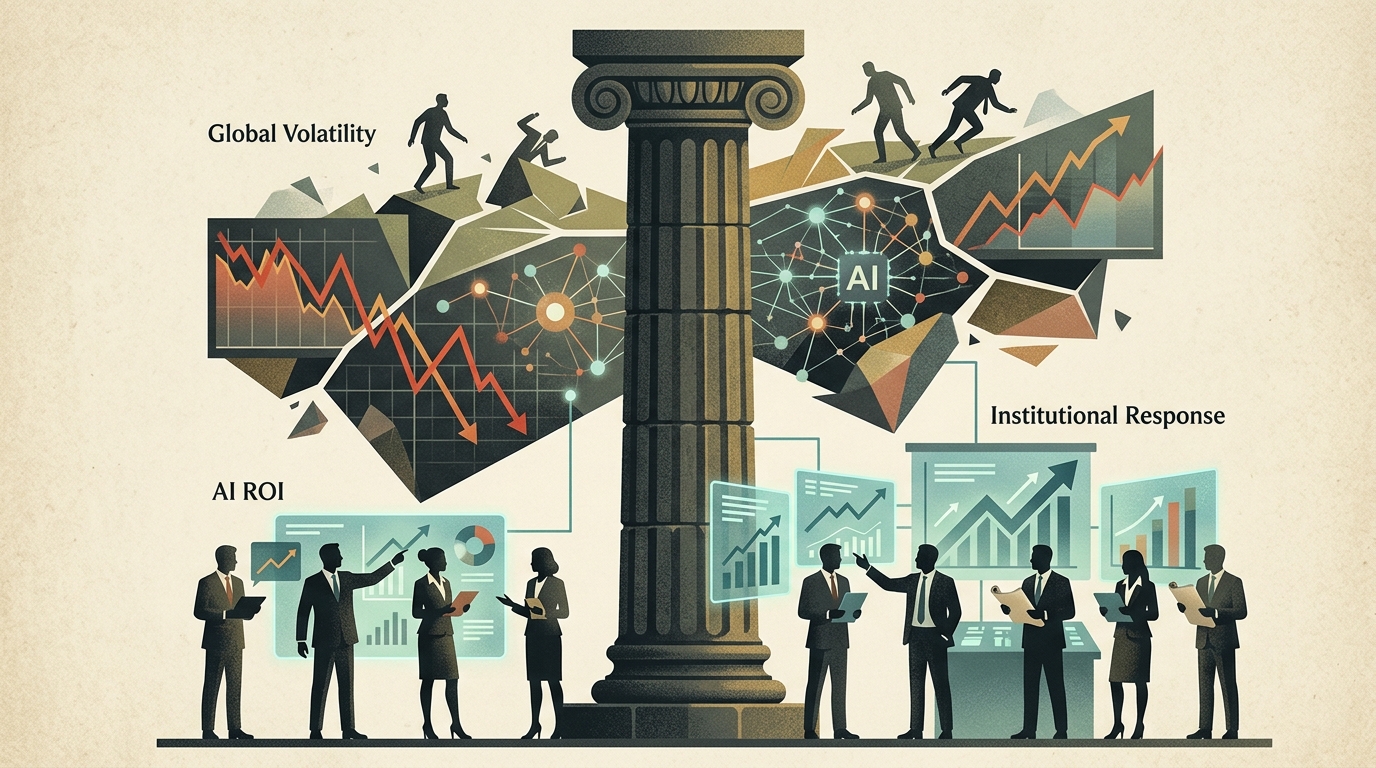
For decades, Silicon Valley has been the bastion of libertarian capitalism—a place where "creative destruction" was celebrated and state intervention was viewed with skepticism. However, the advent of Artificial Intelligence (AI) appears to be shaking these ideological foundations. According to a recent analysis by Le Monde, the very individuals who built the algorithms threatening to displace millions of workers are now proposing solutions once deemed "radical" or "European socialist": Universal Basic Income (UBI), a reduced work week, and increased capital taxation.
The Great Pivot: From Innovation to Social Welfare
The debate is no longer about whether AI will replace jobs, but how quickly and at what scale. The difference between this technological revolution and previous ones lies in its velocity and scope. While the Industrial Revolution replaced muscles, AI targets cognition, affecting sectors from law and medicine to programming and creative writing. In this context, the concept of Universal Basic Income is gaining traction as a necessary "safety net."
OpenAI's Sam Altman has already begun experiments with UBI, arguing that the abundance generated by AI must be shared. However, the European approach, as noted, differs significantly. In Europe, the welfare state is not an act of billionaire philanthropy but an institutionalized right. The convergence of these two worlds creates a new political reality where technology mandates wealth redistribution to maintain social cohesion.
The Reduced Work Week as an Antidote to Automation
Another proposal gaining momentum is the reduction of the work week—for instance, to four days—without a loss in pay. The logic is straightforward: if productivity skyrockets thanks to AI, the fruits of this progress should not accrue solely to shareholders but should translate into more leisure time for workers. This model, already being tested in countries like Iceland and Belgium, seems to be the answer to the potential scarcity of available work hours in the future.
- AI increases productivity while decreasing demand for human labor.
- Leisure time becomes the new currency of social well-being.
- Mental health and social participation emerge as priorities over traditional employment.
Taxing Capital and the "Robots"
The most contentious issue remains the funding of these measures. Here, Silicon Valley seems to be accepting the necessity of a "capital tax" or an "AI tax." As value shifts from labor to capital (algorithms and data), traditional income tax systems are becoming obsolete. If machines are doing the work, then the machines—or rather, their owners—must pay for the upkeep of the social fabric.
"We cannot have a society where technology generates trillions and people cannot afford to live. Redistribution is no longer an option; it is a condition for the survival of capitalism," state analysts aligned with European policy think tanks.
However, a risk remains: the creation of a "digital feudalism." If the state or tech giants merely provide a survival stipend, citizens risk becoming passive consumers without political agency. The challenge for Europe is to integrate these technological solutions while preserving democratic participation and the dignity of work, even if that work changes form.
Conclusion: Toward a New Social Architecture
The pivot of tech leaders toward European welfare models is an admission of AI's disruptive power. This is not a sudden burst of altruism but a pragmatic assessment of risk. Without a new social contract, social upheaval is inevitable. Europe, with its long tradition of social protection, has the opportunity to lead this transition, offering a model that combines technological innovation with human dignity. The question remains: can political institutions evolve as fast as the algorithms?