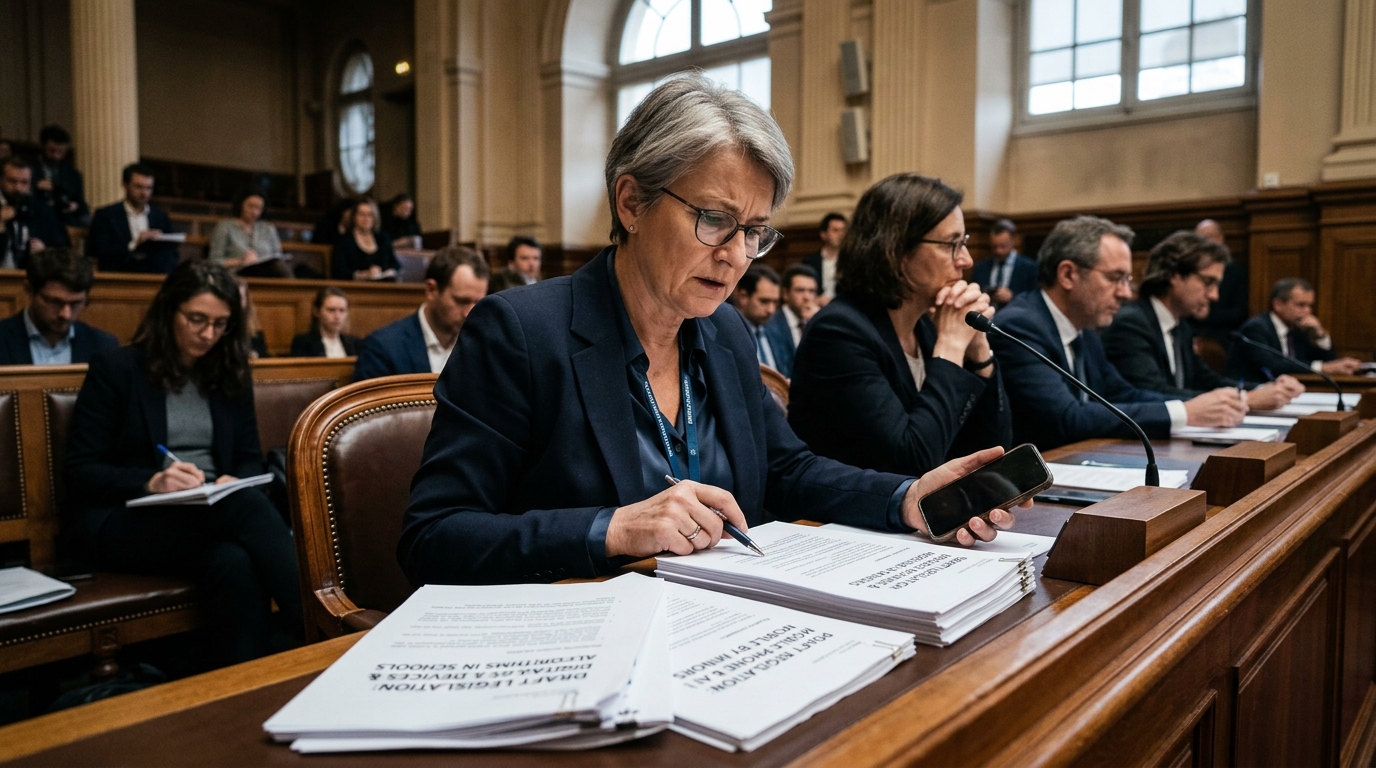
The history of education is punctuated by moments where technological progress was met with suspicion, from the introduction of the pocket calculator to the ubiquitous use of Wikipedia. However, the advent of Generative AI seems to be triggering a reaction of unprecedented scale. Following the recent global trend of banning smartphones and social media in schools, a new 'red line' is being drawn: the restricted or even total ban of tools like ChatGPT and Claude for minor students.
Intellectual Atrophy and the Danger of Convenience
The primary argument for these bans focuses on cognitive development. Learning, in its traditional form, requires what educators call 'desirable difficulty.' The process of synthesizing an essay, solving a complex mathematical problem, or critically analyzing a text is what builds the neural connections of critical thinking. When an AI model can produce a high-quality result in seconds, the student bypasses the stage of intellectual effort.
According to recent reports, including those highlighted by Insomnia.gr, the concern is not limited to mere plagiarism. The deeper issue is the gradual loss of young people's ability to structure arguments without digital scaffolding. Artificial Intelligence acts as an 'exoskeleton' for the mind, which, if used prematurely, could lead to the atrophy of core cognitive functions.
Regulatory Frameworks and the European Approach
The European Union, through the AI Act, has already established strict rules for systems concerning education, classifying them as 'high-risk.' However, implementing these rules in the daily reality of the classroom remains a challenge. Many countries are now considering legislative measures that would force schools to use 'closed' AI ecosystems, where access is strictly controlled by educators.
In many jurisdictions, the debate is evolving: does protection of intellectual integrity take precedence over technological literacy? Critics of a total ban argue that such moves could widen the digital divide. Students from affluent families will continue to access advanced AI tools at home, gaining a strategic advantage over those who rely solely on public education resources.
The Need for a New Pedagogy
Instead of a simple ban, many experts suggest a radical restructuring of student assessment. If AI can answer the questions on an exam, then perhaps the questions themselves are flawed. A shift toward oral examinations, in-class assignments without internet access, and the evaluation of the 'process' rather than the 'final product' seems to be the only viable path forward.
- Reintroduction of pen-and-paper exams to ensure authenticity.
- Focus on teaching 'AI Literacy' – how students can question and verify AI outputs.
- Utilizing AI as a teacher's assistant rather than a substitute for student study.
In conclusion, banning AI in schools is not necessarily a regressive move, but an attempt to preserve human uniqueness in thought production. In a world increasingly flooded with synthetic content, the ability to think autonomously is transforming from a basic right into a rare and valuable skill.