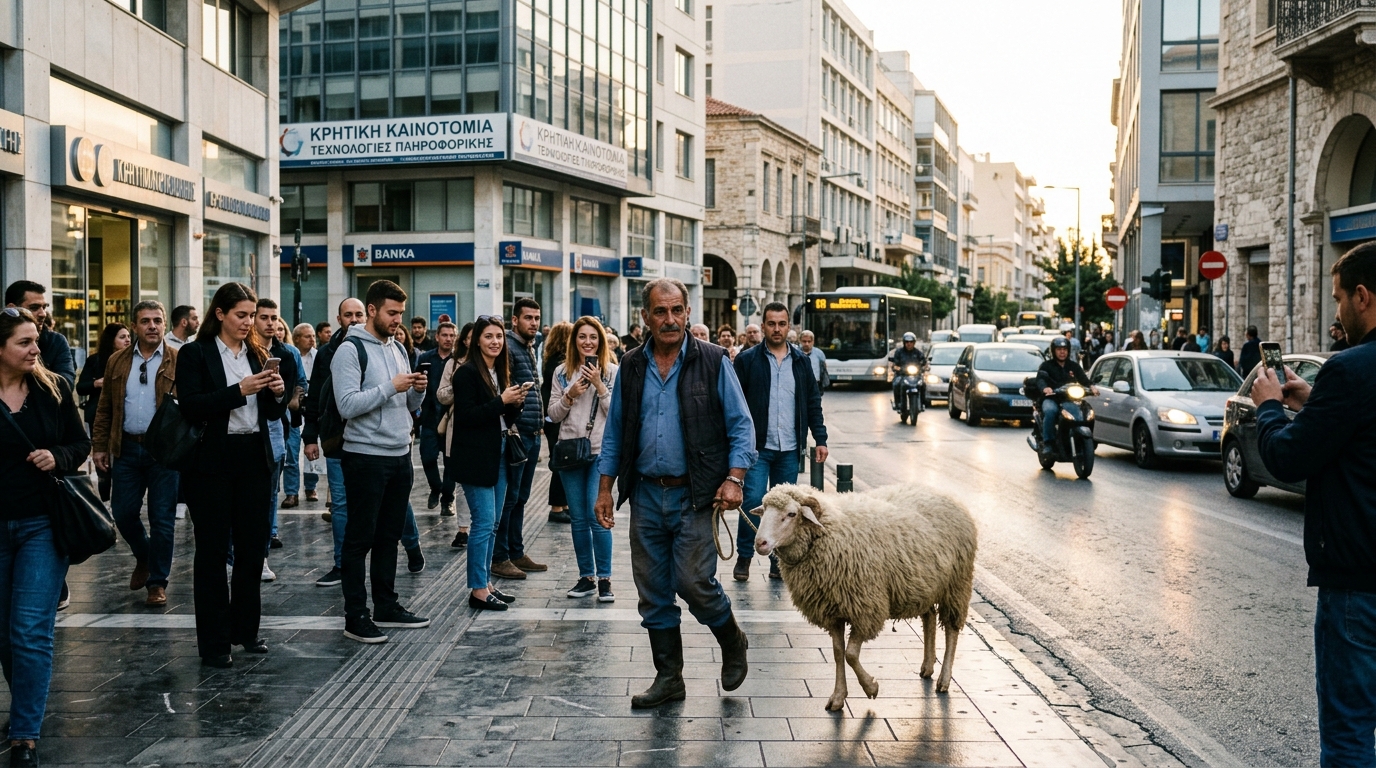
The news began as just another "quirky" social media post: a sheep wandering nonchalantly through Eleftherias Square, in the heart of Heraklion, Crete. In any other era, the photo would have prompted laughter, comments about the Cretan countryside invading the urban fabric, or perhaps slight indignation over city order. In 2026, however, the primary reaction isn't laughter—it's suspicion. "Is it real or AI?" hundreds of users asked, sparking a debate that transcends the borders of Crete and touches the core of our modern epistemological crisis.
The Anatomy of Digital Doubt
The incident in Heraklion, as reported by the newspaper "Patris," serves as a textbook example of how Artificial Intelligence has irrevocably changed the way we consume information. The photo depicted a scene that, while unusual, is not entirely impossible by Cretan standards. However, the perfection of the lighting, the strange contrast of the animal against the concrete backdrop, and the overall "crispness" of the image led many to conclude it was the product of an advanced generative model like Midjourney or DALL-E.
This skepticism is not unfounded. Over the past two years, we have seen images of the Pope in a puffer jacket, arrests of political leaders that never happened, and disasters that existed only in pixels. The problem now is not just that AI can fabricate lies, but that the existence of AI makes us question the truth even when it is right before our eyes. This is what researchers call the "liar’s dividend": the ability for people to dismiss real events as "fake" to avoid reality or simply because they have lost trust in their senses.
Local Journalism in the Age of Deepfakes
For local media outlets like "Patris," such incidents present a new set of challenges. Fact-checking is no longer just about "who said what," but also about "what is it that we are seeing." In the case of the Heraklion sheep, journalistic investigation must employ traditional methods—eyewitnesses, security camera footage, contacting local authorities—to confirm an image that would once have been considered self-evident.
- The speed of dissemination: An AI image can go viral in minutes, long before any journalist has the chance to verify it.
- Cultural familiarity: Choosing a subject that fits the local narrative (like sheep in Crete) makes the deception more plausible.
- The erosion of trust: Every time a user discovers an image was fake, they become more cynical toward all news.
Digital Literacy: The Only Defense
The Heraklion case highlights the urgent need for digital literacy. Citizens must learn to recognize the "tells" of AI: unnatural shadows, distortions in fine details (like animal hooves or human fingers), and a general "dreamlike" texture. However, as technology evolves, these signs are disappearing. The solution will not be purely technical but also institutional. We need digital signatures and provenance verification systems to accompany every photo published by official media.
"We are no longer in an era where a picture is worth a thousand words. In the age of AI, a picture can be a thousand lies if it isn't backed by the credibility of its source."
At the end of the day, whether the sheep was real or a well-crafted algorithm, the lesson remains the same: reality is now a battlefield. In Heraklion, a city with deep history and a strong identity, the invasion of digital doubt reminds us that no place is immune to the challenges of post-truth. The responsibility for preserving the truth now falls on the shoulders of both content creators and readers, who are called to be more discerning than ever before.