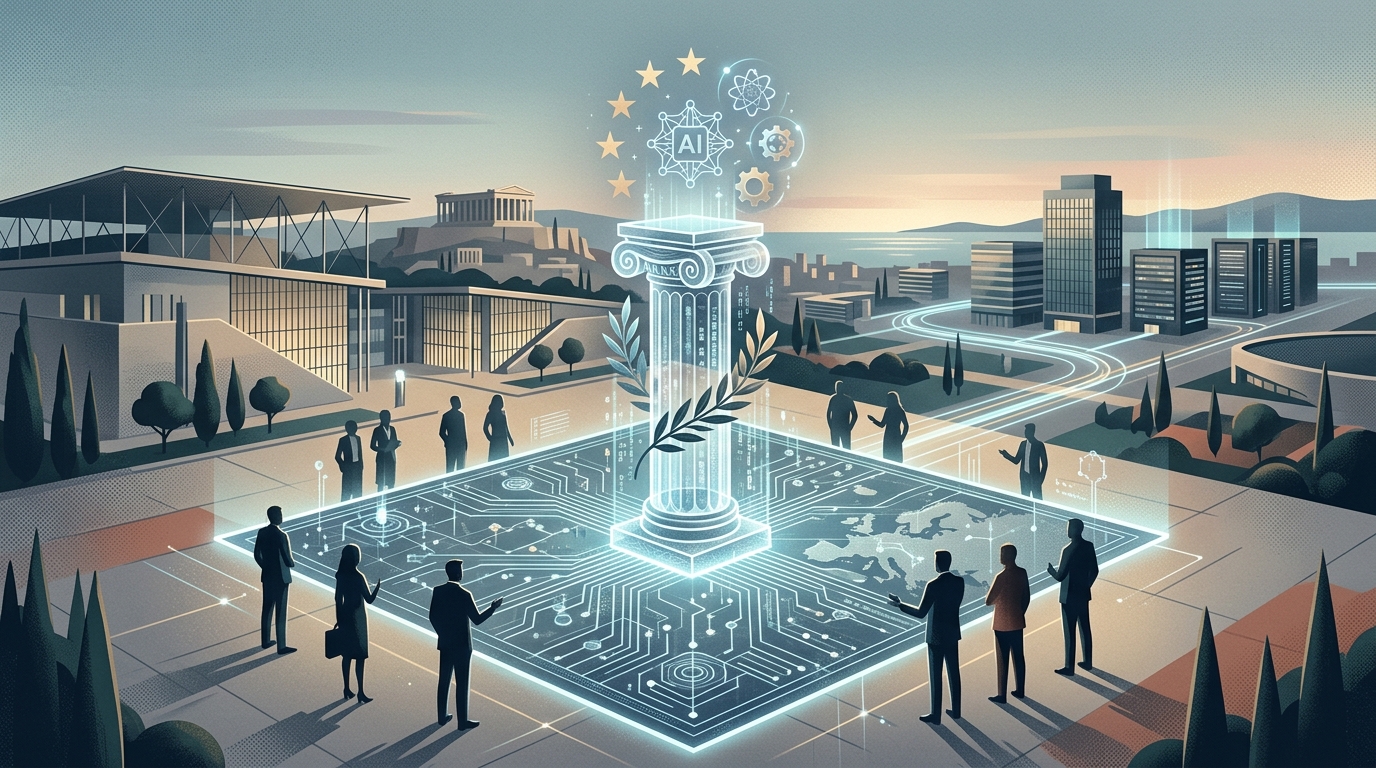
In an era where the global geopolitical balance is shifting from traditional military power to computational sovereignty, Europe finds itself at a critical crossroads. Kyriakos Pierrakakis, Greece's Minister of Education, Religious Affairs, and Sports—and the primary architect of the nation's digital transformation—has reignited the debate on the absolute necessity of a unified European strategy for Artificial Intelligence (AI). His recent remarks, framed by the landmark reports of Enrico Letta and Mario Draghi, transcend mere political rhetoric; they represent a strategic warning regarding the continent's future competitiveness.
The Shadow of the Letta and Draghi Reports
The reports authored by Enrico Letta and Mario Draghi have acted as a systemic "wake-up call" for Brussels. Letta, focusing on the future of the Single Market, argued that fragmentation remains Europe’s Achilles' heel, preventing businesses from reaching the scale necessary to compete globally. Mario Draghi, in his comprehensive assessment of European competitiveness, was even more direct: Europe faces an existential challenge if it fails to close the productivity gap through technological adoption. Minister Pierrakakis aligns himself with these findings, asserting that the formulation of common goals is no longer a luxury but a prerequisite for survival.
Pierrakakis points out that while Europe possesses world-class talent and a robust academic tradition, it suffers from a chronic inability to scale innovation. While the United States benefits from a massive, homogeneous market and China utilizes a state-driven strategic model, Europe remains entangled in 27 different regulatory frameworks and often conflicting national agendas. AI development requires immense capital and infrastructure—resources that no single European nation can muster alone to rival the giants of Silicon Valley or Shenzhen.
Balancing Regulation and Innovation
A central theme of Pierrakakis’ discourse is the nature of European intervention. Europe has led the world in regulation with the AI Act, the first comprehensive legal framework for AI. However, there is a growing consensus that regulation without a corresponding investment strategy risks stifling innovation in its infancy. The Greek minister argues that for every regulatory hurdle, there must be an equivalent incentive for growth.
- The establishment of European "AI Factories" to provide necessary computing power to startups and researchers.
- The urgent completion of the Capital Markets Union to facilitate the flow of private investment into tech ventures.
- Joint R&D initiatives designed to curb the "brain drain" of European researchers to American tech firms.
According to Pierrakakis, Greece can serve as a vital contributor to this collective effort. Having successfully bypassed decades of bureaucratic inertia through rapid digitization, Greece provides a "proof of concept" that political will can overcome structural stagnation. The country’s evolution from a digital laggard to a regional pioneer offers a blueprint for how agility can be integrated into traditional governance.
Education as the Foundation of the AI Era
In his current capacity as Minister of Education, Pierrakakis inextricably links AI strategy with the future of learning. This is not merely about integrating tools like ChatGPT into the classroom; it is about a fundamental shift in pedagogy. Europe must prepare its workforce for a labor market that is being radically reshaped. A holistic AI strategy must include massive reskilling programs and the introduction of computational thinking from the earliest stages of education.
"Artificial Intelligence is not just a sector of the economy; it is the operating system of tomorrow's society," Pierrakakis notes.
The challenge for the European Commission and member states is to translate the Letta and Draghi diagnoses into decisive action. Pierrakakis suggests a "coalition of the willing" within the EU to spearhead the creation of a common AI ecosystem. If Europe fails to harmonize its policy framework, it risks becoming a mere consumer of foreign technologies, thereby ceding its digital sovereignty and its ability to project its ethical and social values into the digital realm.
Conclusion: The Window of Opportunity is Closing
Kyriakos Pierrakakis’ intervention comes at a time when time is no longer a luxury Europe enjoys. The advancements in Generative AI are exponential, and the gap is widening. The need for a common strategy is not just about economic metrics; it is about the continent's democratic resilience. Europe must decide whether it will be the player that defines the rules of the game or merely the stadium where others compete for dominance.