The Marfin tragedy, which took place on May 5, 2010, remains one of the darkest and most unhealed wounds in modern Greek history. Three people lost their lives, including a pregnant woman, when hooded individuals set fire to the bank branch on Stadiou Street during anti-austerity protests. For years, the investigation seemed to have reached a dead end, with the audiovisual material of the time being of low resolution and the perpetrators' faces covered. However, in 2026, technology is providing answers where human observation failed.
The Revolution of Digital Forensics
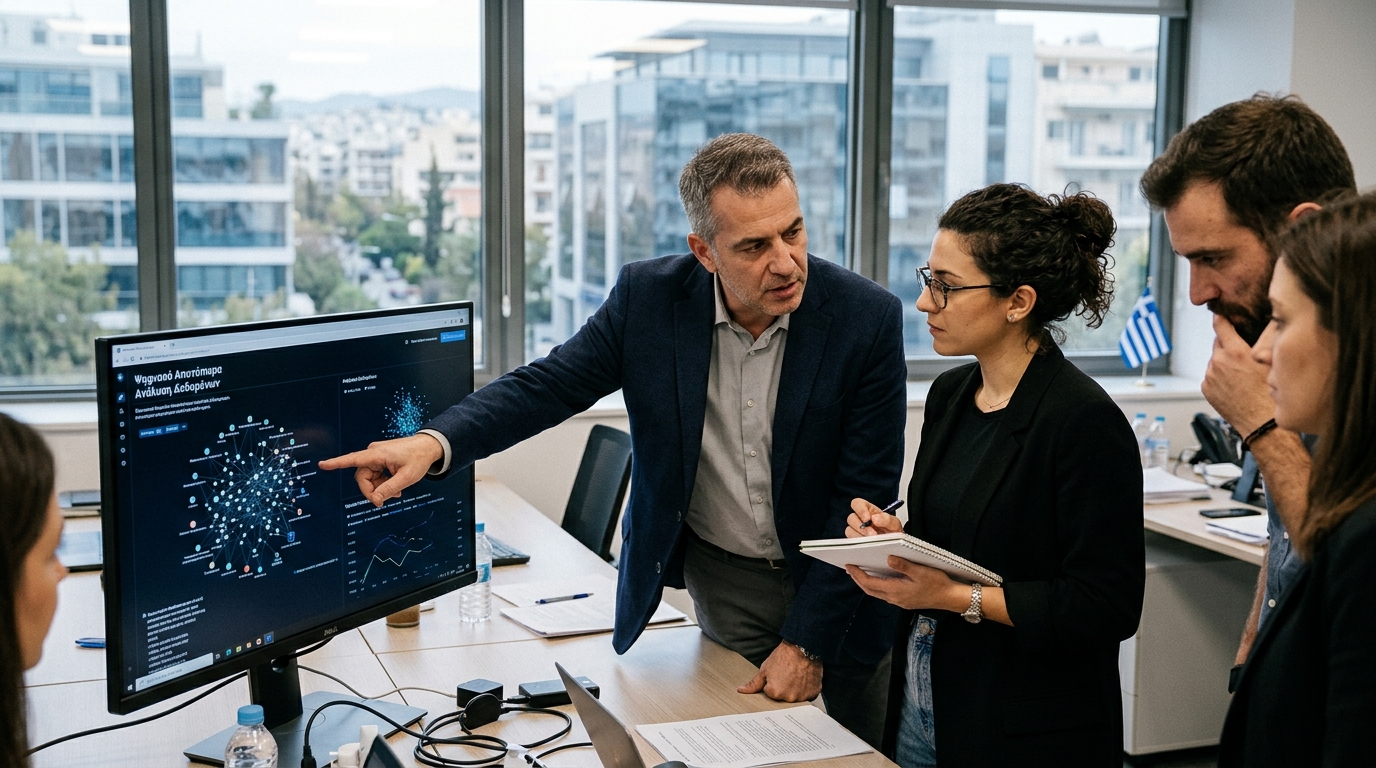
The use of Artificial Intelligence (AI) by Greek authorities is no longer a science fiction scenario. In the Marfin case, the Hellenic Police (EL.AS.) utilized advanced machine learning algorithms to process thousands of hours of video from security cameras, TV crews, and amateur footage. This process, known as 'Super-Resolution', allows for the digital reconstruction of low-quality images, adding details that the human eye could never discern.
The key to recent progress was not just image enhancement, but the analysis of biometric features that go beyond the face. AI was used for 'gait analysis'. Every human has a unique way of moving, influenced by physique, height, and posture. Even with covered features, the algorithm was able to compare the perpetrators' movement patterns in the 2010 footage with modern data and records of known offenders, creating a probability grid that led to specific identifications.
Data Cross-Referencing and the 'Big Brother' of Justice
Artificial Intelligence also acted as a powerful link between disparate information sources. Authorities used Big Data Analytics tools to correlate cell phone signals (from telecommunications records of the time), early social media posts, and testimonies recorded a decade and a half ago. AI's ability to identify patterns in seemingly unrelated data allowed researchers to build a timeline of the suspects' movements before and after the arson.
This methodology, of course, raises significant questions regarding ethics and legality. Using AI for the retroactive identification of criminals is a gray area. However, in the Marfin case, the severity of the crime and the need for justice served as a catalyst for overcoming technical barriers. Legal circles point out that AI does not 'judge', but provides evidence that must be validated by human experts and withstand the scrutiny of the courtroom.
The Social Dimension and the Future
The news of identifying new suspects through AI caused both emotional resonance and intense reflection in Greek society. For the victims' families, it is a hope that time does not erase the crime. For the rule of law, it is a demonstration that technology can function as a tool for catharsis. However, the debate over personal data protection remains open. If AI can 'turn back time' to find the guilty, who guarantees it won't be used for monitoring citizens without serious cause?
In conclusion, the Marfin case marks a new era for forensic investigation in Greece. Artificial Intelligence is no longer just an automation tool, but a digital detective with a memory that doesn't fade and eyes that see through the darkness of the past. Justice, albeit delayed, seems to be acquiring the digital weapons needed to close history's open wounds.