At a critical juncture for the Greek economy, the Minister of National Economy and Finance, Kostis Hatzidakis, has sent a clear message to both domestic audiences and international markets: Greece cannot and must not risk the achievements of recent years for the sake of temporary impressions. His statement that "sacrifices and successes must not be lost" encapsulates the government's strategy for 2026, a year where fiscal stability is called upon to coexist with intense social dissatisfaction due to the cost-of-living crisis.
The Threat of Inflation and the Markets
Despite growth rates that exceed the Eurozone average, Greek society continues to be squeezed by high living costs. Mr. Hatzidakis, specifically referring to fuel prices and ferry tickets, emphasized that the government is closely monitoring market distortions. The admission that the state "will not remain indifferent" if unjustified increases continue serves as a clear warning to the oligopolies operating in these sectors.
However, such an intervention is no simple task. The Minister is well aware that any horizontal support measure carries the risk of fiscal derailment. In his analysis, he highlighted that Greece has now regained its investment-grade status, and any move reminiscent of old deficit-spending practices could trigger an immediate reaction from credit rating agencies. The "success" he refers to is the country's credibility, which is the most valuable yet fragile asset of current economic policy.
The Ghost of Populism
A significant portion of Mr. Hatzidakis's address was dedicated to the need for protection against populism. With an eye on political developments, the Minister noted that the "easy solutions" proposed by the opposition often lead to dead ends. His rhetoric focuses on the fact that the sacrifices made by Greek citizens during the economic crisis must not go to waste due to a return to reckless spending policies.
According to Mr. Hatzidakis, real social policy is practiced through the reduction of public debt and the creation of a friendly environment for investments that will bring new and better-paying jobs. The use of Artificial Intelligence and digital tools in the fight against tax evasion is, in his view, the key to finding the necessary "fiscal space" that will allow for targeted relief without endangering the budget.
Ferries and Fuel: The Summer Bet
As we approach the peak of the 2026 tourist season, the issue of ferry tickets takes on national significance. Mr. Hatzidakis hinted that if companies do not proceed with price rationalization, the government has intervention tools at its disposal, such as imposing a cap on profit margins or strengthening audits by the Competition Commission. In the fuel sector, the situation is more complex due to international oil prices, but even there, the government is considering the possibility of targeted subsidies for the most vulnerable social groups.
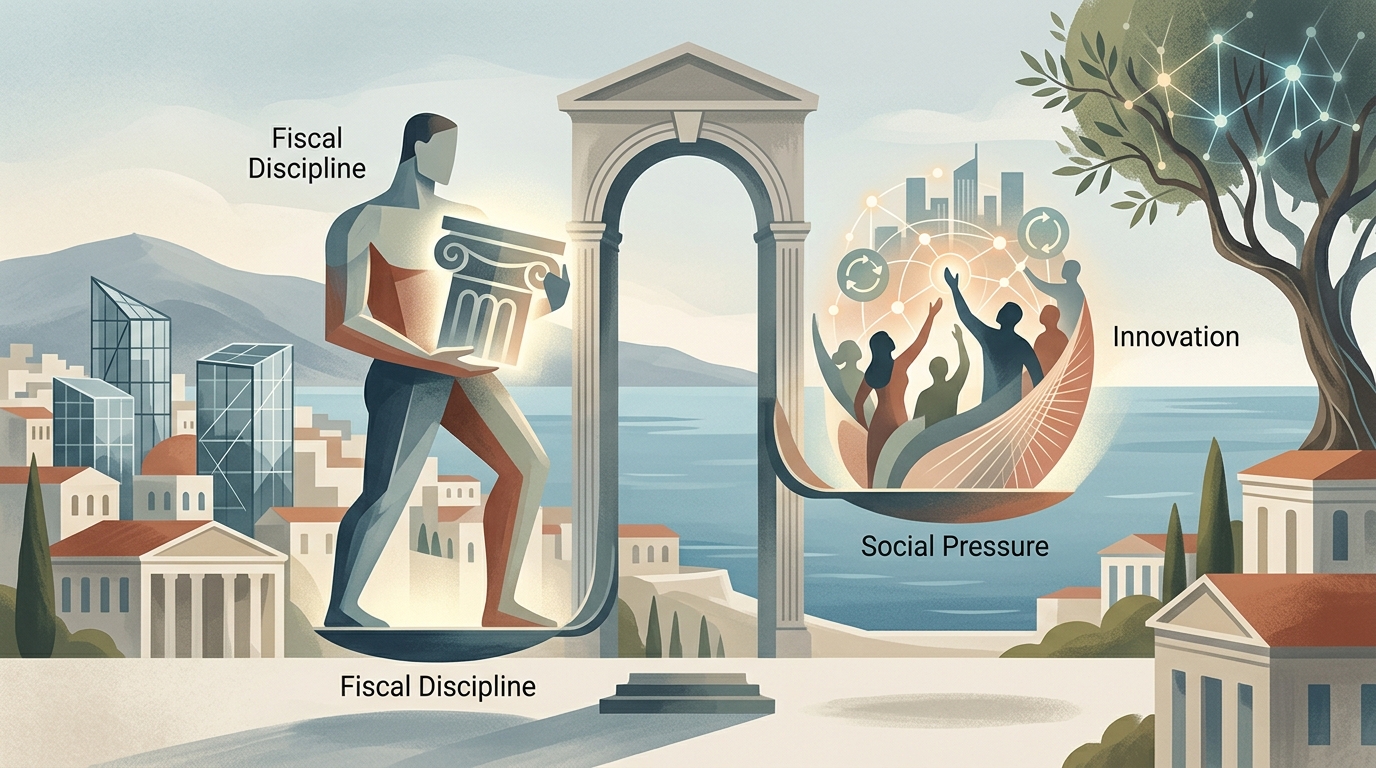
In conclusion, Kostis Hatzidakis is attempting a difficult balancing act. On one hand, he must appear as the guarantor of the fiscal seriousness required by Brussels and Frankfurt. On the other, he cannot ignore the reality of the "shelf" and the "pump" that erodes household income. Whether he manages to maintain this balance without causing cracks in the economic structure will largely determine the country's course in the coming years.
"Economy is not just numbers; it is primarily psychology and credibility. If we lose our credibility, we lose everything," the Minister stated emphatically.
The challenge for the Ministry of Finance remains: how to translate macroeconomic success into microeconomic relief for the average citizen without returning to the dark days of the memoranda. Mr. Hatzidakis's answer is "seriousness," a word he repeats often, hoping it will serve as a bulwark against the pressures of a society tired of waiting for the "growth dividend."