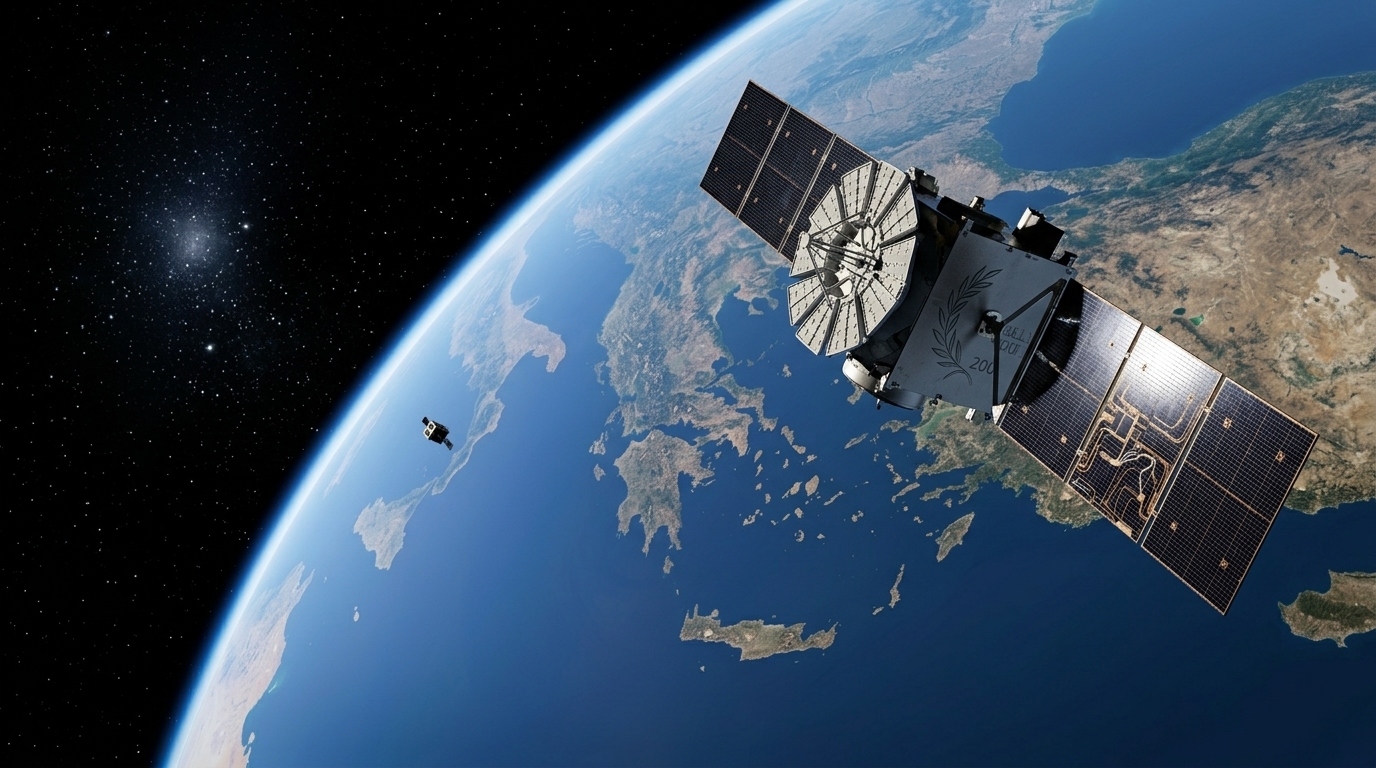
The image of Greece as a mere consumer of foreign technology is undergoing a radical transformation. With the activation of the €200 million National Microsatellite Program, Athens is laying the foundations for an autonomous presence in Earth's orbit. This is not a simple exercise in prestige, but an imperative necessity dictated by modern geopolitical challenges and the climate instability plaguing the Mediterranean region.
The Architecture of the Greek Space Strategy
The program, funded by the Recovery and Resilience Facility (RRF), represents the largest investment the country has ever made in the space sector. Its implementation is carried out in close cooperation with the European Space Agency (ESA), which acts as a technical advisor and manager of the procurement processes. The goal is to create a constellation of microsatellites that will provide Earth observation data in near real-time.
Unlike traditional satellites, which are the size of a bus and cost hundreds of millions, microsatellites offer flexibility. They can be replaced more easily, upgraded technologically in less time, and operate complementarily, forming a "net" over Greek territory. The capabilities the country is acquiring include thermal imaging, high-resolution optical observation, and Synthetic Aperture Radar (SAR) technology, which can "see" through clouds and in the dark.
Civil Protection and the Climate Crisis
The program's primary priority is the reinforcement of Civil Protection. Memories of the catastrophic fires in Evros and the floods in Thessaly (Daniel) remain fresh. Until now, Greece relied on international systems like the EU's Copernicus or commercial providers, which often meant delays in data acquisition.
"The ability to have our own eyes in the sky, alerting us to a fire outbreak within minutes of its start, is a matter of national security," government sources state.
With the new system, operational calls will be based on data refreshed every few hours, allowing scientists and rescuers to predict the path of a fire or the progression of a flood with mathematical precision. Furthermore, the monitoring of forest areas and water resources will be conducted on a continuous basis, enabling timely intervention before a situation becomes irreversible.
The Emergence of a Domestic Ecosystem
One of the most significant aspects of the investment is the participation of the Greek industry. Companies like Open Cosmos (with a strong Greek element), OHB Hellas, and members of the Hellenic Space Technologies and Applications Cluster (HASI) have already assumed central roles. The challenge is the transfer of know-how: Greece is not just buying satellites "off the shelf" but is participating in the design, assembly, and data management.
- Creation of high-specialization jobs for Greek engineers and scientists.
- Development of downstream applications (data processing) by startups.
- Strengthening the country's position in the global space supply chain.
This approach aims to combat brain drain by offering incentives for young scientists to remain in the country and work on cutting-edge programs that until recently seemed like science fiction for Greek standards.
Geopolitical Sovereignty and Security
In a region with intense security challenges, autonomous access to satellite data is a strategic advantage. Border surveillance, maritime monitoring, and the protection of critical infrastructure acquire a new dimension. Greece ceases to be "blind" in sectors where information is the most valuable currency. The €200 million investment is, ultimately, an investment in 21st-century national sovereignty, where borders are guarded not only on the ground but also from orbit.