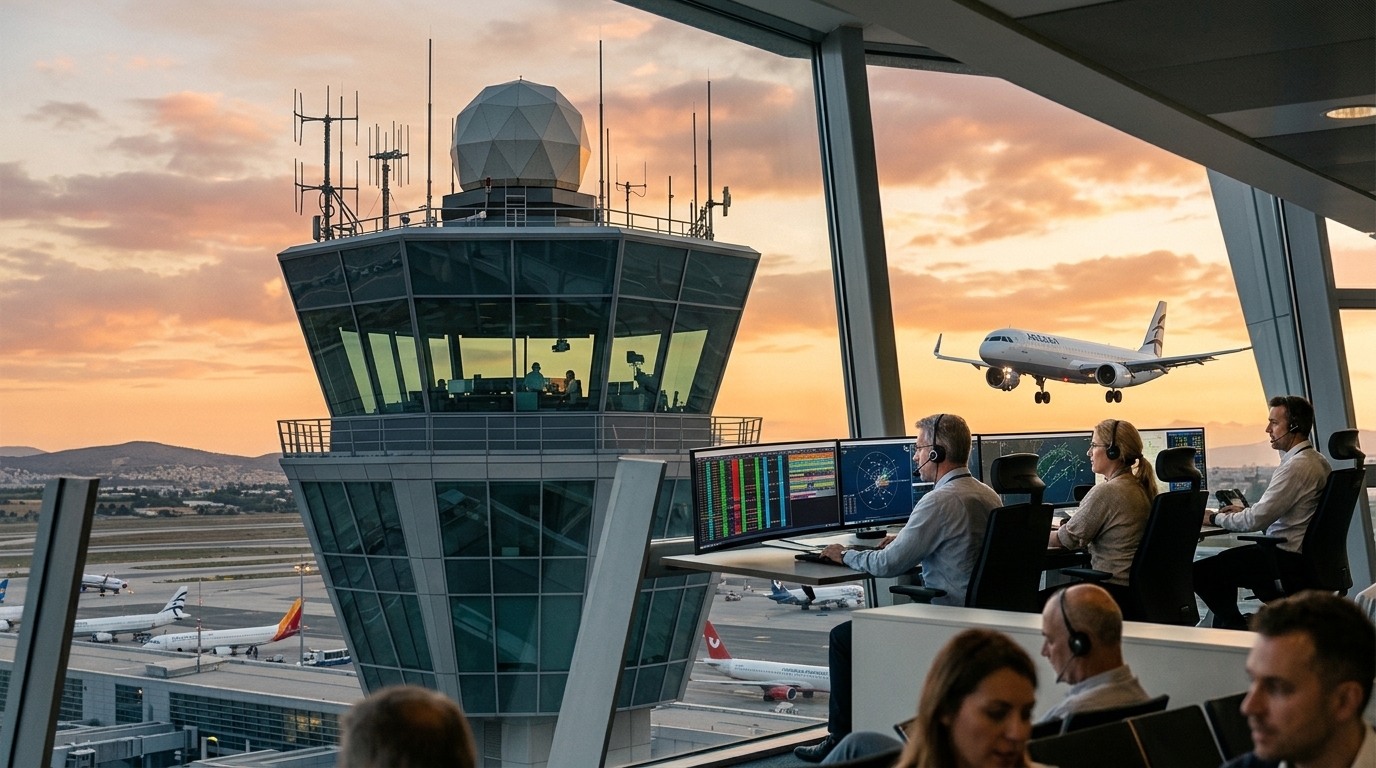
In an era where the skies of the Southeastern Mediterranean increasingly resemble congested superhighways, Greece has decided to invest in the 'software' of its national sovereignty. The recent decision by the Hellenic Civil Aviation Authority (HCAA) to proceed with a €126.17 million upgrade of the national air traffic control system is not merely a technical improvement; it is a strategic necessity that has been pending for decades.
The agreement, reached through a negotiation process with the French company Thales LAS, aims to replace and modernize the aging systems that manage the Greek FIR (Flight Information Region). For a country critically dependent on tourism and holding a pivotal geopolitical position at the crossroads of three continents, the reliability of air traffic control is the foundation upon which the national economy and international credibility are built.
The Technological Gap and the Need for a Leap
For years, Greek air traffic controllers worked with systems that, while safe, were approaching the end of their technological lifecycle. The Pallas/Eurocat system, which formed the backbone of the control infrastructure, urgently needed an upgrade to meet the requirements of the European Union's Single European Sky (SES) initiative. This new investment will introduce advanced radar data processing systems, new operator consoles, and, most importantly, the integration of Artificial Intelligence (AI) technologies for conflict prediction and route optimization.
This modernization is expected to drastically reduce delays, which during the peak summer months have been a constant headache for airlines and travelers alike. According to analysts, improving air traffic flow can lead to annual fuel savings of millions of tons, while simultaneously reducing the environmental footprint of flights over Greek territory.
Geopolitical Dimensions and the Choice of Thales
The selection of Thales LAS through direct negotiation (based on Article 32 of Law 4412/2016) has sparked some debate. However, the government and the HCAA argue that technical exclusivity and the need for compatibility with existing infrastructure made the French firm the only viable partner. Beyond the technical aspects, this move strengthens defense and technological ties between Athens and Paris at a time when security in the Eastern Mediterranean remains a top priority.
"Modernizing air traffic control is not a luxury; it is the digital shielding of our borders and the guarantee that Greece remains a safe and attractive destination," sources from the Ministry of Infrastructure and Transport noted.
Impact on Economy and Tourism
Tourism contributes more than 20% to the Greek GDP, and the vast majority of visitors arrive in the country by air. A dysfunctional air traffic control system translates into lost revenue from overflight fees and, more importantly, a blow to the country's reputation. With the new system, the capacity of Greek airspace is expected to increase by at least 20-30%, allowing for more flights to be serviced without compromising safety.
Furthermore, this investment includes staff training and the creation of a state-of-the-art simulation center. This means that Greek controllers, widely regarded as some of the most experienced in Europe due to the complexity of the country's island geography, will finally have the tools to perform their duties with greater precision and less operational stress.
Implementation Challenges
Despite the optimism, the road to full operational status is not without obstacles. The transition from the old to the new system must be performed 'in-flight,' without interrupting aircraft control for even a single second. This 'surgical' operation requires absolute coordination between the HCAA, Thales, and Eurocontrol. The timeline is tight, as tourist traffic for 2026 is expected to break all previous records, making the need for a reliable system more urgent than ever.