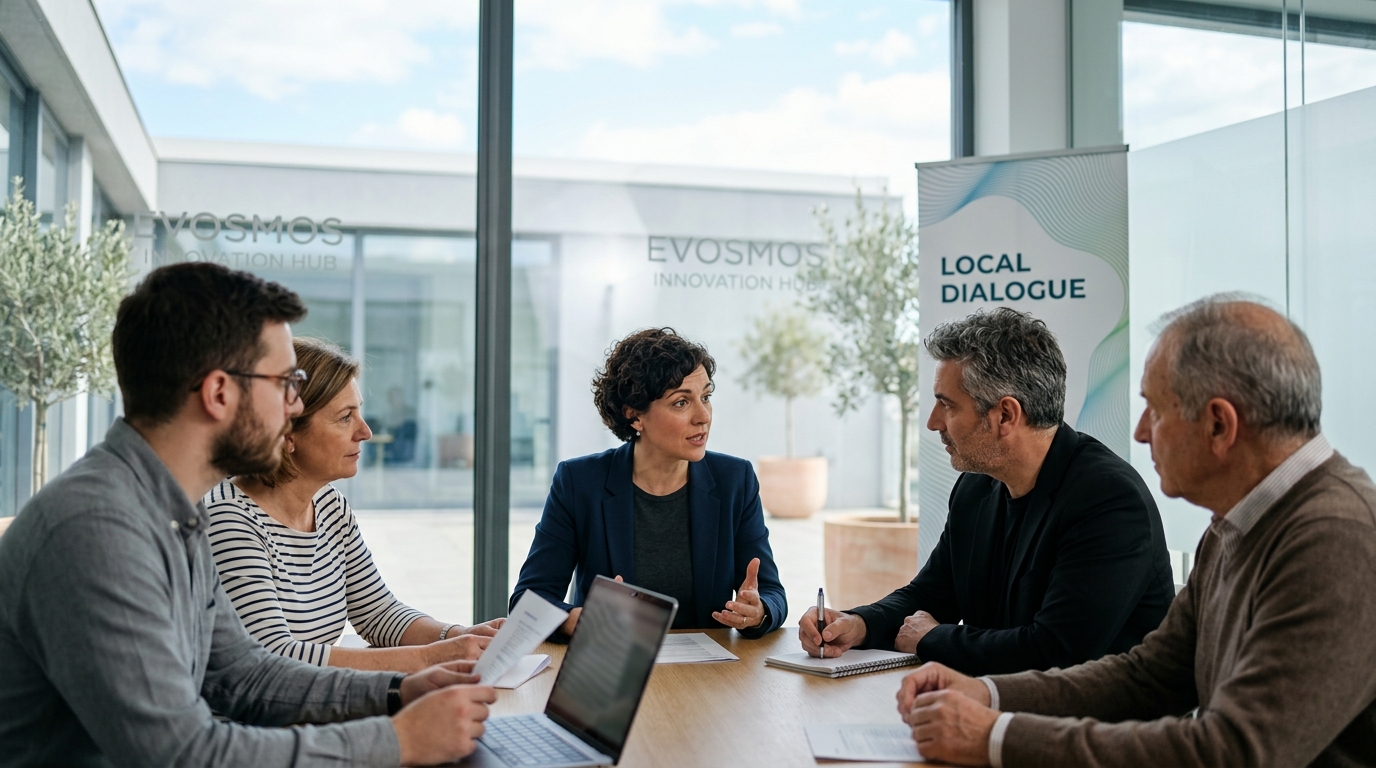
In the heart of western Thessaloniki, specifically in Evosmos, the conversation regarding Artificial Intelligence (AI) has shifted from a theoretical science fiction scenario to an urgent social and professional necessity. A recent forum held in the area served not merely as an informational meeting but as a mirror reflecting the anxieties and expectations of the Greek periphery in the face of the Fourth Industrial Revolution. As we move through 2026, with AI applications already deeply embedded in daily life, the dialogue focused on how local communities can adapt without being left behind.
Demystifying Technology in the Local Community
One of the primary conclusions of the discussion in Evosmos was the dire need to demystify Artificial Intelligence. For many workers and small-to-medium enterprise (SME) owners in the region, AI appears as a looming threat destined to replace human labor. However, experts participating in the seminar emphasized that this technology functions more as "Augmented Intelligence." The goal is not the elimination of jobs, but their fundamental transformation.
In the manufacturing and service sectors that dominate western Thessaloniki, AI can take over repetitive and hazardous tasks, allowing humans to focus on creativity, strategy, and emotional intelligence. The challenge, of course, lies in the velocity of this transition. As noted during the forum, the "digital divide" no longer concerns mere internet access but the capability to utilize advanced AI tools to solve complex, real-world problems.
Education and Reskilling: The Great Bet
The discussion placed significant emphasis on the younger generation. Students in Evosmos are being called to prepare for professions that may not even have been invented yet. The Greek educational system, often criticized for its rigidity, faces immense pressure to integrate the cultivation of "soft skills" and critical thinking as a counterweight to automation.
- Reskilling: Retraining existing workers in new technological frameworks.
- Upskilling: Enhancing skills to utilize generative AI tools effectively.
- AI Ethics: Understanding the limits and risks of algorithmic decision-making.
Participants highlighted that local government must play a leading role by creating lifelong learning centers that bridge the gap between academic theory and market reality. Evosmos, with its youthful demographic, has the potential to evolve into an innovation "lab," provided there is adequate infrastructure and political will.
The Social Dimension and Just Transition
Beyond metrics and productivity, the forum touched upon the critical issue of social justice. Is there a risk that AI will widen existing inequalities? The answer is affirmative if access to technology remains a privilege of the few. The dialogue in Evosmos underscored the need for a new "social contract" in the age of algorithms.
"Technology is not destiny. It is a tool that we are called to direct toward social cohesion rather than alienation," one speaker noted poignantly.
Anxiety regarding job losses in traditional sectors is tangible. However, history has shown that every technological revolution creates new opportunities. The key for Greece, and specifically for areas like Evosmos, is specialization in sectors where human touch and local expertise remain irreplaceable. AI can assist a local merchant in reaching customers worldwide, provided they know how to wield the tools of the digital era.
Conclusion: Shaping the Future Together
The event in Evosmos marks the beginning of a broader dialogue that must extend to every corner of Greece. Artificial Intelligence is not an issue limited to Silicon Valley or the major tech hubs of Athens. It concerns the worker in the industrial zone, the teacher in the local school, and the youth seeking their first professional step. Adaptation requires courage, continuous learning, and, above all, a human-centric approach ensuring that technology serves humanity, rather than the other way around.