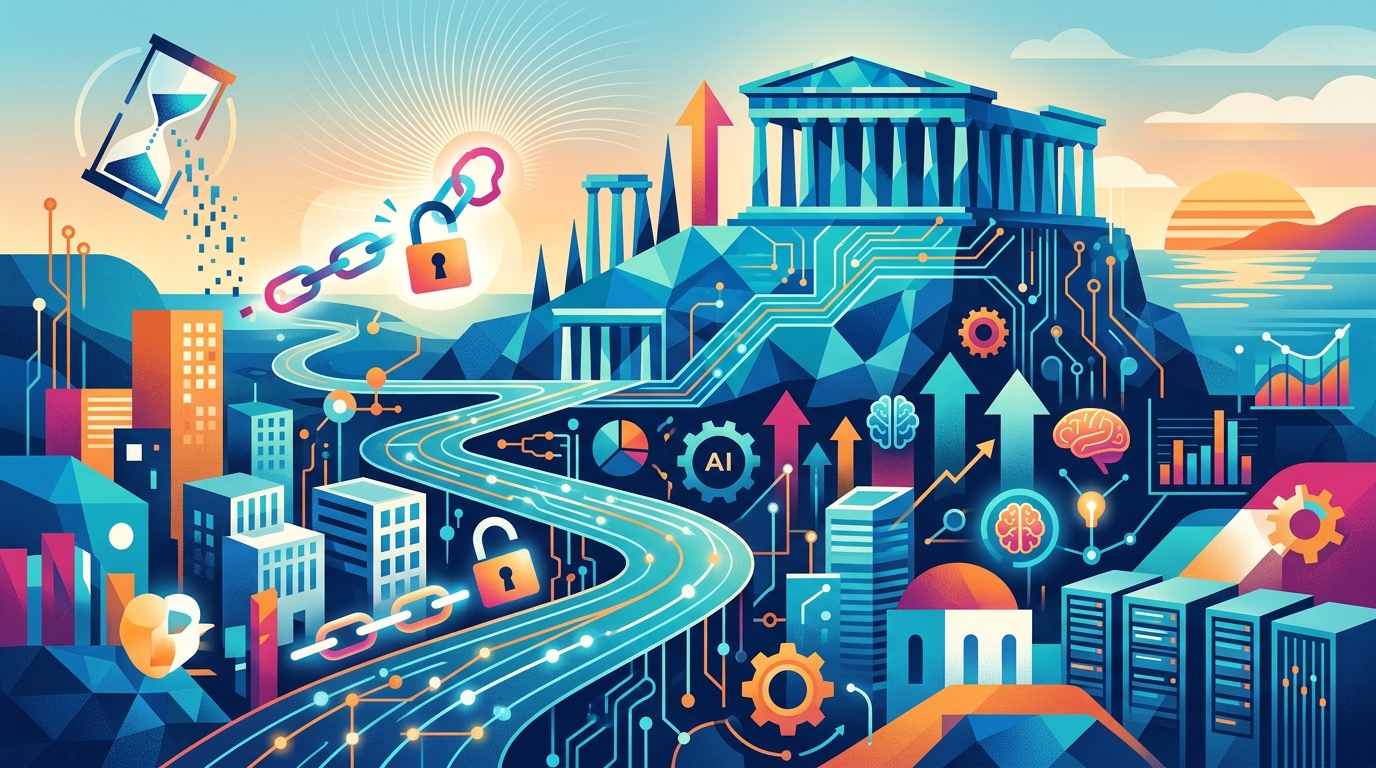
As of June 2026, Greece finds itself at a critical crossroads. While the digitalization of the state via platforms like gov.gr has radically altered daily life, a comprehensive new study regarding the relationship between Greeks, technology, and Artificial Intelligence (AI) reveals fascinating, if not contradictory, findings. A country once considered a laggard in Europe’s digital economy is now showing remarkable adaptability, yet this is coupled with intense skepticism and a widening generational divide.
The Paradox of Digital Familiarity
According to data from the latest survey, the vast majority of Greeks (over 90%) use the internet daily, primarily through mobile devices. However, this "familiarity" appears to be skin-deep. While Greeks are champions in using social media and messaging apps, the use of productivity tools and the fundamental understanding of algorithms remain low. The research indicates that technology is treated more as a medium for entertainment and administrative tasks rather than a tool for creation or professional advancement.
A striking element is the speed at which the general public became aware of AI. In just three years, the term "AI" has moved from computer science labs to the Greek family dinner table. Nevertheless, knowledge remains largely theoretical. Only one in four Greeks claims to use Generative AI tools in their work, a percentage that skyrockets among the 18-24 age group and plummets for those over 55.
The Fear of Displacement and the Ethical Dilemma
Artificial Intelligence evokes a mixture of awe and dread in the average Greek citizen. The survey reveals that 65% of respondents are concerned about job losses due to automation. This anxiety is not limited to manual labor but extends to sectors such as secretarial support, customer service, and even creative writing or graphic design.
"AI in Greece is not viewed as a partner, but as an invisible competitor threatening an already fragile labor market stability," the study's analysis notes.
Furthermore, the risk of misinformation—specifically deepfakes and fake news—is the primary source of stress. In a country with traditionally low trust in institutional media, the advent of AI capable of distorting reality intensifies a sense of insecurity. Greeks are urgently calling for a regulatory framework, with 80% believing that the state and the European Union must intervene immediately to control algorithmic influence.
Education and Entrepreneurship: The High Stakes
The gap between market needs and workforce skills is glaring. Greek Small and Medium Enterprises (SMEs), the backbone of the economy, are hesitant to invest in AI solutions. The reasons are primarily the high cost of transition and the lack of specialized personnel. The survey highlights that without a national plan for digital literacy, Greece risks falling behind in the global competitiveness race.
- Education: The need to introduce AI literacy starting from primary education.
- Reskilling: Programs for older workers to prevent their marginalization in the workforce.
- Incentives: Tax and financial incentives for businesses that integrate ethical AI.
In conclusion, Greeks are "connected" but not necessarily "digitally mature." Technology is moving at a pace that social culture struggles to follow. The challenge for the coming years is not access to tools—that has largely been achieved—but the development of critical thinking and the skills that will allow the Greek citizen to master the machine rather than fear it.