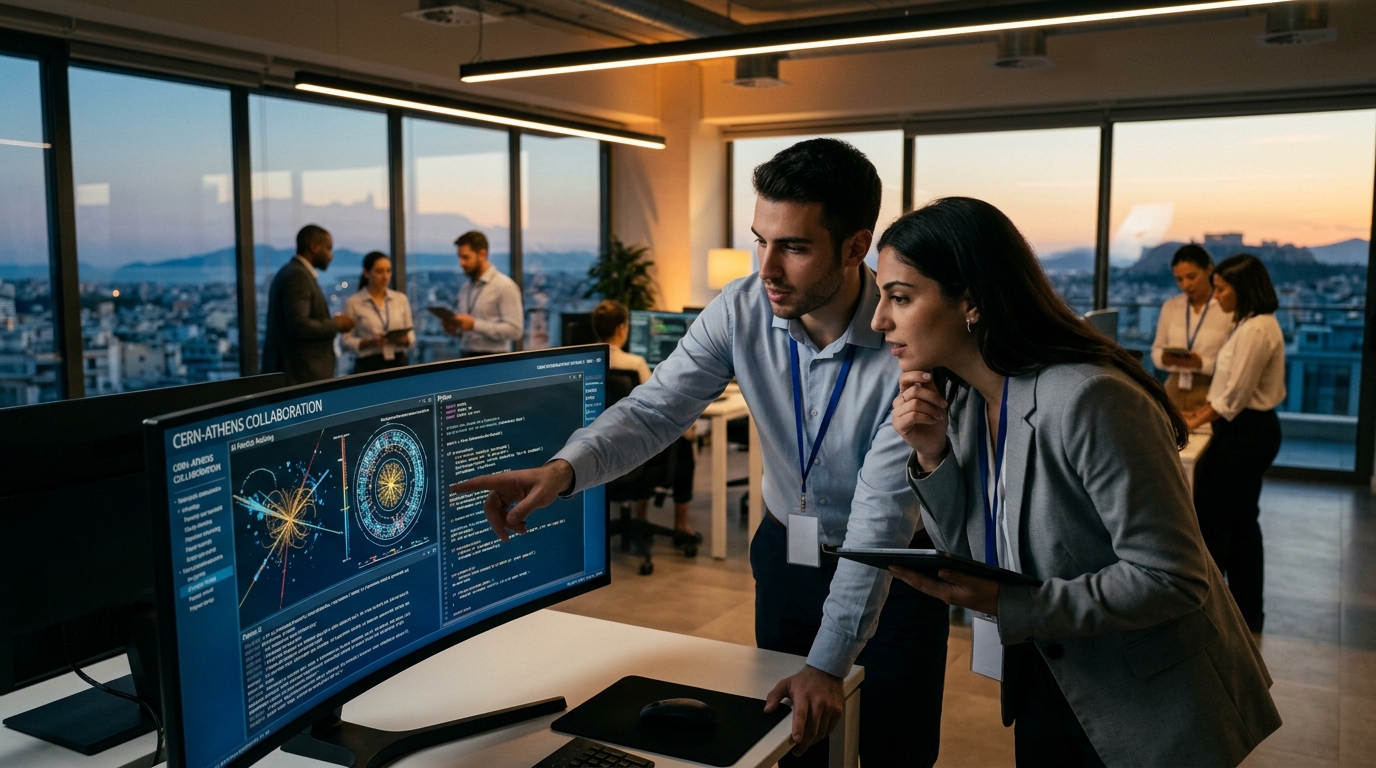
Deep beneath the border of France and Switzerland, where the Large Hadron Collider (LHC) recreates the conditions that existed mere fractions of a second after the Big Bang, a new revolution is underway. It is not a new detector or a more powerful magnet, but an invisible force: Artificial Intelligence. CERN, the world’s leading nuclear research organization, is now decisively turning toward machine learning to manage the unimaginable volume of data produced by particle collisions, opening a new chapter in our understanding of matter, dark energy, and the fundamental laws of nature.
The Challenge of the Data Deluge
To grasp the scale of the problem, one only needs to consider that the LHC produces approximately 40 million particle collisions every single second. Each of these collisions leaves a massive digital footprint. If scientists attempted to store all this data, they would require storage space far exceeding any current technological capacity. Until recently, "trigger systems" were used, relying on predefined algorithms to decide in fractions of a millisecond whether an event was "interesting" or should be deleted forever.
This is precisely where Artificial Intelligence enters the frame. Traditional algorithms, while extremely precise, are often too slow or too rigid to identify exceptionally rare phenomena that haven't been predicted by the Standard Model. Neural networks, however, can be trained to recognize patterns within the noise of the data at speeds and levels of accuracy that were unthinkable a decade ago. AI is not just helping with filtering; it is essential for the "reconstruction" of events, allowing physicists to see more clearly through the chaos of subatomic debris.
Hunting for 'New Physics'
Despite the monumental discovery of the Higgs boson in 2012, physics remains at a crossroads. The Standard Model, successful as it is, cannot explain gravity, dark matter, or the asymmetry between matter and antimatter. CERN scientists hope that AI will act as a "digital anomaly detector." Instead of telling the machine what to look for, they are training it to know what "normal" looks like and to alert them when something unexpected occurs.
"Artificial Intelligence allows us to explore the unknown without the blinkers of our own theoretical biases," notes a researcher from the ATLAS experiment.
This approach, known as unsupervised learning, is the key to discovering new particles. If a dark matter particle exists that interacts only weakly with normal matter, its traces would be so faint that only an extremely sensitive neural network could distinguish it from the statistical noise of billions of other collisions.
The HL-LHC Upgrade and the Road Ahead
The need for AI will become even more urgent in the coming years with the upgrade of the collider to the High-Luminosity LHC (HL-LHC). This new phase of operation will increase the number of collisions tenfold, creating a data environment so dense that traditional analysis methods will simply collapse. The development of specialized chips (FPGAs) that integrate AI algorithms directly into the hardware is already underway, allowing for decision-making in nanoseconds.
Furthermore, AI's contribution extends to simulations. Creating virtual computer-aided collisions to compare with real-world data is an incredibly resource-intensive process. Generative Adversarial Networks (GANs)—the same technology used to create deepfake images—are now being used to produce "synthetic physics data," accelerating simulations by thousands of times while significantly reducing energy consumption and research costs.
Ethical Concerns and Scientific Validity
However, the use of AI in fundamental science is not without its challenges. The primary question is one of "interpretability." In physics, it is not enough to know that something happened; we must know *why* it happened and be able to prove it with mathematical rigor. If a neural network discovers a new particle, how can we be certain it isn't an artifact of the algorithm itself? Ensuring that AI doesn't "invent" physics is the greatest challenge for the new generation of CERN scientists, who must now marry quantum mechanics with data science in an unprecedented way.