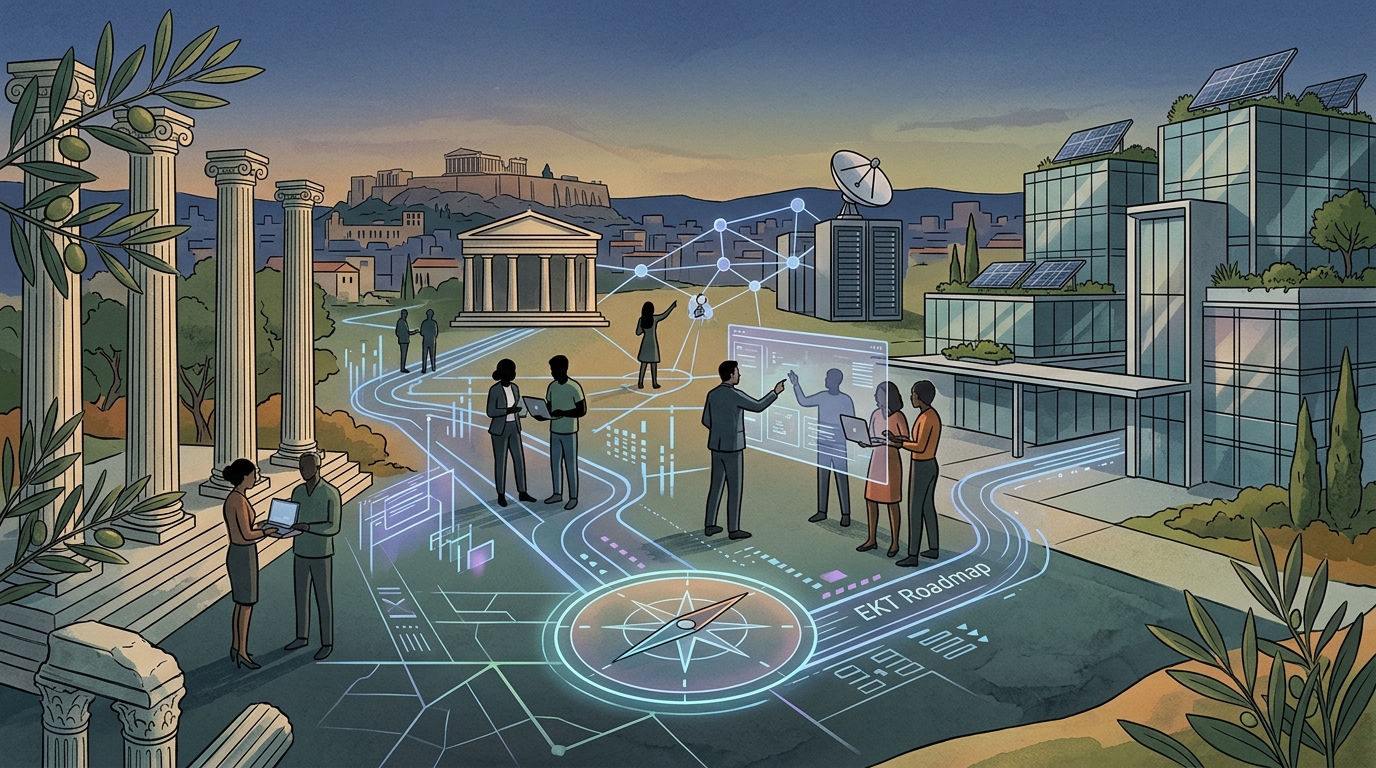
In an era where Artificial Intelligence (AI) is no longer a science fiction scenario but a daily reality transforming the fabric of our society, the need for reliable information and education becomes imperative. The National Documentation Centre (EKT), responding to the challenges of the times, has published the guide "AI for All." This initiative aspires to bridge the digital divide in Greece, providing citizens with the necessary tools to understand and utilize the instruments of the new age.
The Democratization of Technology: From Theory to Practice
The EKT guide is not limited to a dry presentation of technical terms. On the contrary, it is built around the idea that AI is a tool that can enhance human creativity and productivity. Starting with basic concepts—what Machine Learning is, how Large Language Models (LLMs) work, and the difference between Generative and Traditional AI—the manual offers a smooth introduction for the non-expert user. The significance of this effort lies in the fact that AI knowledge should not be the privilege of a few technocrats but a basic skill for every citizen in the 21st century.
Particular emphasis is placed on practical application. The guide introduces tools such as ChatGPT, Gemini, and Claude, explaining how they can be used for writing, data analysis, or even coding. However, EKT goes a step further by introducing the concept of "Prompt Engineering," teaching users how to correctly phrase their requests to achieve the best possible results. This skill is emerging as a key to effective interaction with machines, turning a simple query into a sophisticated command.
AI in the Workplace and Education
The transformation of work is perhaps the most visible impact of AI. The guide analyzes how professionals can automate repetitive tasks, freeing up time for more strategic and creative activities. From creating presentations and managing emails to market research, AI acts as a "smart assistant." EKT emphasizes that the goal is not to replace humans but to "augment" their capabilities. In the Greek labor market, where small and medium-sized enterprises dominate, adopting such technologies can provide the necessary competitive edge.
In the field of learning, the prospects are equally exciting. The guide examines how educators can design personalized lessons and how students can use AI as a tool for study and critical thinking. The challenge here is maintaining academic integrity and avoiding blind trust in machine-generated answers. EKT promotes a model of "critical digital literacy," where the user always evaluates the validity of the information produced by AI. This approach ensures that technology remains a servant of education rather than a substitute for thought.
Ethics, Data Protection, and the Greek Context
One of the most important sections of the guide concerns the ethical dimension of Artificial Intelligence. EKT does not overlook the risks: the biases that algorithms may embody, data privacy issues, and the potential for misinformation through deepfakes. Guidance for the safe use of these tools is clear, urging users not to share sensitive data and to cross-reference their sources. This ethical framework is essential for building public trust in automated systems.
Furthermore, the guide touches upon the nuances of the Greek language. Although global models are constantly improving in Greek, challenges remain regarding cultural understanding and precision of expression. EKT's effort to adapt these international trends to the Greek reality is vital for the national digital strategy. In conclusion, the "AI for All" guide serves as a compass in an ocean of technological change, reminding us that technology is only as beneficial as the knowledge of the person wielding it. As we move further into the 2020s, such resources will be the foundation upon which a more resilient and tech-savvy society is built.