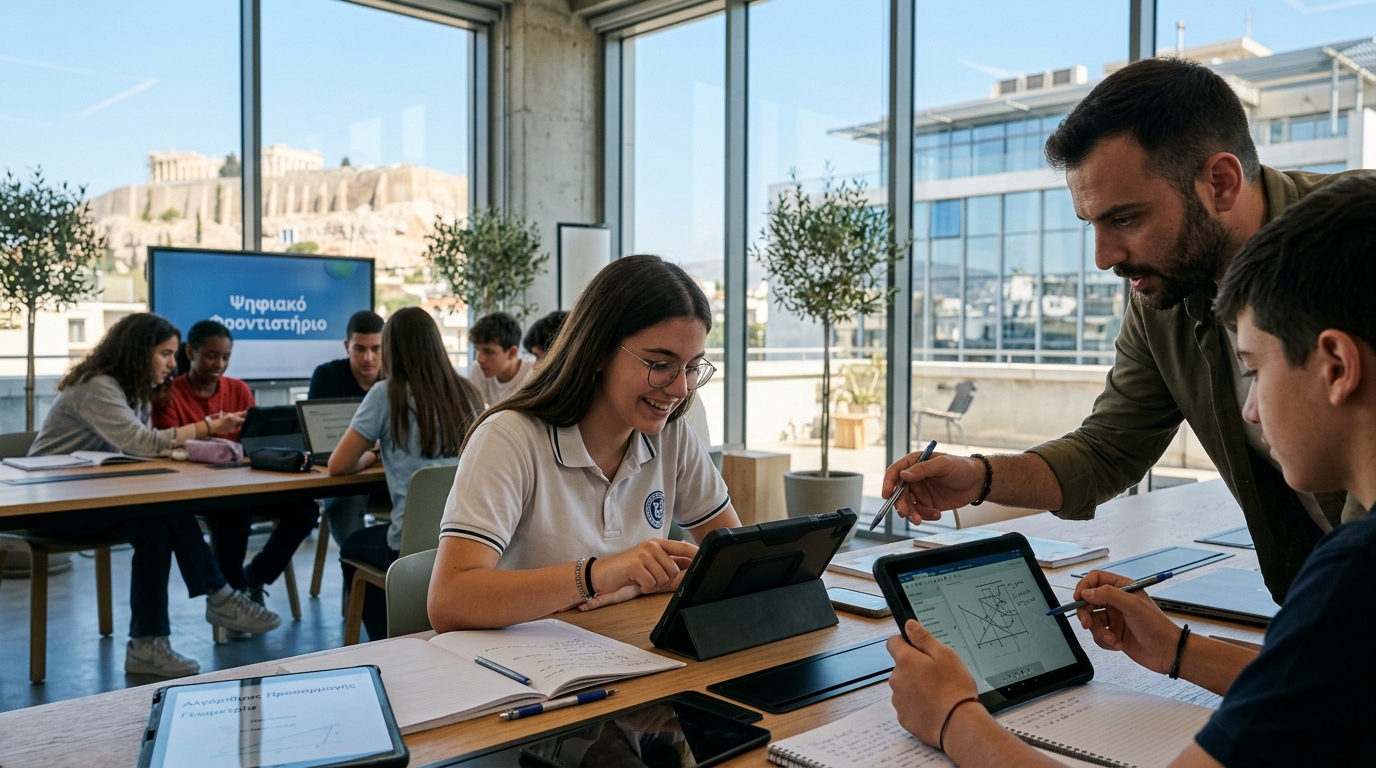
Greek public education is standing at the threshold of a historic transition. With the announcement of a €2.98 million tender for the integration of Artificial Intelligence (AI) into the "Digital Tutoring" (Psifiako Frontistirio) platform, the government is attempting to address a decades-old structural issue: the need for personalized student support, which until now has been almost exclusively covered by the private "shadow education" sector. The goal is ambitious: a digital "personal assistant" for every student, capable of identifying learning gaps and offering tailored content in real-time.
The "Smart" Tutor and the Architecture of Personalization
At the heart of this new project is the creation of an advanced algorithmic system that will function as a digital tutor. Unlike the static distance-learning platforms we encountered during the pandemic, the new Digital Tutoring system will utilize Generative AI and Adaptive Learning technologies. This means the system won't just provide videos and notes; it will "read" how the student interacts with the material.
If a student struggles with quadratic equations, the AI won't simply provide the answer. It will analyze their mistake, suggest a simplified theory, and generate a series of new exercises on the spot, with increasing difficulty, until it ensures the concept is mastered. This process, known as "scaffolding," is the holy grail of pedagogy, allowing students to progress at their own pace without feeling discouraged by the complexity of the classroom average.
The €2.98 Million Challenge: Investment or Experiment?
The €2.98 million budget, sourced from EU and national funds, is not just for software development. It includes building databases, training AI models on Greek educational content, and ensuring accessibility. However, the challenge is as much technical as it is ethical. The Greek language, with its unique syntax and nuances, requires specialized Large Language Models (LLMs) that do not make errors in critical concepts, especially for high school seniors preparing for the high-stakes Panhellenic Examinations.
"Artificial Intelligence is not coming to replace the teacher, but to liberate them from mechanical repetition, allowing them to focus on essential pedagogical guidance," Ministry sources state.
Nevertheless, the question remains: can an algorithm replace the intuitive understanding of an experienced private tutor? The market's response is cautious. While technology can provide exercises, psychological support and exam strategy remain deeply human skills. The success of the project will be judged by whether the AI becomes a mere "exercise corrector" or a true partner in learning.
Social Implications and the Fight Against Inequality
Perhaps the most significant aspect of the Digital Tutoring project is its social dimension. In Greece, the cost of private education (frontistiria) disproportionately burdens low- and middle-income families. A free, public AI tool offering high-level personalization could act as the "great equalizer." Students on remote islands or in mountainous villages will now have access to the same "smart" learning resources as students in major urban centers.
However, for this to happen, the digital divide must be bridged. If a student lacks a stable internet connection or modern hardware, AI remains an unattainable dream. The Ministry of Education must ensure that the €2.98 million investment is accompanied by the necessary logistical infrastructure in schools and the homes of the less privileged.
The Future: From Tutoring to the "Smart" Classroom
This move is only the beginning. The integration of AI into Digital Tutoring serves as a pilot for its subsequent application in daily school life. Imagine a future where digital textbooks adapt to the student's needs and teachers receive weekly reports on which parts of the curriculum proved most difficult for their class, allowing them to adjust their teaching accordingly.
In conclusion, the initiative for the first "smart" digital tutor is a bold step toward modernization. If implemented correctly, it could radically change the educational landscape in Greece, reducing dependence on private tutoring and offering every child the opportunity to reach their full potential. The technology is here; the challenge is to make it speak the "pedagogical language" our students need.