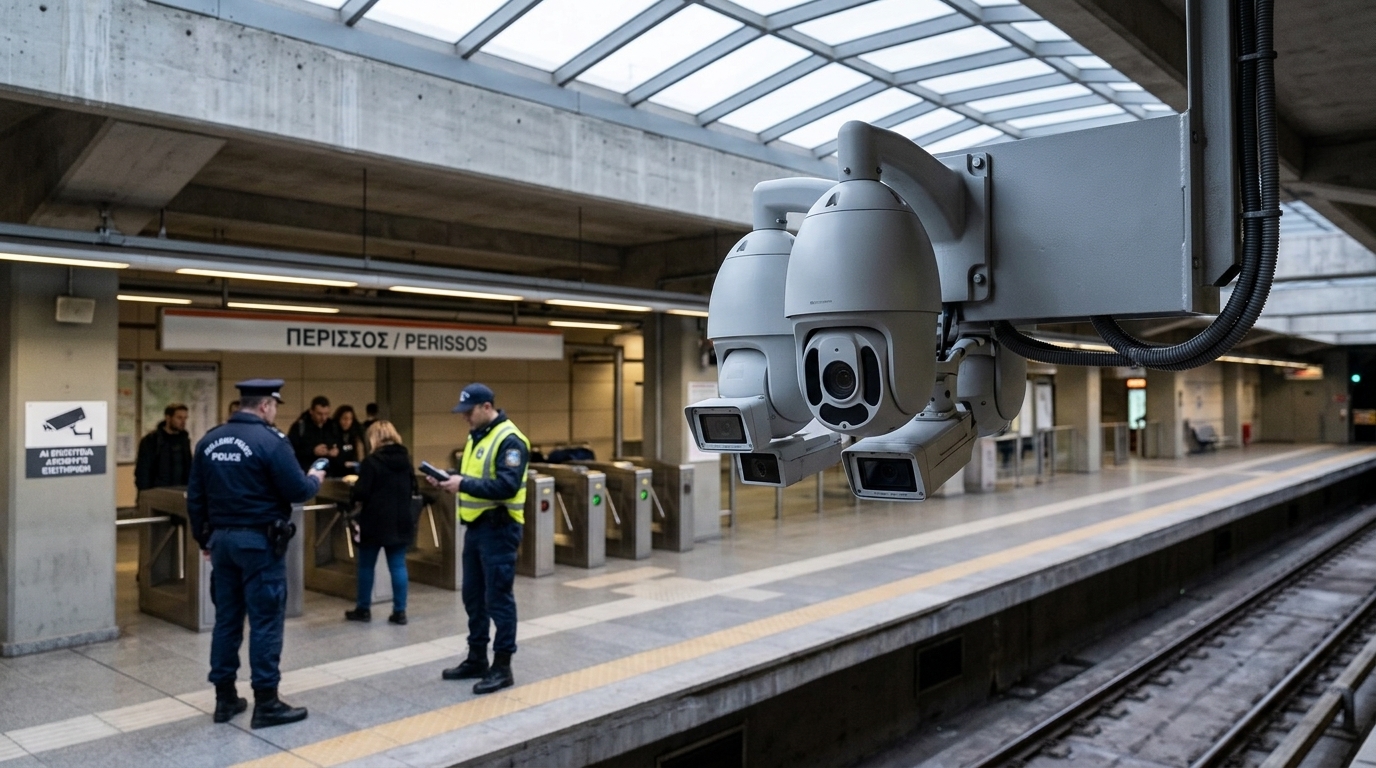
The sight of passengers "tailgating" behind others to pass through the gates of the Athens-Piraeus Electric Railway (ISAP) or jumping over barriers without validating a ticket is a daily reality for Athens' fixed-track transport network. However, STASY (Urban Rail Transport S.A.) has decided to tackle the phenomenon of fare evasion with a weapon from the future: Artificial Intelligence. At Perissos station, a pilot system of smart cameras has already been put into operation, signaling a new era in the surveillance and management of public infrastructure in Greece.
The system, developed in collaboration with specialized technology entities, does not aim to impose fines—at least not yet. Its mission is data collection. Through advanced machine learning algorithms, the cameras recognize movement patterns indicative of illegal passage, such as "tailgating" behind a legitimate passenger or using unauthorized passages. Analyzing this data will allow STASY management to understand peak hours of fare evasion and the exact points where the system has loopholes.
The Technology Behind the Digital "Eye"
The heart of the system at Perissos is based on Real-time Video Analytics. Algorithms have been trained to distinguish between a normal passage and an attempt to bypass the validation machine. An interesting feature is that this technology can operate without the need for facial identification. According to official announcements, the system records "incidents" rather than "people," converting visual information into anonymous statistical data.
This approach is crucial for compliance with the General Data Protection Regulation (GDPR). STASY emphasizes that no biometric characteristics are stored, nor are passengers identified based on facial features. The focus remains on body movement and the flow of users through the gates. Nevertheless, the installation of such systems inevitably raises questions about whether this "anonymity" will remain guaranteed in the future, if and when the system is connected to enforcement mechanisms.
The Economic Footprint and Social Dimension
Fare evasion is not just a matter of delinquency; it is a massive economic drain on the state. It is estimated that revenue losses for OASA (Athens Urban Transport Organization) and its subsidiaries amount to tens of millions of euros annually. This lost revenue deprives the system of the ability for better train maintenance, more frequent services, and station upgrades. Perissos station was chosen as a "testing ground" due to its geographical location and the specific characteristics of passenger traffic in the area.
However, using AI to monitor fare evasion also brings social issues to the surface. In a period of economic hardship, many wonder if tightening control through technology is the appropriate solution or if emphasis should be placed on a more social pricing policy. STASY management, however, argues that modernization is the only way forward for the sustainability of transport, as manual monitoring by inspectors has proven insufficient and often leads to tensions.
Towards a "Smart" Transport Network
The pilot program at Perissos is only the tip of the iceberg. The vision of the Ministry of Infrastructure and Transport includes the full digitalization of urban transport. From telematics and "smart" mobile tickets to predictive maintenance via AI, Athens is trying to follow the standards of cities like London and Paris. In London, Transport for London (TfL) has been using similar systems for years, having managed to significantly reduce revenue loss.
The next step for the Greek reality will be the evaluation of the Perissos results. If the data shows that the mere presence of the system acts as a deterrent, then its expansion across the entire Metro and ISAP network is considered certain. The challenge will be to convince the commuting public that this technology is not a "Big Brother," but a tool to ensure fairness: that everyone pays their fair share so that the system can better serve the community as a whole.