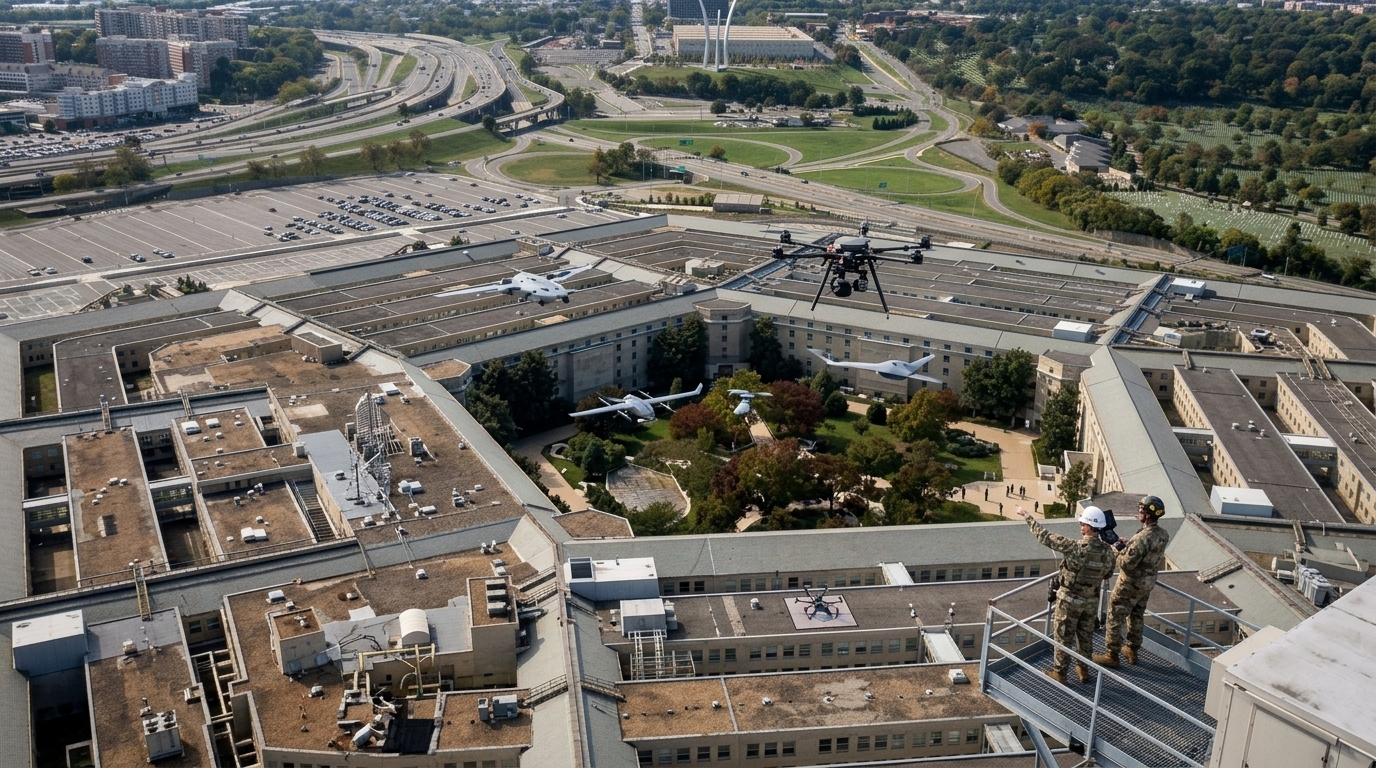
The Pentagon's announcement to triple spending on unmanned aerial vehicles (UAVs) and autonomous systems technology is not merely a budgetary adjustment; it is a fundamental overhaul of how the United States intends to conduct warfare in the 21st century. With funding reaching record levels, Washington is sending a clear signal to its competitors, primarily China, that the era of absolute dominance by manned platforms is drawing to a close.
Lessons from Modern Conflict: From Ukraine to the Pacific
This decision was not made in a vacuum. Conflicts in Ukraine and the Middle East have demonstrated that cheap, attritable drones can neutralize multi-million dollar weapon systems, such as main battle tanks and surface vessels. The Pentagon, observing the effectiveness of swarms and loitering munitions, realized that its strategy of "qualitative advantage" through a few, exquisite units (like the F-35 fighter) must be augmented by a strategy of "mass."
The "Replicator" initiative, which serves as the spearhead of this effort, aims to deploy thousands of autonomous systems across multiple domains in a short timeframe. The goal is to create a "wall" of drones capable of saturating enemy air defenses, making any invasion or offensive action prohibitively costly for an adversary. In the case of Taiwan, for instance, the deployment of thousands of unmanned surface and aerial craft could turn the strait into a "hellscape" for any invading fleet.
Artificial Intelligence and the Ethics of Autonomy
The tripling of funds is not just about the hardware—the aircraft themselves—but primarily about the software. The integration of Artificial Intelligence (AI) is the key to operating these systems. The drones of the future will not simply be remotely piloted by a technician at a base in Nevada. They will possess increased autonomy, the ability to make decisions in the field, and the capability to collaborate in swarms without the need for constant human intervention.
This evolution raises serious ethical and legal questions. The international community is watching with concern the arms race in Lethal Autonomous Weapons Systems (LAWS). Although the Pentagon insists that a "human-in-the-loop" will always be maintained for the final decision to use force, the speed at which modern warfare is conducted makes this promise difficult to uphold in practice. The need for international treaties regulating the use of AI in warfare is becoming increasingly urgent.
Restructuring the Defense Industrial Base
This shift is expected to cause an earthquake within the traditional US defense industry. While giants like Lockheed Martin and Northrop Grumman are scrambling to adapt, a new generation of Silicon Valley tech firms, such as Anduril and Shield AI, are gaining ground. These companies operate on the logic of rapid software development and mass production—something the Pentagon deems essential to compete with China's manufacturing capacity.
Furthermore, the need for cheap and attritable systems means the supply chain must change. We no longer need drones designed to fly for 20 years; we need drones that can be manufactured by the thousands within weeks and sacrificed on the battlefield without causing financial ruin to the defense budget. This "democratized" access to air power is shifting global balances, allowing even smaller nations to acquire significant deterrent capabilities.
Conclusion: Algorithmic Warfare is Here
The tripling of drone spending marks the official start of the era of algorithmic warfare. The US is investing in technological superiority not through brute force, but through the intelligence and mass of autonomous systems. The stakes are high: if successful, deterrence will be strengthened, and human casualties may be reduced. However, if this race spirals out of control, the world may face a new form of instability, where decisions of life and death are made in milliseconds by lines of code.