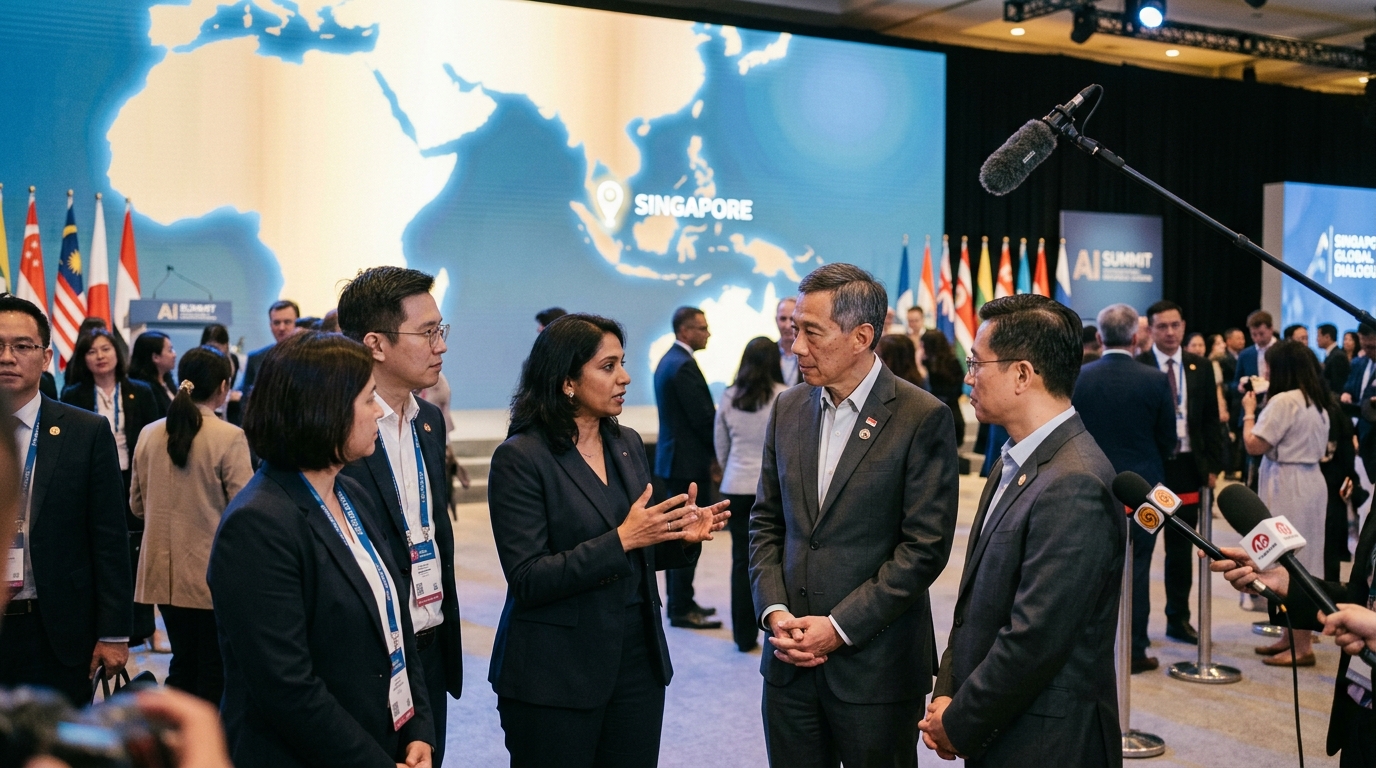
On the global map of technological power, the traditional dominance of Silicon Valley is beginning to face intense pressure from an unexpected but exceptionally well-prepared rival: Singapore. As we move through the first half of 2026, the Southeast Asian city-state is no longer just a financial hub; it has become the "Digital Switzerland" of the Artificial Intelligence (AI) era. The massive pivot of giants like Google, OpenAI, and Nvidia toward Singapore is not accidental; it is the result of years of strategic preparation that blends political stability with a regulatory framework that encourages innovation without stifling it.
The "National AI Strategy 2.0" Blueprint
The Singaporean government was among the first globally to realize that AI is not merely a tool but a new form of national power. With the launch of the National AI Strategy 2.0 (NAIS 2.0), the country set a goal to train thousands of specialists and attract foreign investment through a "smart" regulatory approach. Unlike the European Union, which opted for a strict, protective stance with the AI Act, Singapore promoted the "Model AI Governance Framework." This is a flexible framework that provides guidelines for the ethical use of AI while allowing companies to experiment at high speeds.
Google, for instance, has expanded its Cloud Region in Singapore, making it one of the most advanced in the world. The company works closely with the local government to integrate the Gemini model into public services, ranging from healthcare to urban planning. This symbiotic relationship between the state and tech giants is something rarely seen in the West, where relations between Big Tech and governments are often adversarial.
Nvidia and OpenAI: The Geopolitics of Neutrality
For Nvidia, Singapore represents one of its most significant global customers. It is noteworthy that a disproportionately large percentage of the company's revenue originates from the island nation, as it houses massive data centers serving the entire Asian continent. Jensen Huang, CEO of Nvidia, has visited the country repeatedly, emphasizing that Singapore has the vision to create its own "Sovereign AI," reducing dependence on foreign models.
On the other hand, OpenAI recently announced the opening of regional offices in Singapore, recognizing it as the gateway to the Asia-Pacific (APAC) market. This move also has geopolitical undertones. Amidst the "chip wars" between the US and China, Singapore maintains a careful balance. It serves as a safe harbor where American companies can operate with access to Asian talent and supply chains without being directly caught in the crossfire of Washington-Beijing tensions.
Infrastructure and Talent: The Competitive Edge
Singapore's success is built on three pillars: power, connectivity, and human capital. The country boasts one of the world's densest networks of subsea fiber-optic cables, ensuring minimal latency in data transfer. Furthermore, despite land constraints, Singapore is investing in next-generation green data centers, addressing the energy challenges that plague other regions.
- Education: The AI Singapore (AISG) program has already trained thousands of citizens, creating a talent pool ready to fill new job roles.
- SEA-LION: The country developed its own Large Language Model (LLM), SEA-LION, which is optimized for Southeast Asian languages and cultures, offering an alternative to Western-centric models.
- Sovereign Wealth Funds: Temasek and GIC, Singapore's sovereign wealth funds, are actively funding AI startups, creating a self-sustaining ecosystem.
In conclusion, Singapore does not just offer tax incentives. It offers a vision of the future where technology is organically integrated into society. For Google, OpenAI, and Nvidia, Singapore is not just a destination; it is the laboratory where their global dominance for the next decade is being tested.