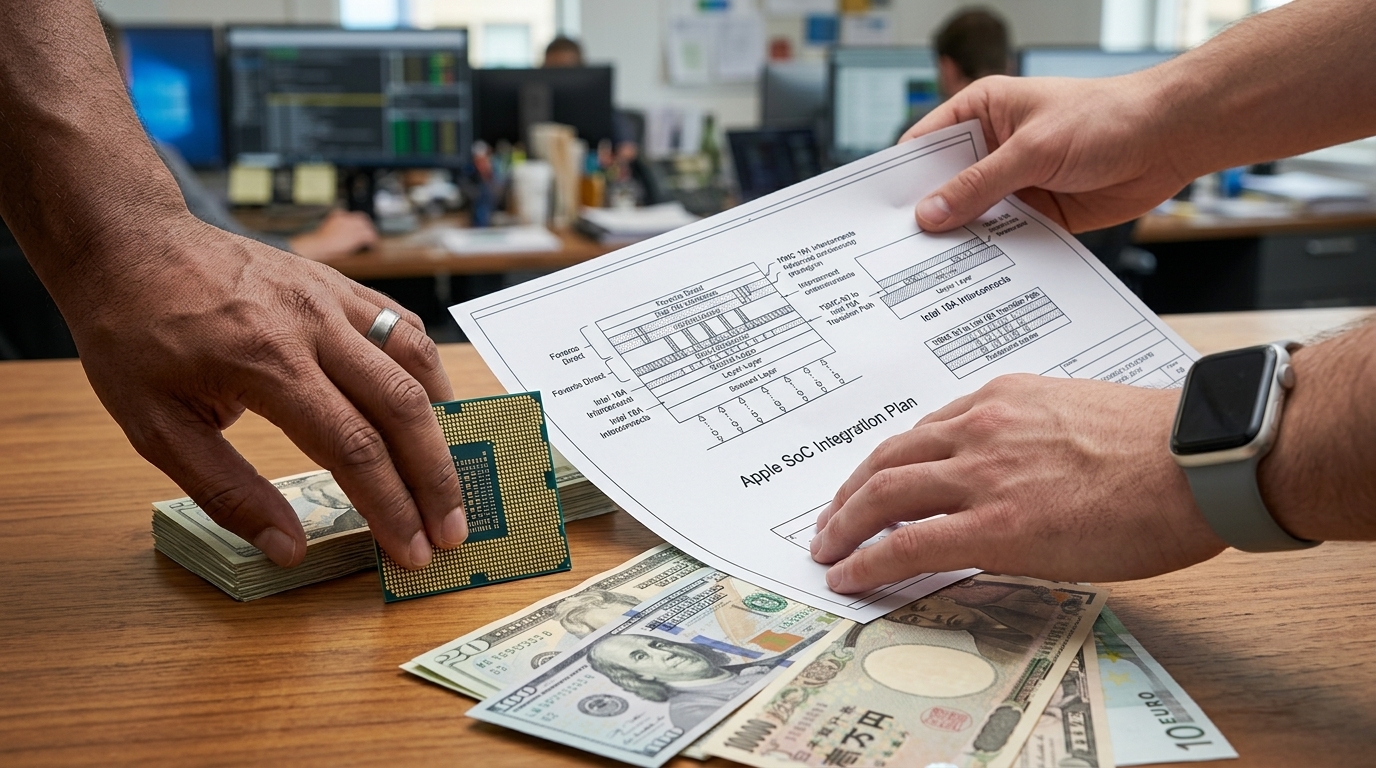
May 5, 2026, will likely be recorded in the annals of technology as the day the geopolitics of silicon definitively shifted course. The news that Apple, the tech giant that for years served as the premier client of Taiwan's TSMC, is activating a secret plan to move part of its production to Intel, has sent shockwaves through international markets. Intel's stock experienced a historic rally, reclaiming decades of lost prestige, while Washington celebrates the first major victory of its 'Silicon Sovereignty' strategy.
This move is not merely a business decision; it is a profound political act. In a world where Taiwan sits at the epicenter of Sino-American tensions, Apple's dependence on a single factory complex just miles from the shores of mainland China had become the single greatest risk in the history of modern capitalism. Intel, under the leadership of Pat Gelsinger, appears to have achieved the impossible: convincing Tim Cook that American fabs can compete with Asian precision and scale.
The Technological Counter-Offensive: The 18A Process
The 'key' that unlocked the deal with Apple was none other than the Intel 18A manufacturing process. This represents the world's most advanced chipmaking method, utilizing the new RibbonFET architecture and the PowerVia backside power delivery system. According to sources in Cupertino, the initial samples of 'A' and 'M' series processors manufactured at Intel’s Oregon facilities demonstrated power efficiency that surpasses TSMC's 2nm equivalents.
Intel invested billions in High-NA EUV machines from the Dutch firm ASML, successfully overcoming the technological stagnation that plagued it in the previous decade. Apple, recognizing that TSMC has reached its capacity limits and faces rising costs due to geopolitical uncertainty, decided to place its bets on the domestic player. This means that future iPhones and Macs will bear the 'Made in USA' mark not just for their design, but for the very silicon heart that beats within them.
Geopolitical Security and the CHIPS Act
One cannot ignore the pivotal role of the U.S. government in this development. Billions in subsidies via the CHIPS and Science Act acted as the catalyst that allowed Intel to build its new 'Mega-Fabs' in Ohio and Arizona. Washington has long been pressuring Apple to diversify its supply chain, fearing that a potential blockade of Taiwan would paralyze the American economy and its technological edge.
The Intel-Apple agreement serves as the ultimate case study of how industrial policy can steer the market. For Intel, Apple is not just a client, but the 'seal of quality' it needed to attract other titans like Nvidia and Qualcomm to its Foundry network. The market now views Intel not as a sluggish PC processor manufacturer, but as the 'Western pillar' of global semiconductor production, a necessary counterweight to East Asian dominance.
Implications for TSMC and the Global Market
For TSMC, the loss of Apple's exclusivity is a heavy, though expected, blow. The Taiwanese firm is now rushing to accelerate its own investments on European and American soil, attempting to retain its clientele by offering geographic diversity. However, Intel's advantage lies in its total vertical integration and close cooperation with the U.S. Department of Defense, granting it an aura of a 'national champion' that TSMC simply cannot replicate in the United States.
Economically, this move is expected to restructure profit margins across the industry. While production in the U.S. remains more expensive on paper, the reduction in logistics costs and, crucially, the elimination of the 'geopolitical risk premium' make Intel's solution financially viable. Investors who bought Intel shares during the lows of 2024 and 2025 are now seeing their returns skyrocket as the company transforms into a cash-flow machine with a renewed strategic purpose.
Conclusion: A New Era for Technology
Apple's pivot toward Intel signals the end of the era of 'blind globalization.' Technology no longer seeks only the cheapest labor or the most efficient factory; it seeks security, resilience, and proximity. Intel, against all odds, managed to survive and lead this new trend. The challenge now is whether it can maintain this momentum and prove that American manufacturing prowess can remain at the pinnacle for decades to come. One thing is certain: the map of the silicon world will never be the same again.