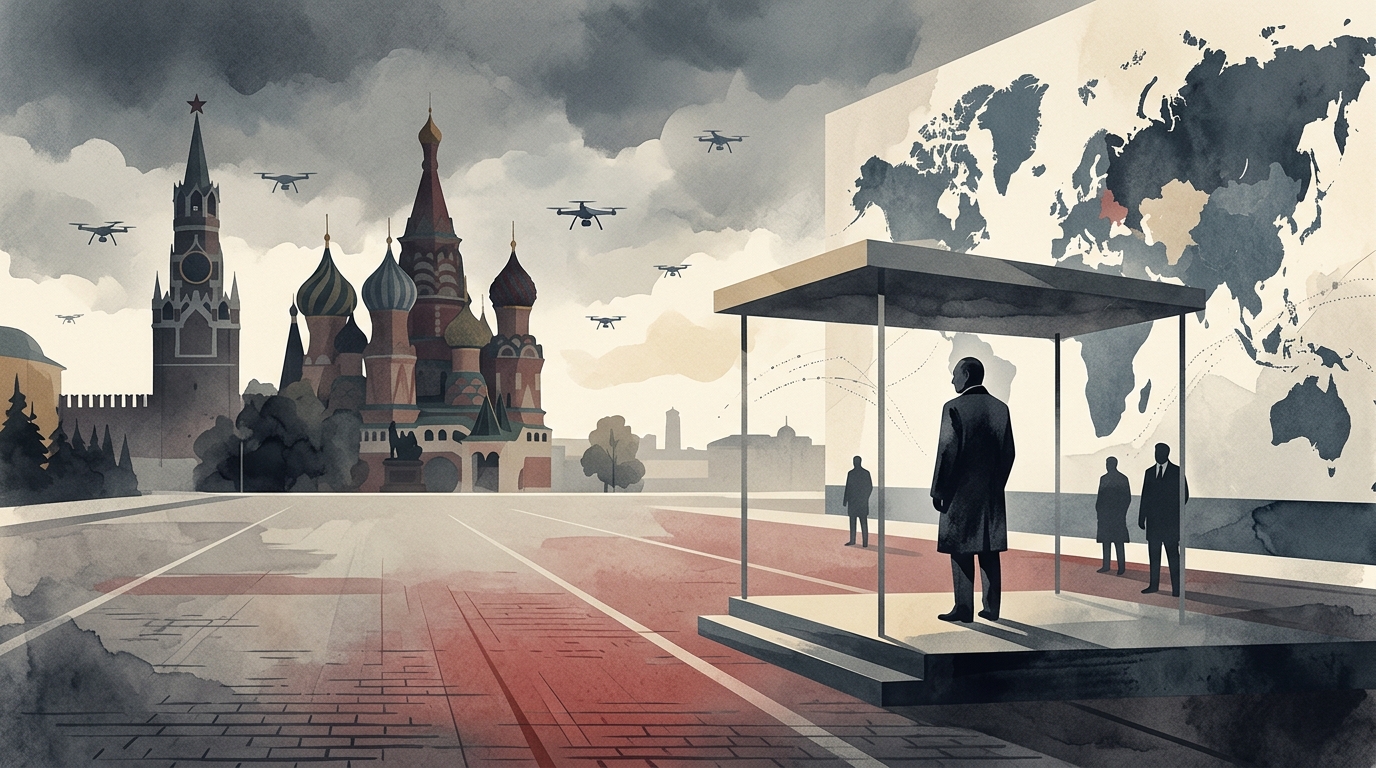
On May 9, 2026, Moscow awoke to a reality that few could have imagined five years ago. Victory Day, Russia's most sacred secular holiday, was held under the shadow of a tangible and humiliating threat. For the first time in modern Russian history, Red Square remained "naked" of its iconic T-14 Armata tanks, Yars missiles, and heavy armor that traditionally formed the spearhead of Russian propaganda. The cause? The technological prowess of Ukrainian long-range drones, which have turned any concentration of military power into a potential target.
The Absence of Steel and the Reign of Fear
The image of Vladimir Putin standing on the podium, surrounded by veterans, without the low rumble of tank tracks, was a powerful metaphor for the state of the war in 2026. The Kremlin's decision to withdraw heavy equipment from the parade was not a move of humility, but a choice of necessity. According to intelligence sources, the Ukrainian side had warned of "surprises" over the Moscow sky, and recent strikes on refineries and military bases deep within Russian territory proved that Russian air defenses are not impenetrable.
The absence of S-400 missile systems and intercontinental ballistic missiles from the parade suggests a deep concern for the safety of the weapon systems themselves, as well as the political leadership. A successful drone strike in the heart of Red Square during a live broadcast would be the ultimate communicative blow to the regime. Thus, Moscow chose the safety of a "lean" parade, attempting to shift focus to human capital and its new allies.
"The May 9th parade is no longer about showing strength, but about showing survival. When tanks fear drones during a time of celebration, the message of victory becomes blurred," comments an international relations analyst.
The North Korean Factor and the New Axis
If the absence of tanks was the first shock, the presence of North Korean troops was the second. For the first time, Pyongyang's soldiers marched alongside their Russian colleagues, sealing the "Comprehensive Strategic Partnership" signed by the two countries. This presence is not merely symbolic. After years of international isolation, Russia is desperately seeking support, and North Korea has emerged as a key supplier of ammunition and, as it now appears, manpower.
The inclusion of North Koreans in the parade sends a clear message to the West: Moscow is not alone. However, for many Russian citizens, the sight of foreign troops in Red Square causes unease, as it highlights the former superpower's dependence on a pariah state. This geopolitical shift shows that Putin is willing to sacrifice national pride for military survival.
- Participation of over 500 North Korean soldiers in the marching units.
- Absence of an aerial flypast for the third consecutive year due to drone risks.
- Emphasis on historical WWII vehicles (T-34) instead of modern models.
- Increased security measures with electronic warfare (jamming) systems throughout central Moscow.
The Psychology of a Besieged Capital
The atmosphere in Moscow was electric. Despite Mayor Sobyanin's efforts to project an image of normalcy, the disruption of GPS signals and the heavy police presence betrayed the underlying anxiety. Muscovites, accustomed to displays of invincible power, found themselves before a parade that felt more like a memorial service than a triumph. Putin's rhetoric in his speech remained harsh, blaming the "collective West" for trying to destabilize Russia, but his body language and the image of the empty square told a different story.
This development marks the end of an era. Traditional parades, designed for the 20th century, are failing to adapt to the demands of the 21st century, where an asymmetric enemy can cause chaos at a minimal cost. Russia, in its attempt to protect its prestige, ended up highlighting its weakness. The question now is not whether Russia can win on the battlefield, but whether it can protect even its most sacred traditions from the technological progress of its adversaries.