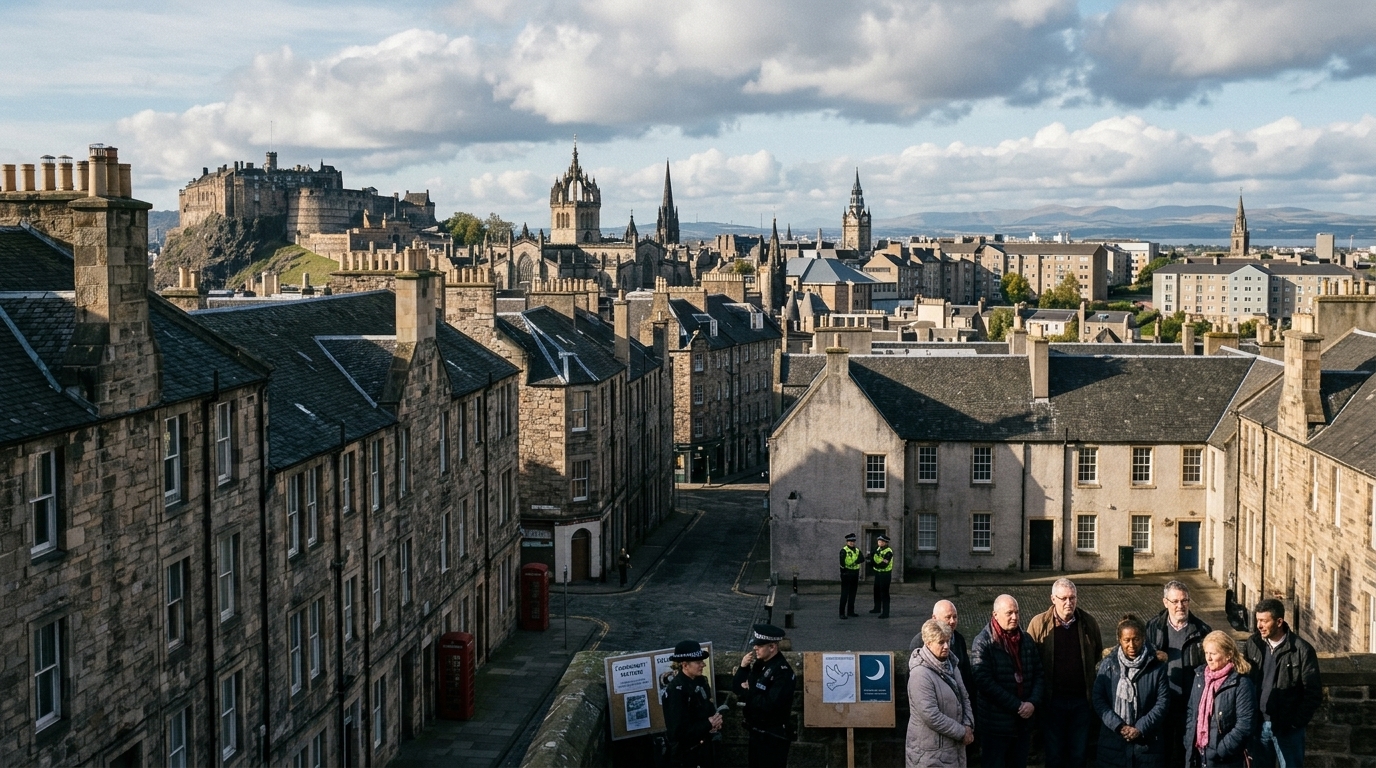
The tranquility of the Scottish capital was shattered on Friday night when a series of violent attacks, potentially fueled by anti-Muslim sentiment, left five men injured. The incident, occurring near a local mosque and Islamic center, is no longer being treated as a routine criminal matter but has come under the direct scrutiny of Police Scotland’s Counter Terrorism Unit. While the arrest of a 36-year-old man marks an initial breakthrough for the authorities, the questions regarding the safety of minorities in the United Kingdom remain urgent and unsettling.
The Timeline of the Attack and Police Response
According to official reports, the attacks took place within a short timeframe, specifically targeting individuals associated with the local Muslim community. The five victims were rushed to the hospital, and while their injuries are reportedly not life-threatening, the psychological scar left on the community is profound. Police are currently analyzing CCTV footage and witness testimonies that describe unprovoked violence accompanied by hate-filled rhetoric during the assaults.
The involvement of counter-terrorism units suggests that authorities suspect a deeper motivation beyond a random act of violence. Investigators are looking into whether the suspect was radicalized online or if he is part of a broader network promoting Islamophobia. Scotland, which has traditionally prided itself on a more inclusive and civic-minded approach to national identity compared to its southern neighbor, is reeling from the shock of such blatant sectarian violence.
The Rise of the Far-Right and Stochastic Terrorism
Edinburgh does not exist in a vacuum. Over the past few years, the UK has witnessed a surge in far-right rhetoric that frequently manifests as physical aggression. The concept of "stochastic terrorism"—where the public demonization of a specific group inspires "lone wolves" to take violent action—is at the heart of current sociological analysis.
- The role of social media algorithms in creating echo chambers of hate.
- Economic disenfranchisement leading to the scapegoating of immigrant communities.
- The failure of political leadership to condemn racism without caveats or political maneuvering.
"This is not just an attack on five individuals; it is an assault on the values of tolerance that define modern Scotland," stated a representative from the local Islamic center.
Political Implications and the Path Forward
The Scottish Government now faces the challenge of balancing security with community cohesion. Increasing police presence around places of worship is a necessary short-term fix, but the root cause remains social polarization. Following the Southport riots of 2024 and the subsequent unrest across the UK, British society appears to be sitting on a powder keg. The Edinburgh attack serves as a painful reminder that social peace is fragile and requires constant cultivation.
On a geopolitical level, internal instability within Britain weakens its standing on the global stage. When a nation that champions human rights abroad fails to protect its citizens at home based on their faith, its diplomatic credibility is eroded. The international community is watching closely to see how London and Edinburgh manage this crisis, as Islamophobia is a growing threat to the cohesion of Western democracies as a whole.
Conclusion
The Edinburgh attack is a clarion call. Capturing the perpetrator is only the first step; what is required is a fundamental shift in how hate is addressed in both the digital and physical realms. Scotland must prove that its model of multiculturalism is resilient, or it risks sliding into a cycle of violence that will be difficult to break. The five injured men are the faces of a crisis that concerns us all, demanding more than just thoughts and prayers—it demands systemic change.