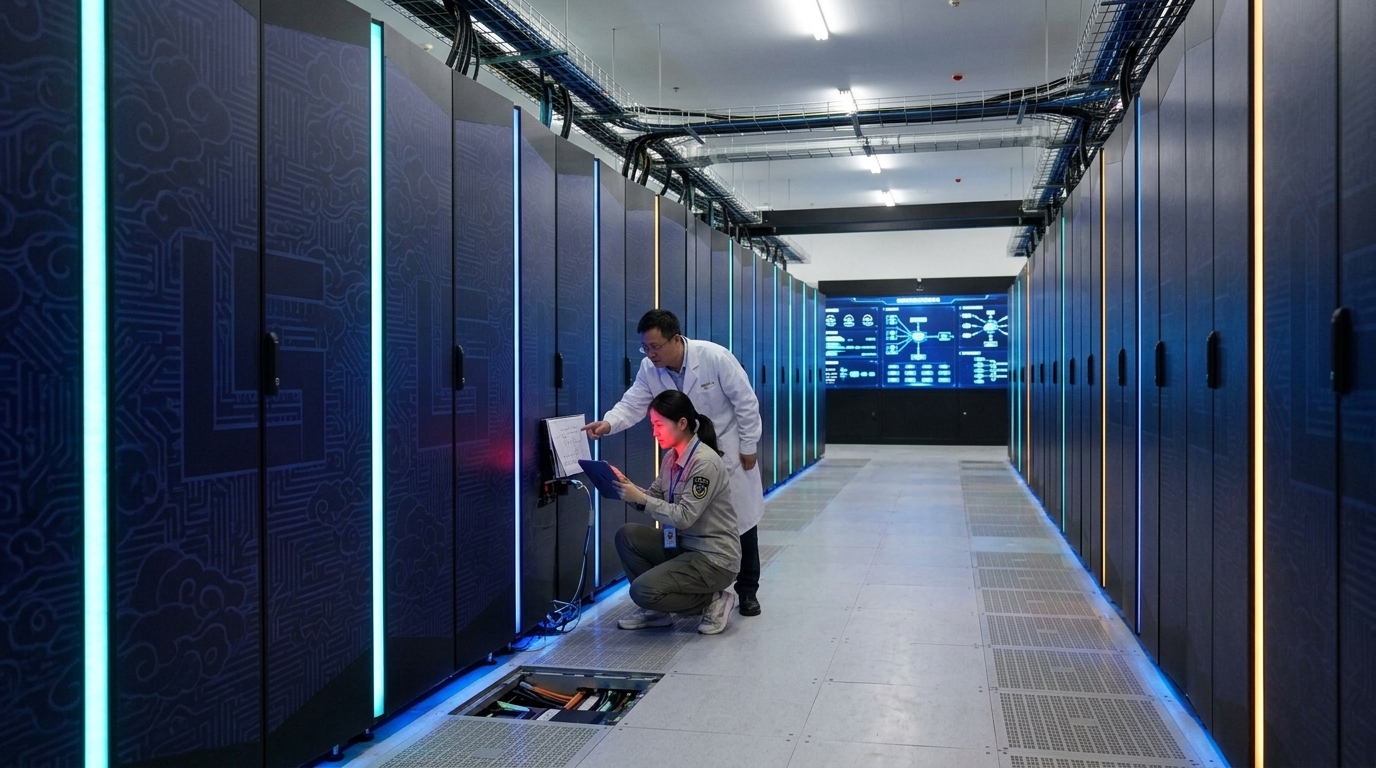
In a development that is sending shockwaves through Washington’s geopolitical circles, China has announced its return to the summit of the global supercomputing rankings. LineShine, a technological marvel developed under a veil of strict secrecy, has managed to surpass the American El Capitan, claiming the number one spot on the TOP500 list. This marks the first time since 2018 that Beijing officially holds the title of the world's most powerful computer, a news story that upends the narrative regarding the effectiveness of Western trade restrictions.
The Architecture of Autonomy
The success of LineShine is not merely a victory of raw processing power; it is a testament to Chinese resilience. While the US has imposed draconian restrictions on the export of advanced semiconductors, such as NVIDIA’s GPUs and Intel’s processors, China appears to have found its own path. According to initial analyses, LineShine is based on a sophisticated domestic architecture, likely an evolution of the Sunway series, utilizing millions of custom cores designed entirely within the country.
This shift toward domestic production suggests that the 'decoupling' strategy promoted by the West has had the opposite effect of what was intended. Instead of slowing Chinese progress, it forced Beijing to invest billions into developing an autonomous semiconductor ecosystem. LineShine is not just a fast computer; it is the symbol of a China that no longer needs Silicon Valley to lead in High-Performance Computing (HPC).
Geopolitical and Military Implications
In the 21st century, supercomputers are the 'factories' of knowledge and power. Possessing the fastest system in the world provides a critical advantage in fields ranging from climate modeling to cryptography and the design of new weaponry. LineShine is expected to be used extensively for simulating nuclear tests, developing hypersonic missiles, and, of course, training next-generation artificial intelligence models.
- Aerodynamic simulation for stealth aircraft.
- Genomic analysis for the development of personalized medicine.
- Quantum simulation for the discovery of new materials.
- Training LLMs with trillions of parameters.
Washington is watching with concern, as supercomputing supremacy is directly linked to a nation's ability to dominate the field of artificial intelligence. If China can build such systems without access to American-linked fabrication plants (like TSMC), then the effectiveness of sanctions is called into serious question.
The End of the Semiconductor 'Iron Curtain'?
The emergence of LineShine poses a fundamental question: Can innovation be contained through trade barriers? History shows that technological diffusion is inevitable. The US tried to build a 'digital wall' around China, but Beijing responded by building its own ladder. Analysts point out that LineShine achieves Exascale-level performance, breaking the barrier of one quintillion calculations per second, using technology that many in the West considered 'outdated.'
"China is no longer playing the game by our rules. They built their own stadium and their own ball," noted a prominent semiconductor market analyst.
In conclusion, China's return to the top is not a temporary aberration but the confirmation of a bipolar technological world. The competition for supercomputing primacy will intensify, with the US already preparing its response with new systems, but the psychological and strategic victory currently belongs to Beijing. The era where the West held a monopoly on high technology seems to be firmly in the past.