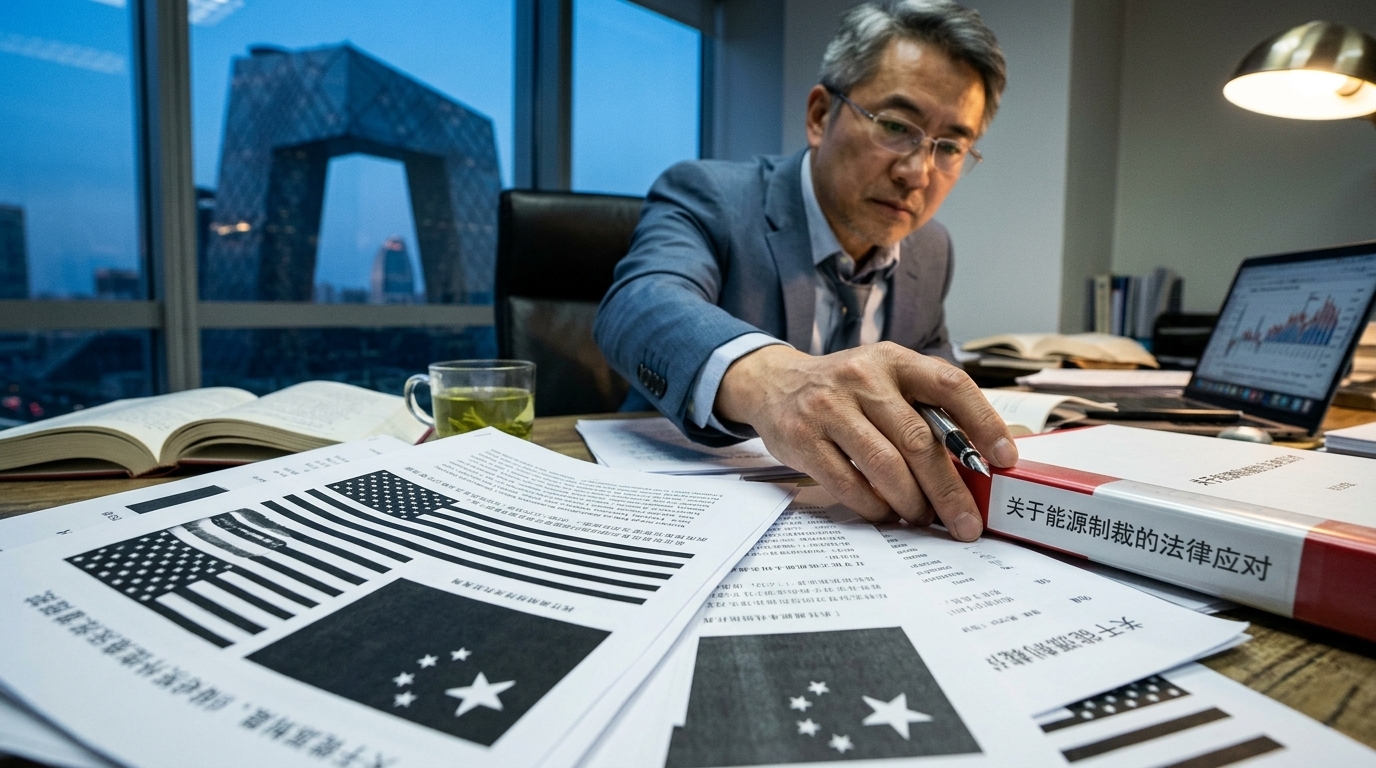
In a move that further escalates the already strained geopolitical confrontation between the world's two largest economies, China's Ministry of Commerce announced on Saturday that it has issued an order to block the implementation of U.S. sanctions against five Chinese refineries. This decision is not merely a diplomatic protest, but a institutional counter-offensive based on the 'Rules on Counteracting Unjustified Extra-territorial Application of Foreign Legislation and Other Measures'—a mechanism Beijing established in 2021 to shield its businesses from the influence of the U.S. dollar and American jurisdiction.
The five refineries, primarily based in Shandong province—the hub of China's independent refiners, often referred to as 'teapots'—stand accused by Washington of facilitating transactions and purchasing crude oil from Iran. For the United States, these sanctions are a core component of its 'maximum pressure' campaign against Tehran. For China, however, they represent an unacceptable infringement on national sovereignty and its right to conduct free trade with any partner it chooses.
The Legal Architecture of Chinese Resistance
The activation of the Chinese 'blocking statute' marks a critical milestone. This law allows Chinese authorities to issue orders prohibiting Chinese entities from complying with foreign sanctions deemed 'unjustified.' Most significantly, it provides a legal basis for Chinese companies to sue in domestic courts for damages from any party that complies with U.S. sanctions, causing them economic loss.
This development creates an intractable dilemma for international banks and service providers operating in China. If they comply with U.S. sanctions, they risk heavy fines and legal battles within China. If they ignore them, they risk being cut off from the U.S.-led global financial system. China is essentially erecting a legal wall, forcing financial actors to choose sides. This 'lawfare' strategy is designed to make the enforcement of American sanctions prohibitively expensive for private entities.
Oil as a Geopolitical Tool
China remains the world's largest buyer of Iranian crude oil. Despite strict sanctions from Washington, oil flows from Tehran to Shandong's refineries have increased significantly in recent years. These transactions are often conducted in Chinese yuan, bypassing the SWIFT system and the U.S. dollar, making them extremely difficult for the U.S. Treasury to track or intercept.
The 'teapot' refineries play a central role in this process. Being smaller and less exposed to international markets compared to state-owned giants like Sinopec, they have greater flexibility to take on the risk of processing 'sanctioned' oil. Beijing's decision to officially protect them indicates that the Chinese leadership no longer views these activities as something to be kept 'under the radar,' but as a legitimate economic activity deserving of full state support.
The Erosion of American Hegemony
Analysts point out that this move is part of a broader strategy of de-dollarization and the weakening of U.S. economic coercive tools. As China develops its own protection mechanisms, sanctions become less effective as a tool of foreign policy. The creation of a 'parallel' economic system, where Washington's rules do not apply, is now a rapidly forming reality.
Furthermore, this move sends a clear signal to other sanctioned nations, such as Russia. Beijing is demonstrating that it possesses both the will and the means to challenge the 'jurisdiction of the dollar,' offering an alternative haven for the trade of strategic resources. The conflict over the five refineries is, in reality, a conflict over who will define the rules of global trade in the 21st century. The era of unchallenged American financial extraterritoriality appears to be coming to a close.
Conclusion
China's decision to block sanctions against its refineries marks the end of an era where the U.S. could impose its will on global trade without substantial resistance. As Beijing fortifies its industry, the risk of a full economic bipolarity increases. International markets must now navigate a minefield of conflicting legislations, where compliance with one side automatically entails illegality for the other. The geopolitical stakes have never been higher, as the very foundation of the global financial order is being contested in the oil docks of Shandong.