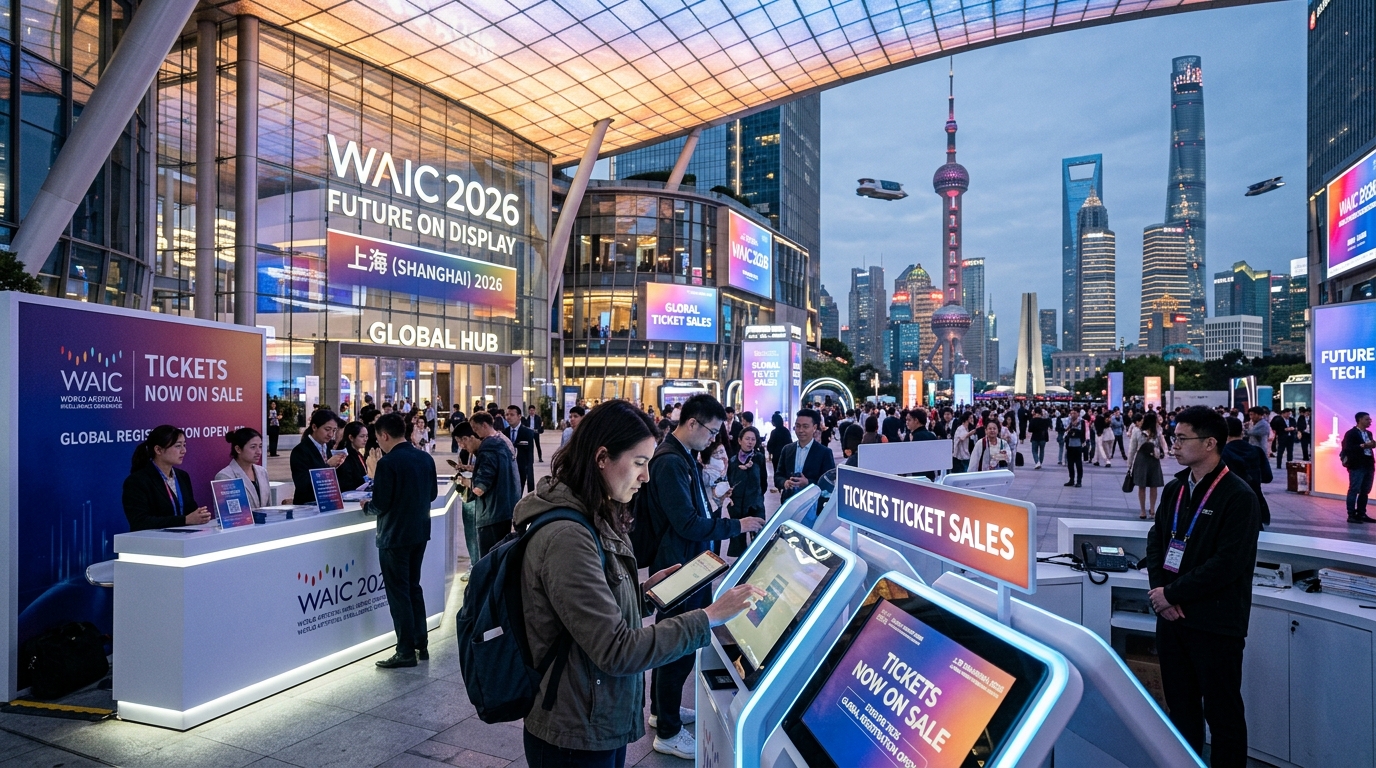
As we navigate the summer of 2026, the technological world is turning its gaze eastward. The World Artificial Intelligence Conference (WAIC) 2026, the premier event traditionally hosted in Shanghai, has officially opened its global ticket sales, signaling the dawn of a new era for global innovation. In a period where Artificial Intelligence is no longer an experimental promise but a fundamental infrastructure of society, this year's conference is expected to lay the groundwork for the transition from Large Language Models (LLMs) to Embodied AI and Artificial General Intelligence (AGI).
The Rise of Embodied AI: The Robots are Here
If 2024 and 2025 were the years of chatbots and generative AI, 2026 is characterized by the physical presence of intelligence in the material world. According to preliminary announcements by the organizers, the central exhibition of WAIC 2026 will host over 500 robotics companies, with a heavy emphasis on general-purpose humanoid robots. These machines, equipped with advanced sensors and neural networks trained in real-time, promise to take over tasks ranging from elderly care to complex industrial manufacturing.
China, a leading force in hardware manufacturing, is using WAIC as a platform to demonstrate its dominance. Visitors will have the opportunity to witness firsthand the convergence of computer vision with haptic feedback, allowing robots to interact with their environment with unprecedented delicacy. The conversation is no longer about whether robots will enter our daily lives, but how the coexistence of humans and machines in shared spaces will be regulated.
Geopolitics and Technological Diplomacy
WAIC 2026 is not just a tech expo; it is a field of geopolitical balance. Despite tensions between the United States and China regarding semiconductor restrictions and technology exports, the Shanghai conference remains one of the few venues where academics and industry leaders from both the West and the East meet. This year's agenda includes critical discussions on global AI governance, the prevention of autonomous weapons, and the creation of shared safety standards.
The participation of representatives from the European Union is expected to be pivotal, as the EU seeks to play the role of the "regulator" between the two technological giants. The looming question is whether the global community can agree on an ethical framework for AGI before the technology surpasses human control capacity. Shanghai, as a hub of the "Digital Silk Road," provides the ideal backdrop for these deliberations.
Energy Sustainability and Green AI
One of the most pressing issues to be addressed at WAIC 2026 is the energy cost of intelligence. With the training of next-generation models requiring massive amounts of electricity, the industry faces a sustainability crisis. Major tech companies are expected to present new "green chip" architectures and training methods that reduce the carbon footprint by up to 40%.
- Presentation of low-power quantum processors.
- Agreements on the use of renewable energy sources for data centers.
- "Sparse activation" algorithms that reduce required computational power.
The shift toward efficiency is not only an environmental imperative but also an economic necessity. As the demand for computing power grows exponentially, the ability of a country or company to produce "cheap and clean intelligence" will become the new competitive advantage in the 21st century.
Conclusion: The Invitation to Tomorrow
The opening of ticket sales for WAIC 2026 is a call to global mobilization. From Silicon Valley investors to Shenzhen engineers, everyone is preparing for an event that promises to define the next decade. Artificial intelligence is no longer a tool we use, but the environment in which we live. The Shanghai conference will show us if we are ready to manage the power we have created.