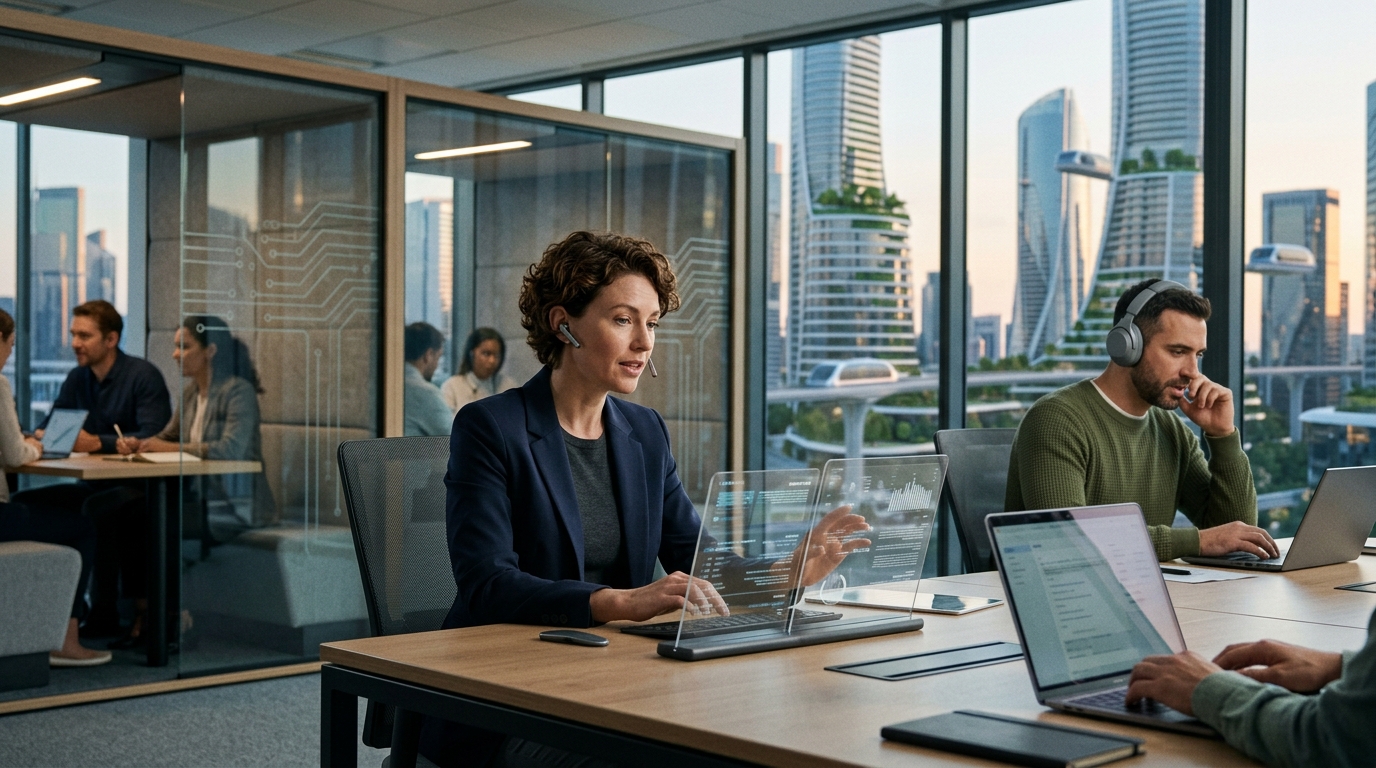
Walking into a modern corporate office in 2026, your first impression isn't the clatter of keyboards or the drone of loud conversations, but an eerie, almost sacred stillness. What would have been described in the past as "dead silence" is now the result of a sophisticated orchestration of audio technology and artificial intelligence. Welcome to the "whisper-filled office," an evolution that promises to solve the greatest architectural failure of the last twenty years: the open-plan workspace.
Reclaiming Focus Through Acoustic Isolation
For decades, the open office was hailed as the temple of collaboration, yet it effectively became the enemy of deep work. Research consistently showed that employees lost up to 86 minutes of productivity daily due to noise distractions. Today, AI intervenes with "active zone control" systems. Instead of traditional noise-canceling headphones that isolate the user from their environment, new offices utilize ceiling-mounted micro-speaker arrays that emit out-of-phase frequencies (anti-noise) focused on specific square centimeters.
The result is startling: you can sit six feet away from a colleague who is in the middle of a high-stakes video call and hear absolutely nothing, while they don't even need to wear a headset. This "bubble of silence" allows for the simultaneous existence of intense communication and absolute concentration in the same room, transforming the office from a chaotic hive into a network of private yet visible work nodes.
The Rise of the Personal AI Whisperer
The shift, however, is not just spatial but interfacial. The rise of AI wearables—such as smart earrings or discreet bone-conduction drivers—has fundamentally changed how we interact with information. Employees no longer constantly glance at screens for notifications. Instead, they receive "whispers" from their personal AI assistants.
- Real-time alerts for the next meeting with a synthesized summary of previous action items.
- Live translation during face-to-face discussions with international partners.
- Subtle feedback on vocal tone and sentiment during negotiations.
This transition from visual to auditory information reduces digital eye strain and allows for more natural movement within the workspace. The office is filled with people who appear to be talking softly to themselves or listening to something no one else can perceive. It is a new etiquette, where the whisper is the primary tool of maximum efficiency.
The Challenge of Authentic Human Connection
However, this technological utopia brings serious questions regarding corporate culture. If everyone is ensconced in their own sonic bubble, what remains of the spontaneity of the "water cooler moment"? Social cohesion in a team is often built on ambient noise, shared laughter, and a collective atmosphere. Total controlled acoustics might lead to a sense of alienation, where colleagues become digital avatars in a shared physical space.
"Silence in the office of the future is not the silence of absence, but the silence of hyper-focus. The challenge is to not let it become the silence of loneliness," say workplace psychology analysts.
Companies are now being forced to design "friction zones"—areas where silence technology is intentionally deactivated to encourage noisy, messy, and quintessentially human creativity. The whisper-filled office is a victory for engineering, but maintaining the human spark remains a challenge for leadership.