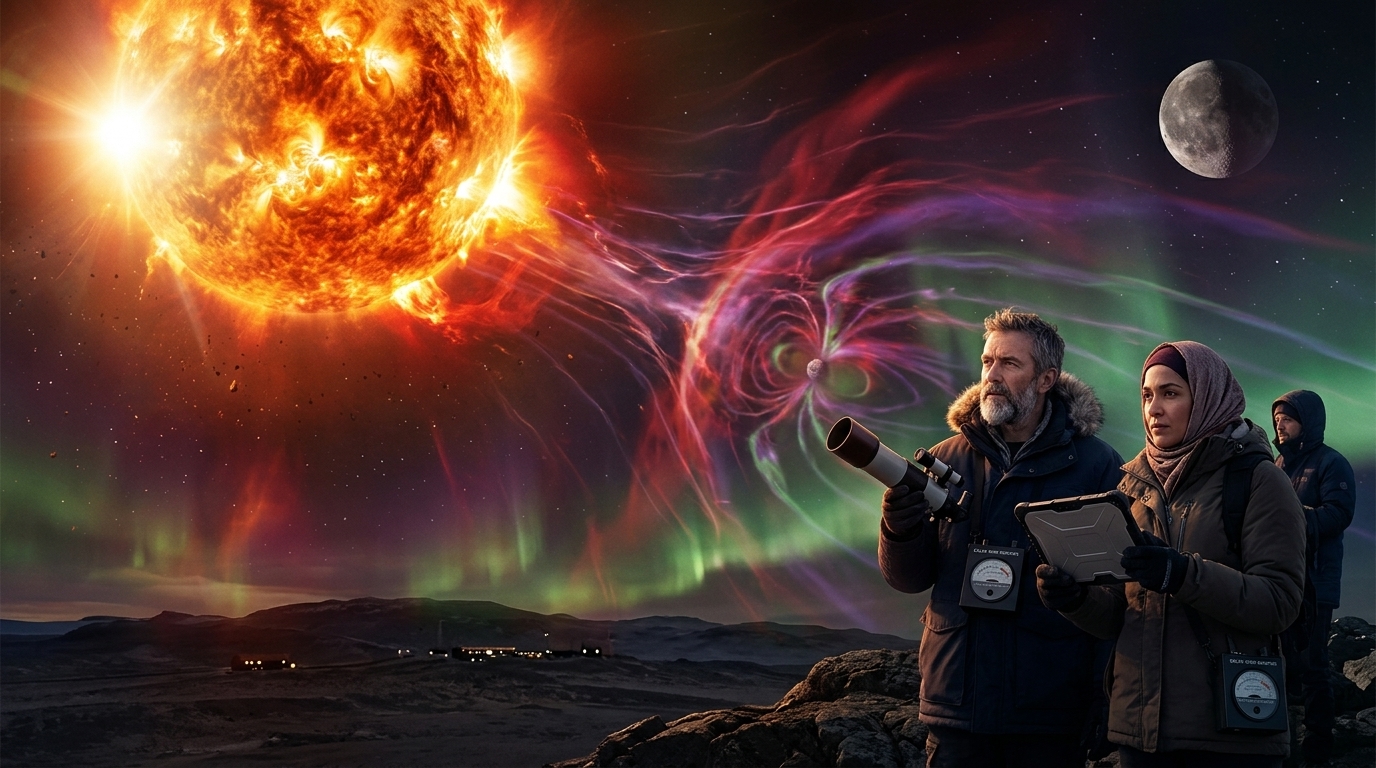
In the heart of our digital era, humanity is facing a stark reminder of its cosmic vulnerability. In just twenty-four hours, the Sun unleashed ten solar storms directed toward Earth, signaling the peak of Solar Cycle 25. While for most this translates into the breathtaking spectacle of the Aurora Borealis reaching unusually low latitudes, for scientists and infrastructure managers, it is a blaring siren.
The Anatomy of the Solar Maximum
The Sun follows an activity cycle of approximately eleven years, during which its magnetic field flips. We are now in the "Solar Maximum," a period where sunspots multiply and eruptions on its surface become a daily occurrence. The recent ten storms were not mere flares but included Coronal Mass Ejections (CMEs) — massive clouds of plasma and magnetic fields traveling at millions of miles per hour.
When these particles collide with Earth's magnetic field, they trigger geomagnetic storms. The intensity of these events is measured on the G-scale, from G1 (minor) to G5 (extreme). Recent activity has fluctuated between G3 and G4, already causing interference in high-frequency (HF) radio communications used by aviation and maritime industries.
The Threat to Digital Civilization
Unlike 1859, when the famous "Carrington Event" scorched telegraph wires, today's society is entirely dependent on technology sensitive to space weather. Low Earth Orbit (LEO) satellites, such as those in the Starlink constellation, are at risk from "atmospheric drag." Solar radiation heats Earth's exosphere, causing it to expand, which slows down satellites and can lead to their premature reentry and destruction in the atmosphere.
Furthermore, Global Positioning Systems (GPS/GNSS) are showing significant deviations. For an autonomous vehicle or a precision farming machine, a discrepancy of a few meters can be fatal. The most concerning scenario, however, involves power grids. Geomagnetically Induced Currents (GICs) can overload high-voltage transformers, causing widespread blackouts that could last weeks or even months in the event of severe damage.
AI as a Shield
In this landscape of cosmic threat, Artificial Intelligence is emerging as a critical ally. NASA and NOAA are now employing deep learning models, such as the DAGGER (Deep Learning Geomagnetic Perturbation) system, which can predict the exact location and intensity of a geomagnetic storm 30 minutes before it hits Earth. While 30 minutes may seem brief, it is sufficient to put satellites into "safe mode" and isolate critical segments of the electrical grid.
Data analysis from satellites like the SDO (Solar Dynamics Observatory) allows AI to identify patterns in sunspots that the human eye cannot discern. This predictive capability will determine whether the next major storm is merely a visual spectacle or a global catastrophe.
Geopolitical and Social Implications
Space weather knows no borders, but the capacity to handle it is unequal. Developed economies, with their complex fiber-optic networks and thousands of satellites, are more exposed. There is also a national security dimension: solar storms can "blind" early-warning systems for missile attacks, creating dangerous misinterpretations during times of geopolitical tension.
As the Sun continues its bombardment, the need for international cooperation in monitoring space weather becomes imperative. This is no longer a matter of academic interest but a question of the survival of modern infrastructure. Nature reminds us that, despite our technological hubris, we remain inhabitants of a planet dependent on the whims of a variable star.