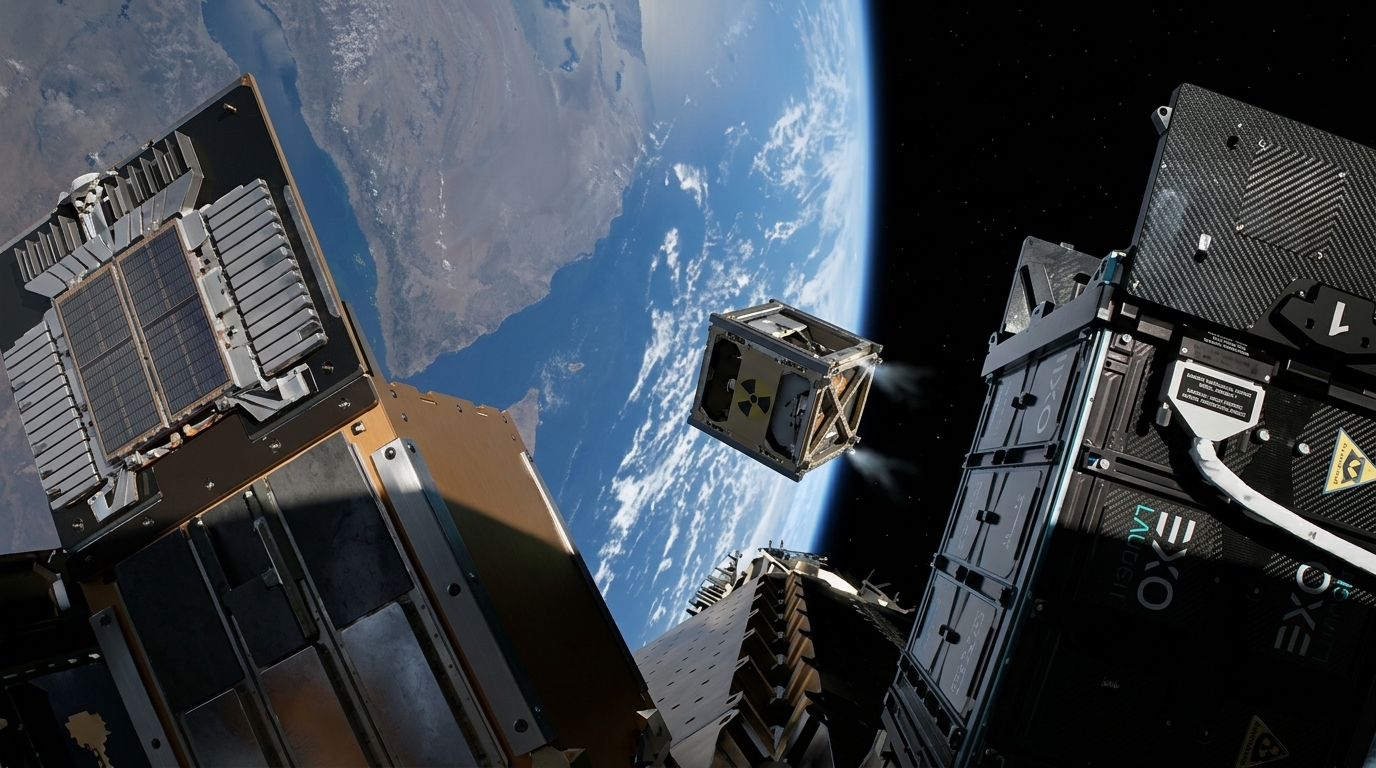
On July 8, 2026, the global space industry witnessed a moment many deemed inevitable yet technically and politically daunting: the launch of the first commercial satellite powered by nuclear energy. SpaceX's Falcon 9 rocket lifted off from Cape Canaveral, carrying the BOHR (Betavoltaic Orbital High-Reliability) satellite, a craft that promises to fundamentally alter how machines operate in the vacuum of space.
This mission is not merely another milestone for Elon Musk’s aerospace giant, but the culmination of years of research into betavoltaic cells. Unlike the massive fission reactors we know on Earth, BOHR utilizes a 'nuclear battery' that converts energy from the decay of radioactive isotopes directly into electricity. This technology allows the satellite to operate without the need for solar panels, which are often vulnerable to space debris and limited by periods of Earth-shadowing (eclipses).
The Technology of Betavoltaics: How It Works
The heart of the BOHR satellite lies in betavoltaic technology. While traditional Radioisotope Thermoelectric Generators (RTGs) used by NASA on missions like Voyager rely on heat generated by radioactive decay, betavoltaic cells use semiconductors to capture high-energy electrons (beta particles) emitted by an isotope, such as Tritium or Nickel-63.
- Lifespan: These batteries can provide consistent power for over 20 to 50 years, depending on the isotope used.
- Resilience: They are unaffected by extreme temperature fluctuations or dust, making them ideal for missions in permanently shadowed regions or deep space.
- Compactness: The absence of solar arrays dramatically reduces the satellite's volume and weight, enabling more cost-effective launches.
The commercial application of this technology by the firm behind BOHR marks a significant shift. Until now, nuclear power in space was the exclusive domain of government agencies for military or high-stakes scientific exploration. The entry of the private sector paves the way for 'orbital data hubs' and telecommunications networks that never need to power down.
Geopolitical and Environmental Challenges
Despite the technological triumph, launching nuclear materials into orbit triggers intense debate. Regulatory bodies, including the FAA and the International Atomic Energy Agency (IAEA), enforced stringent safety protocols. The fear of a launch failure, which could disperse radioactive material into the atmosphere, remained the primary argument for critics.
"The use of nuclear power by private entities in space is a double-edged sword. It offers limitless power but demands a level of accountability the market has yet to prove it possesses," noted an analyst from the International Institute for Strategic Studies.
Furthermore, the issue of space debris looms large. If a nuclear-powered satellite were to collide with another object, the resulting debris would be radioactive, potentially rendering certain orbital planes hazardous for centuries. SpaceX and its partners maintain that BOHR features shielding capable of withstanding even high-velocity impacts, and the fuel is in a solid ceramic form that does not easily disperse.
The Future: From Low Earth Orbit to the Moon
The success of BOHR is viewed as the 'test case' for the burgeoning lunar economy. With plans for permanent lunar bases (Artemis and ILRS) moving forward, the need for energy during the lunar night—which lasts 14 Earth days—makes solar panels insufficient. Small nuclear reactors and betavoltaic batteries will be the backbone of future settlements.
Through this launch, SpaceX solidifies its position as the ultimate logistics provider of the new era. It is no longer just transporting cargo; it is deploying the infrastructure that will enable a sustained human presence beyond Earth. The conversation is now shifting from 'if' we should use nuclear power in space to 'how' we will manage it safely as the number of such units increases exponentially in the coming years.