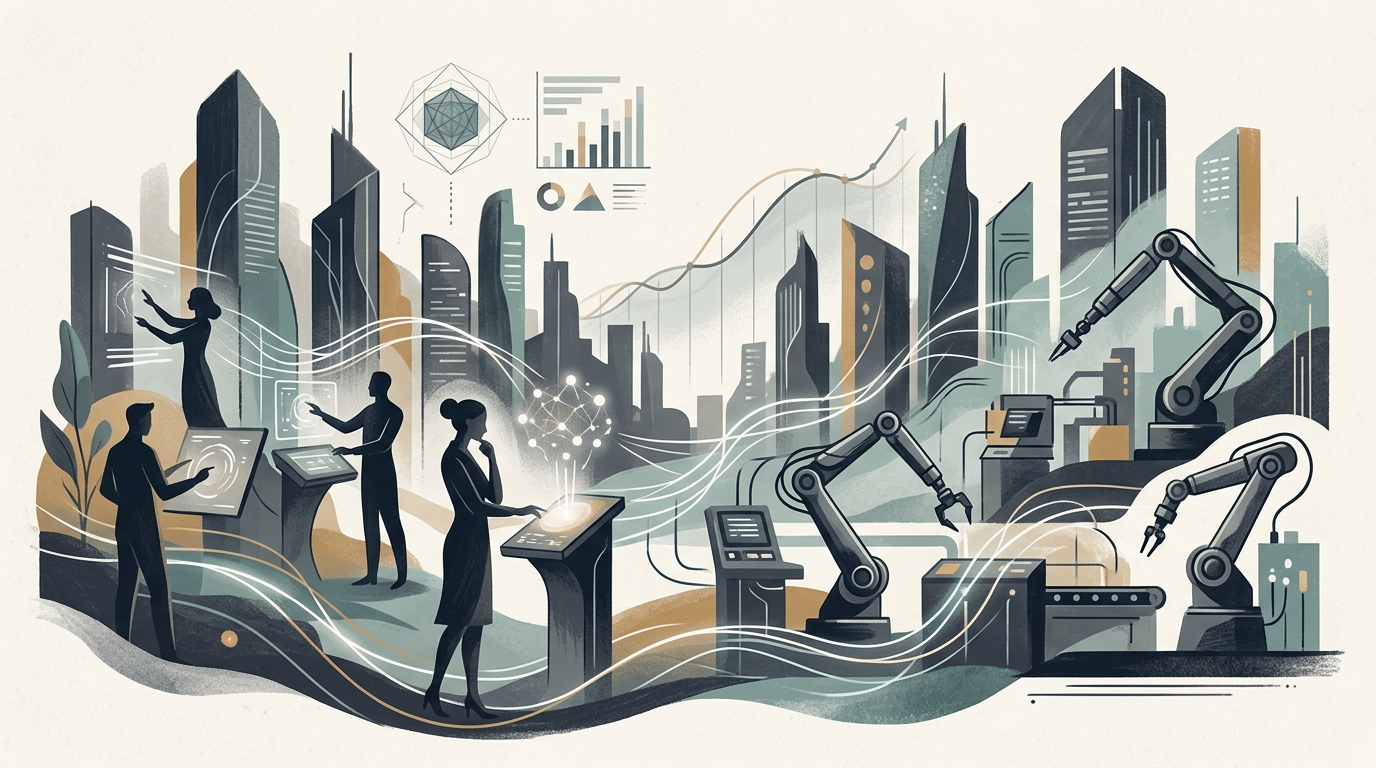
The debate over the future of work is entering a new, radical phase. With Artificial Intelligence (AI) reshaping the global production model, the Pancyprian Federation of Labour (PEO) is opening a chapter that many previously considered utopian: the establishment of a 35-hour work week without a reduction in pay. PEO's position is not merely a trade union demand, but a profound political and economic analysis of the new reality shaped by the Fourth Industrial Revolution.
According to the Federation, the rapid increase in productivity brought about by the integration of algorithms and automation into the production process cannot and should not translate exclusively into increased corporate profits. On the contrary, technological surplus value must be returned to society through improved living conditions and a better work-life balance. The argument is clear: if a machine can perform the work of three people in less time, the goal should not be to fire two, but to reduce working hours for all three.
Productivity in the Age of Algorithms
The history of labor is inextricably linked to technological evolution. From the establishment of the eight-hour day in the early 20th century to the present, every major leap in efficiency has been accompanied by social struggles for reduced working hours. Today, Artificial Intelligence offers an unprecedented capacity to automate not only manual but also complex cognitive tasks. From data analysis and coding to customer service, AI drastically reduces the time required to complete tasks.
PEO emphasizes that Cyprus, like the rest of Europe, stands at a crossroads. If the increase in productivity leads only to the accumulation of wealth at the top of the pyramid, social inequalities will widen dangerously. The 35-hour work week is presented as a necessary "social brake" that will prevent employee burnout and create room for new jobs, offsetting any losses resulting from automation.
The Social Dividend of Technology
One of the central points of the argument is the concept of the "social dividend." Technology does not develop in a vacuum; it is based on public investment, academic research, and the collective knowledge of humanity. Therefore, its fruits belong to the whole. Reducing working hours is the most direct form of distributing this dividend. Furthermore, PEO focuses on the need for upskilling and reskilling so that workers do not become "technologically unemployed."
The transition to a 35-hour work week certainly requires a change in mindset from employers. Traditionally, productivity was equated with hours spent in the office. Artificial Intelligence shatters this dogma, proving that the quality and speed of work are more important than its duration. Experimental applications of the four-day work week in countries like Iceland and the UK have shown that workers are happier, healthier, and, paradoxically, more efficient.
Challenges, Resistance, and the Political Stakes
Despite the obvious benefits, significant challenges remain. Employer organizations often argue that such measures lead to increased costs and loss of competitiveness, especially in a globalized market. However, PEO counters that competitiveness cannot be based on the exhaustion of human capital, but on innovation and the rational use of new tools. The discussion about the 35-hour work week is not just economic; it is deeply ethical: What kind of society do we want to build with the help of technology?
At the European level, the debate has already begun. The European Trade Union Confederation (ETUC) is pushing for directives to protect workers from "digital surveillance" and ensure the right to disconnect. PEO's initiative in Cyprus aligns with these trends, calling on the government and social partners to start an honest dialogue. The stake is whether AI will become the tool for human liberation from toil or a new means of imposing more intensive work rates.
- Reducing working hours as a response to automation.
- The need for fair distribution of technological surplus value.
- Protecting mental health and combating burnout.
- The importance of lifelong learning in the age of AI.
In conclusion, the proposal for a 35-hour work week is not a return to the past, but a leap into the future. It is the recognition that humans must remain at the center of economic activity, using the machine as an assistant and not as a master. Artificial Intelligence gives us the tools; political will and social struggles will determine whether we use them for the common good.