Humanity stands at the threshold of a new era where Artificial Intelligence (AI) is no longer a mere tool but a "General-Purpose Technology" (GPT), comparable to electricity or the steam engine. However, this revolution comes with a staggering cost: an insatiable thirst for computational power and, consequently, electrical energy. With projections suggesting that data centers could soon consume a significant percentage of global energy production, a pressing question arises: Can Earth sustain the weight of our digital evolution, or does the solution lie beyond our atmosphere?
The AI Energy Crisis
Modern AI models, such as those we utilize in 2026, require thousands of specialized processors (GPUs and ASICs) operating around the clock. This creates two fundamental problems on the planet's surface. First, the need for vast amounts of stable energy, which still often originates from non-renewable sources, exacerbating the climate crisis. Second, the issue of heat. Data centers generate massive thermal loads that require expensive and energy-intensive cooling systems, often consuming millions of liters of water.
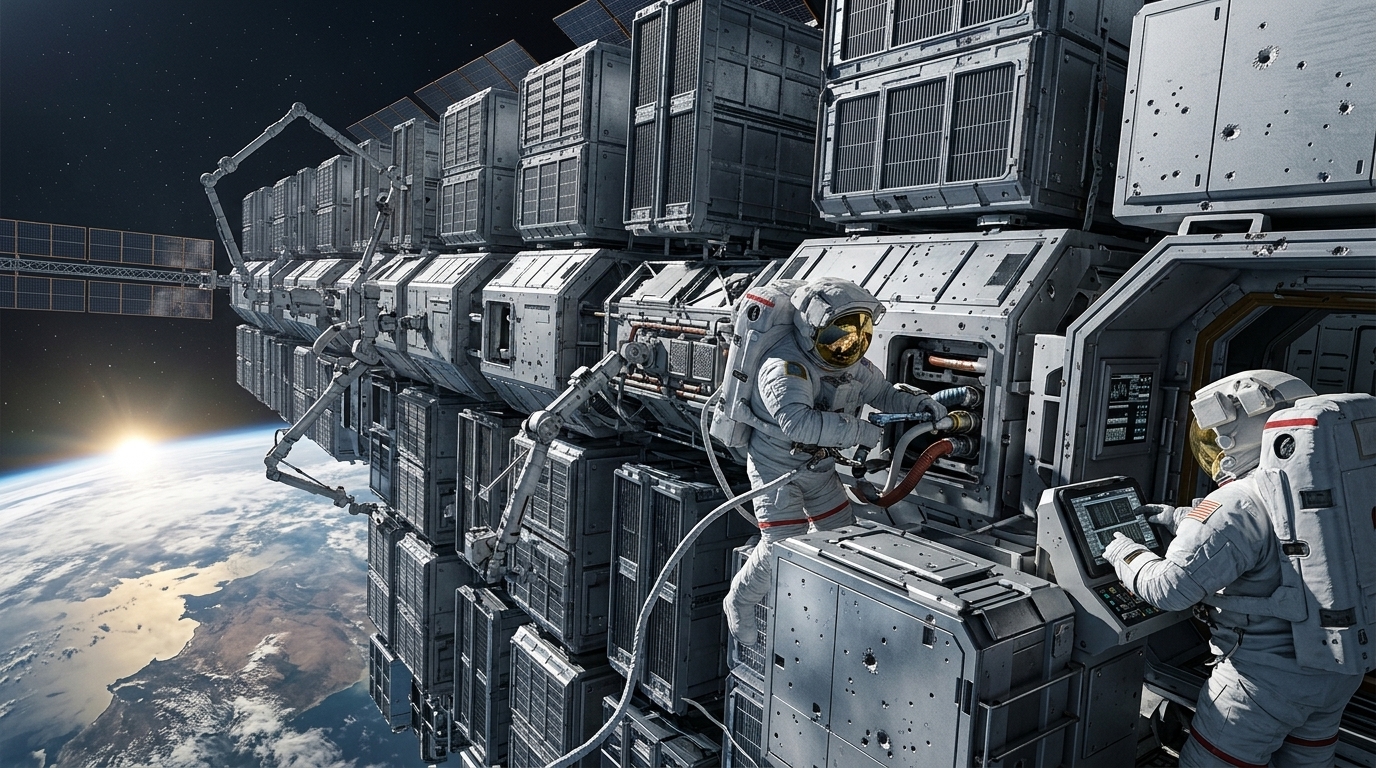
In this context, space appears as an ideal "paradise." In Earth's orbit, solar energy is abundant, continuous (in specific sun-synchronous orbits), and unhindered by the atmosphere or weather conditions. Installing solar arrays in space could power server clusters without straining the terrestrial power grids of our cities.
The Advantage of the Vacuum and Thermal Management
One of the greatest advantages of space is heat management. While on Earth we struggle to dissipate heat into the air or water, in the vacuum of space, heat transfer occurs through radiation. Although a vacuum acts as an insulator, the vast temperature difference with the cosmic background allows, via advanced radiators, for the efficient management of processor thermal loads. Furthermore, the lack of oxygen eliminates fire hazards and the material corrosion caused by humidity.
"Moving data processing to space is no longer a science fiction scenario, but an economic and environmental necessity to maintain the pace of AI innovation," industry analysts suggest.
Geopolitics, Sovereignty, and Data
Beyond the technical aspects, moving AI to space raises serious questions of sovereignty. An orbital data center could operate in "international waters," far from the direct jurisdiction of national governments. This offers a unique opportunity for data storage with absolute privacy, but simultaneously creates risks for the emergence of "digital havens" where AI could be developed without ethical or legal constraints.
Moreover, the military significance of such infrastructure is self-evident. The ability to process intelligence data directly in space, without the need to transmit massive volumes of data back to Earth (Edge Computing in Space), would provide a strategic advantage to any power controlling these satellites.
The Challenges: Radiation and Maintenance
Of course, the road to the stars is not without obstacles. Cosmic radiation and solar particles can cause processor errors (bit flips) or even permanent hardware damage. Shielding these systems increases weight and launch costs. Additionally, the problem of space debris (Kessler Syndrome) poses a constant threat to any permanent infrastructure in Low Earth Orbit (LEO).
Finally, there is the issue of maintenance. On Earth, a technician can replace a faulty GPU in minutes. In space, this requires robotic missions or prohibitively expensive manned flights. However, with advancements in robotics and the falling cost of launches driven by companies like SpaceX, these barriers are gradually being overcome.
Conclusion
Space may be the only outlet for the unbridled growth of Artificial Intelligence. If we can master the technical difficulties, orbital processing hubs could serve as the "brain" of our civilization, allowing Planet Earth to breathe, free from the energy burden of our digital ambition. AI does not need air to think, and the vacuum of space may ultimately be its most welcoming home.