In an era where artificial intelligence is no longer a futuristic promise but a daily productive reality, the question of job security has shifted from "if" jobs will be affected to "how" workers will adapt. The announcement of the Raise US initiative, a non-profit alliance featuring OpenAI, Anthropic, Microsoft, and Amazon, marks a historic turning point in the industry's attempt to manage the social consequences of its own creations.
The goal is ambitious: to raise $1 billion to fund reskilling and upskilling programs across the United States. This move attempts to bridge the gap between rapid technological evolution and the slower adaptation of educational systems and the labor market. It comes at a time when reports from international organizations warn of significant disruptions in sectors previously considered "safe" from automation, such as software engineering, legal support, and administrative management.
The Anatomy of a Strategic Alliance
The participation of these four titans is no coincidence. Microsoft and Amazon control the lion's share of global cloud infrastructure, while OpenAI and Anthropic are at the forefront of Large Language Model (LLM) development. Their collaboration under the Raise US umbrella suggests a shared realization: the success of AI depends on its social license to operate. If the technology leads to mass unemployment without a safety net, the political and social backlash could lead to stifling restrictions and regulatory hurdles.
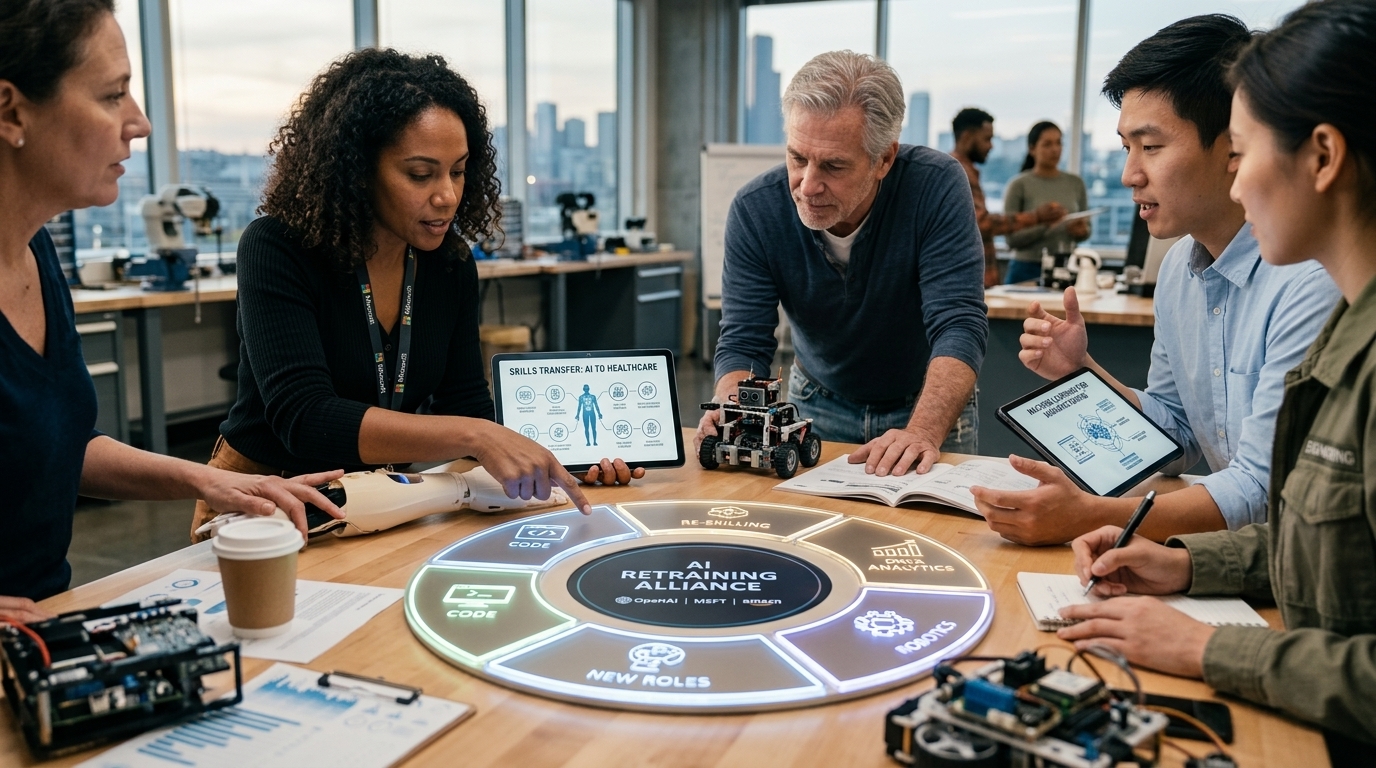
The Raise US program does not focus solely on teaching coding. Instead, it emphasizes "hybrid intelligence"—the ability of workers to use AI tools to enhance their own creativity and critical thinking. Training programs will range from learning prompt engineering to data management and algorithmic ethical oversight, targeting mid-career workers who are most at risk of displacement. This focus on the human-in-the-loop model is a strategic pivot away from the narrative of total replacement.
Philanthropy or Survival Strategy?
Despite the positive reception of the news, many analysts question the true motives behind this $1 billion investment. Is it an act of corporate social responsibility or a preemptive move to appease regulators? The US government, through recent executive orders on AI, has made it clear that worker protection is a priority. By funding their own solution, tech companies may be trying to shape the framework of the debate before stricter laws or "robot taxes" are imposed.
Furthermore, there is the question of effectiveness. The history of large-scale retraining programs is littered with failures, as the training provided often fails to meet the actual needs of businesses. Raise US promises to differentiate itself by directly linking training programs to the hiring networks of the participating companies and their partners. This creates a closed loop where the companies creating the technology also train the people who will manage it, thereby gaining even greater control over the future workforce.
The Global Ripple Effect and the Future of Labor
While the Raise US initiative initially focuses on the United States, its implications are global. In the European Union, where the approach to AI is more regulatory (e.g., the AI Act), the need for similar private initiatives is urgent. Countries with service-heavy economies are at a critical crossroads. The digital transition requires not just infrastructure, but a radical overhaul of lifelong learning and vocational training.
The Raise US model could serve as a blueprint for domestic partnerships between the state, universities, and major corporations. Retraining cannot be the sole responsibility of the individual; it requires collective action and significant resources. The challenge is to ensure that the "AI generation" is not a generation of the excluded, but a generation equipped with the tools to thrive in a digital environment that is changing at a geometric rate.
"AI won't replace people, but people using AI will replace those who don't," OpenAI's Sam Altman often remarks, and the Raise US initiative appears to be the material embodiment of this belief.
In conclusion, the move by OpenAI, Anthropic, Microsoft, and Amazon is an admission of the immense responsibility they bear. The $1 billion bet is only the beginning. Real success will be judged by whether the workers who go through these programs find meaningful jobs with decent wages, or if retraining will be merely a temporary painkiller in a painful economic transformation. The social contract of the 21st century is being rewritten in the data centers of Silicon Valley, and the stakes for the global workforce have never been higher.