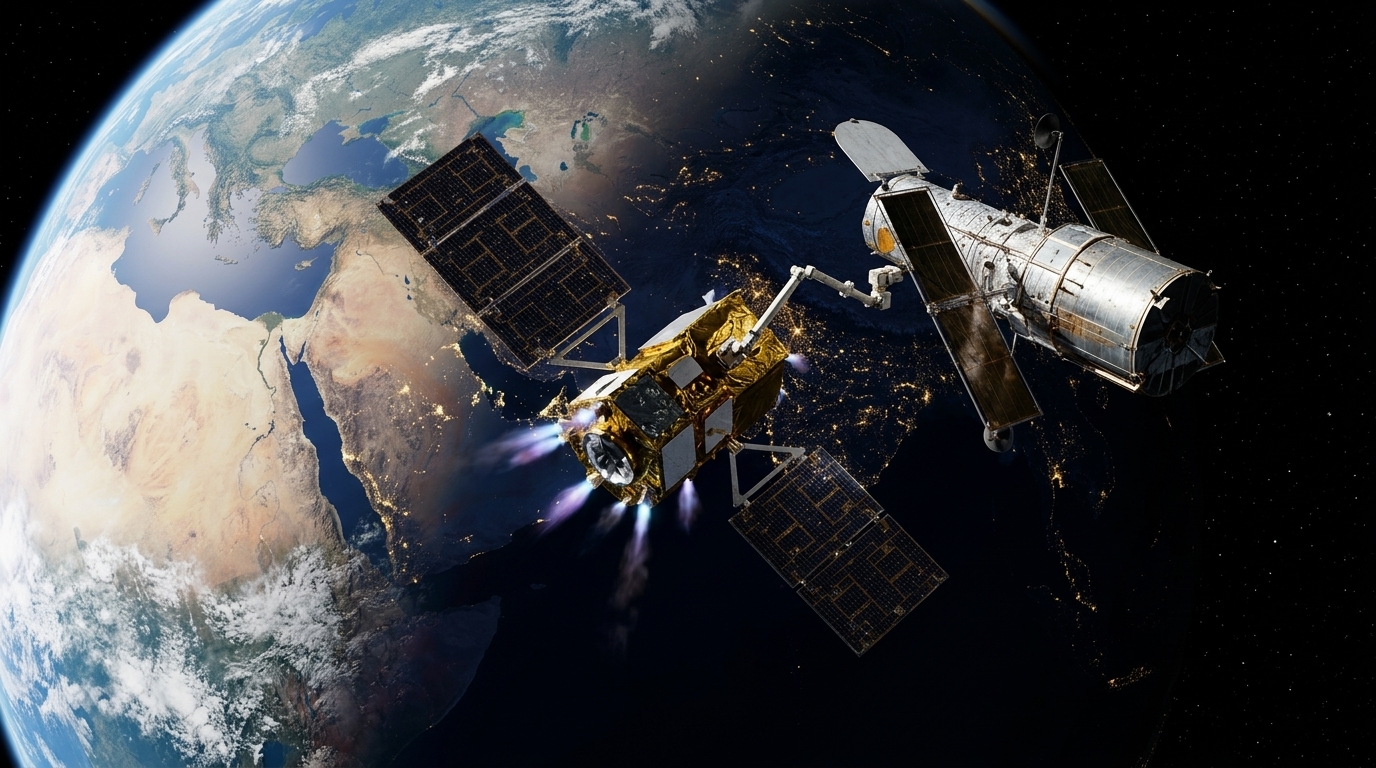
Humanity stands at the threshold of a new era in space exploration, where the concept of the 'disposable' is finally giving way to sustainability. Today, Tuesday, June 30, 2026, NASA, overcoming the weather challenges that led to a two-day delay, is placing into orbit one of its most ambitious vehicles: a space tug designed for in-orbit servicing. This mission is not merely a technical demonstration; it is a rescue operation for a multi-billion dollar space telescope at risk of falling silent, and simultaneously, a bold step toward creating a permanent maintenance infrastructure beyond Earth's atmosphere.
The Technology of Contact: How the Robotic Tug Operates
The vehicle launched today represents the culmination of decades of research in robotics and autonomous navigation. Unlike traditional missions launched with a fixed and limited lifespan, NASA's tug features sophisticated LiDAR sensors, high-definition cameras, and robotic arms with millimeter precision. Its primary objective is to approach the target telescope, synchronize with its rotational speed, and dock securely.
This process, known as 'rendezvous and docking,' is exceptionally complex when dealing with older telescopes that were not originally designed to be serviced. The robotic vehicle must improvise, utilizing advanced Artificial Intelligence algorithms to identify docking points on a structure never intended for such contact. Once the connection is established, the tug can take control of the telescope's trajectory, move it to a safer altitude, or even provide additional fuel, extending its operation for a decade or more.
Economic and Scientific Viability: Why Repair is the Future
Building and launching a modern space telescope, such as the James Webb or its successors, costs billions of dollars and requires decades of preparation. The loss of such an instrument due to simple fuel depletion or a minor mechanical failure is a massive blow to the scientific community and taxpayers alike. The space tug introduces the logic of the 'circular economy' to outer space.
- Resource Conservation: Extending the life of an existing telescope costs a fraction of the price of building a new one.
- Space Debris Mitigation: Instead of leaving decommissioned satellites to drift aimlessly, the tug can guide them to a controlled atmospheric reentry.
- Continuous Scientific Flow: Avoiding gaps in observations allows astronomers to monitor cosmic phenomena without interruptions that could last years.
Furthermore, the success of this mission will pave the way for 'gas stations' in space and repair shops capable of upgrading telescope electronics with new, more advanced instruments without needing to replace the entire spacecraft.
Geopolitical Implications and the Private Sector's Role
While today's mission is led by NASA, space tug technology carries significant geopolitical weight. The ability to approach and manipulate another object in orbit is a 'dual-use technology.' While it can save a telescope, it could theoretically be used to disable adversary satellites. This makes NASA's transparency and cooperation with international bodies essential to avoid misunderstandings in an already tense international climate.
"We are not just saving a telescope; we are building the bridge for a permanent human and robotic presence beyond low Earth orbit," a NASA official stated during a press briefing.
Meanwhile, private companies are closely monitoring the progress. The 'In-Orbit Servicing' market is expected to skyrocket in the coming years, with the private sector gradually assuming the role of 'roadside assistance' for the thousands of satellites now crowding our skies. NASA, acting as a pioneer, is laying the groundwork for a new commercial activity that will make space more accessible and sustainable.
Conclusion: Toward a New Space Ethic
Tuesday's launch marks the end of the era of 'waste' in space. As the tug heads toward its target, it carries the hope that technology can correct past mistakes and protect our scientific heritage. Our ability to maintain and repair our eyes on the universe is the first step toward becoming a truly spacefaring civilization—one that respects its resources and invests in knowledge with a long-term perspective.