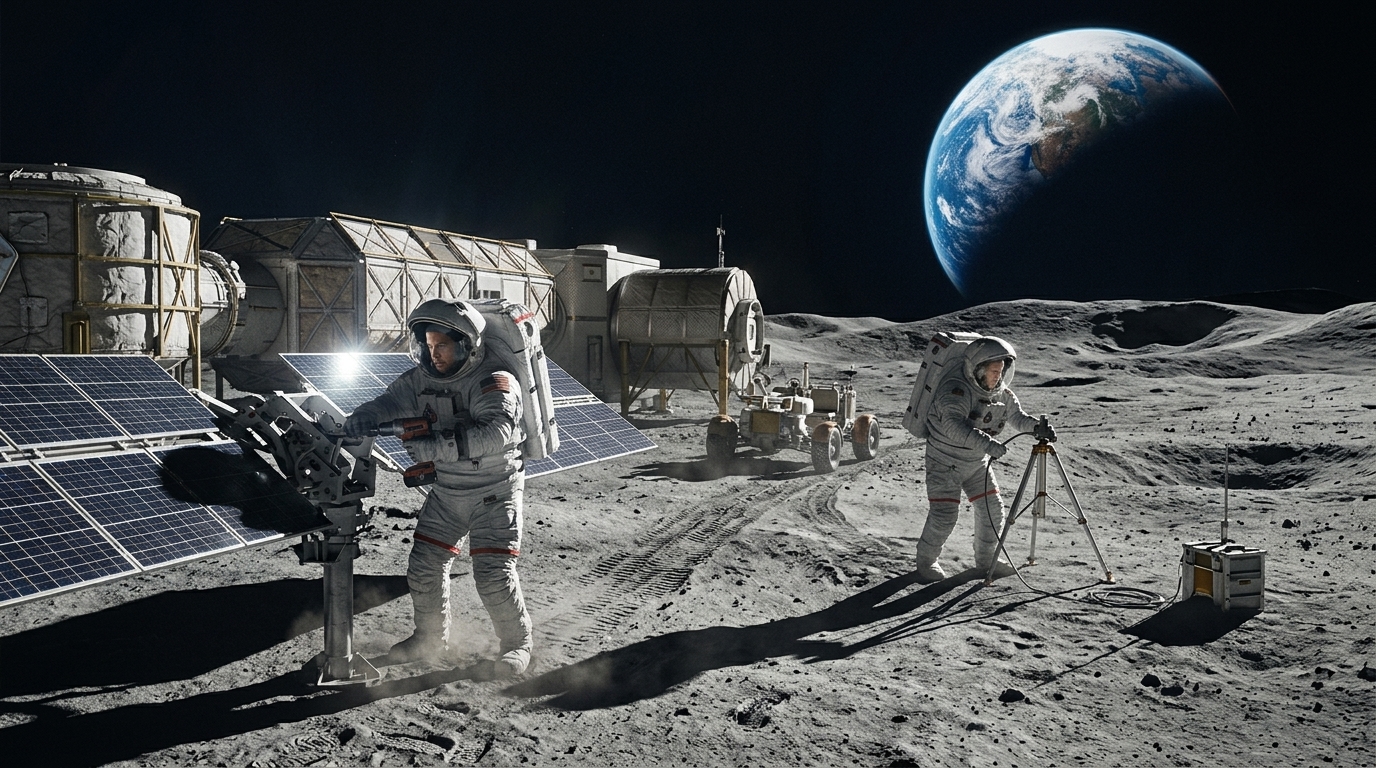
Humanity stands on the precipice of a new era where the Moon is no longer a distant destination for brief visits but the next frontier for permanent habitation. NASA, through its Artemis program, recently unveiled a detailed strategy for constructing a base at the lunar South Pole—a region that until a few years ago was considered unremarkable but is now the most sought-after "real estate" in our solar system.
The Strategic Importance of the South Pole
Why the South Pole? The answer lies in two words: water and light. The craters of the South Pole are in permanent shadow, meaning temperatures there are low enough to preserve vast quantities of water ice. This water isn't just for hydrating astronauts; it is the "gasoline" of the future. Through electrolysis, water can be split into hydrogen and oxygen, providing rocket fuel and breathable air.
Simultaneously, the rims of these craters enjoy near-constant sunlight. These "Peaks of Eternal Light" offer an inexhaustible source of solar energy, essential for operating machinery and the base's life-support systems. NASA plans to deploy solar arrays there to power the Artemis Base Camp, the central hub of human presence.
Partnerships with Blue Origin and the Private Sector
One of the most compelling aspects of the new plan is its increased reliance on the private sector. Blue Origin, Jeff Bezos's space company, has been tasked with developing the "Blue Moon" lander, which will serve as the primary transport vehicle for heavy cargo and infrastructure. This partnership marks a paradigm shift: NASA is no longer the sole manufacturer but the customer and coordinator of a broader ecosystem.
"We are not going to the Moon to leave flags and footprints. We are going to stay, to learn, and to prepare for the next giant leap: Mars," a NASA official stated during the plan's presentation.
The first cargo mission from Blue Origin is expected to reach the South Pole soon, carrying the initial building blocks of the base. This includes communication systems, robotic exploration vehicles, and experimental setups for extracting resources from the lunar soil (regolith).
Technical Challenges and the Hostile Environment
Despite the excitement, the challenges remain daunting. Lunar dust, or regolith, is extremely abrasive and electrically charged, making it hazardous for machinery and astronaut suits. NASA is investing in self-cleaning surface technologies and specialized filters to combat this issue.
Furthermore, managing extreme temperatures requires innovative thermal protection systems. While the peaks are bathed in light, the shadowed crater floors are among the coldest places in the universe. The base must function as a closed, perfectly controlled environment, capable of protecting its inhabitants from cosmic radiation and solar flares.
Geopolitics and the Artemis Accords
The return to the Moon is not just a scientific endeavor but a geopolitical one. The Artemis Accords represent the cooperation framework proposed by the US, but China and Russia are developing their own rival project, the International Lunar Research Station (ILRS). The competition for control over strategic points at the South Pole echoes the Age of Discovery on Earth, raising questions about resource ownership and peaceful coexistence in space.
In conclusion, NASA's plan for the South Pole is the beginning of a new story for the human species. The Moon is being transformed from an object of observation into a field of action, economic development, and ultimately, a new home away from Earth.