As we navigate the first half of 2026, the global discourse on Artificial Intelligence has undergone a profound shift. If 2023 and 2024 were defined by Large Language Models (LLMs) and generative AI in office environments, 2026 marks the definitive rise of "Physical AI." According to recent analyses from the World Economic Forum (WEF), the next frontier of innovation lies not within our screens, but in the factories and laboratories where AI meets the molecular fabric of reality.
The Challenge of Process Manufacturing
Process manufacturing—encompassing chemicals, pharmaceuticals, energy, and materials science—forms the backbone of modern civilization. Despite its criticality, it has remained tethered for decades to a methodology of trial and error. Discovering a new catalyst or a more resilient polymer could take up to a decade of research and billions of dollars in R&D. The sheer complexity of thermodynamics and chemical reactions at a macroscopic scale made this sector notoriously difficult to digitize effectively.
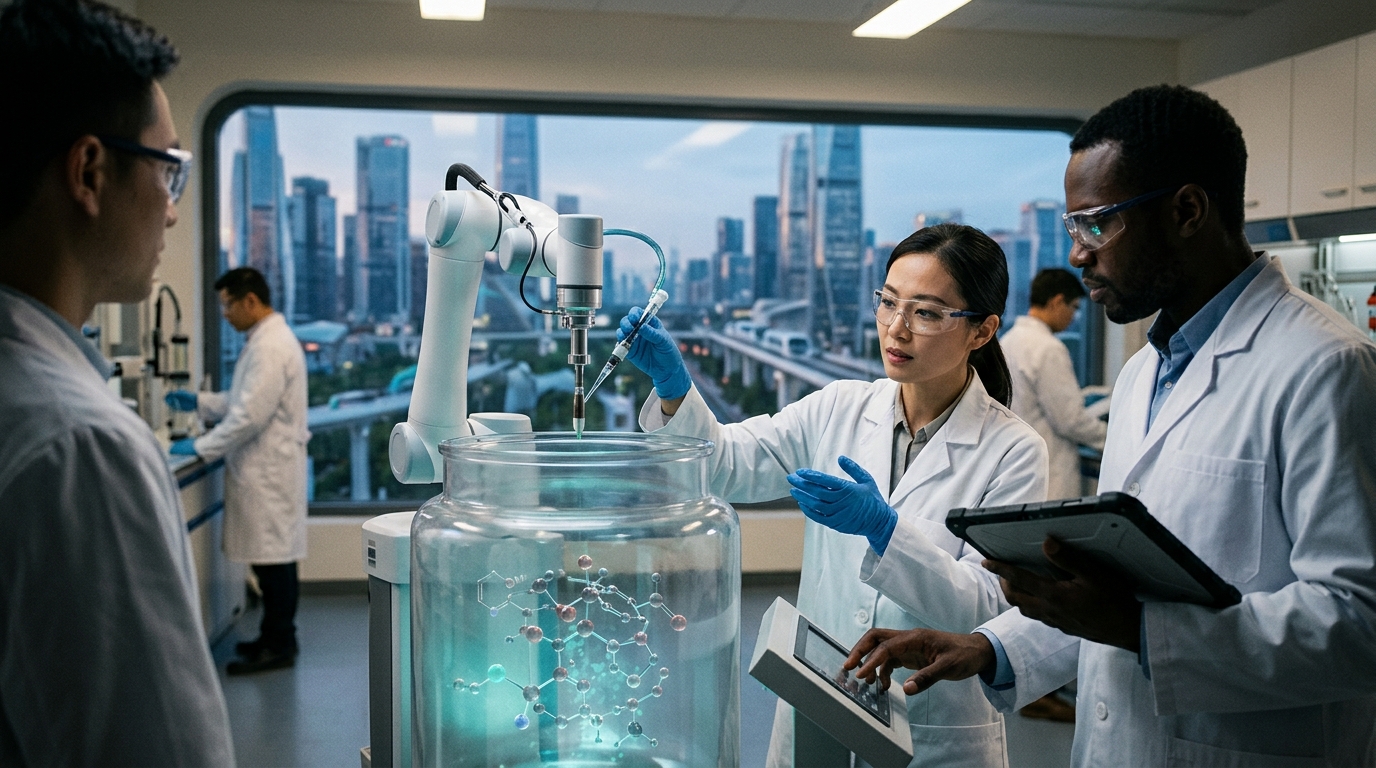
The "Molecular Revolution" championed by the WEF involves leveraging AI to understand and manipulate matter at the atomic level. We are no longer discussing simple automation; we are looking at models capable of simulating the behavior of billions of molecules in real-time. This allows industries to engage in "inverse design"—starting with the desired properties of a material and letting AI determine the molecular structure needed to achieve them.
From Digital Twins to Molecular Twins
Until recently, digital twins were primarily used to monitor machine health and logistics. Today, the technology has evolved into "molecular twins." These AI models integrate the laws of physics and quantum mechanics to predict how chemical compounds will behave under specific pressures and temperatures. The implications for the green transition are staggering. For instance, optimizing green hydrogen production requires new, cost-effective catalysts that do not rely on rare earth metals. AI can now scan millions of potential elemental combinations in days, accelerating a process that would have taken decades in a traditional lab.
- Accelerated Innovation: Reducing the development time for new materials by up to 80%.
- Sustainability: Minimizing waste through more precise chemical processes and yields.
- Energy Efficiency: Optimizing industrial reactors for significantly lower energy consumption.
Geopolitical and Economic Implications
Dominance in Physical AI is not merely a matter of corporate profitability; it is a pillar of national security. Nations that possess the most advanced molecular simulation models will control the production of next-generation semiconductors, high-density batteries, and advanced biodegradable materials. Europe, with its historically strong chemical sector (led by giants like BASF), stands at a crossroads. Failure to integrate AI into its production processes could mean losing its competitive edge to China and the United States, both of which are funneling massive capital into "AI for Science" initiatives.
"We are not just in a new phase of digitization. We are at the threshold of an era where humanity will program matter as easily as it programs software," states the WEF report.
In conclusion, the molecular revolution in process manufacturing is the definitive answer to the grand challenges of the 21st century. From mitigating climate change to addressing resource scarcity, our ability to manipulate the physical world through the lens of AI will determine the prosperity of future generations. Industry is no longer a realm of gears and steam; it is a realm of algorithms and atoms.