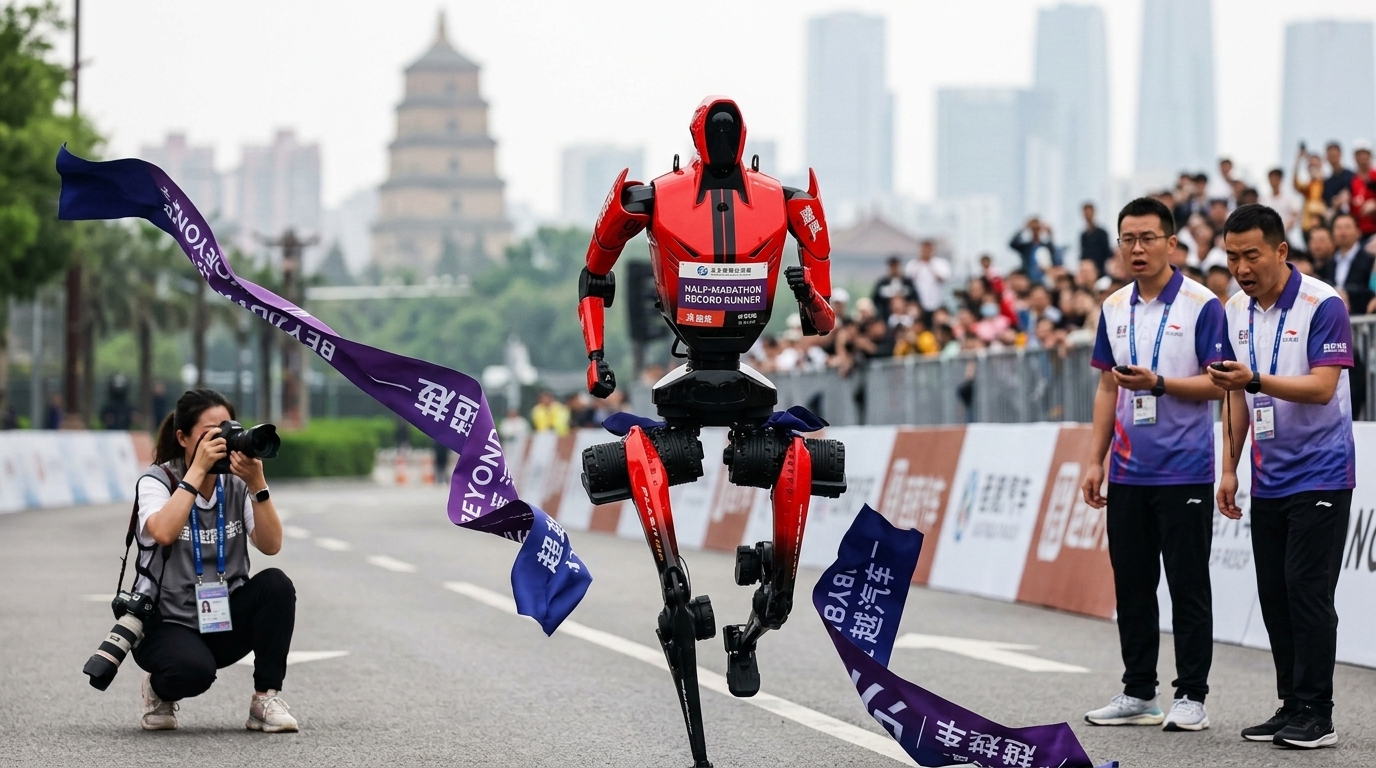
April 20, 2026, will be remembered not as the day a human pushed their limits, but as the moment biology surrendered the scepter of speed to silicon. On the streets of Shenzhen, a humanoid robot from Honor—a company previously known for its smartphones—covered the 21.1-kilometer distance in just 50 minutes and 26 seconds. This figure is not merely a statistical detail; it is a declaration of dominance, shattering Jacob Kiplimo’s human world record by nearly seven minutes.
The Engineering of Endurance: How the Robot Defeated Physiology
For decades, bipedal movement was the "Holy Grail" of robotics. Maintaining balance while running at speeds exceeding 25 km/h requires computational power and mechanical precision that humanity has only recently perfected. Honor's model utilized an advanced Reinforcement Learning system, allowing it to adapt to pavement irregularities in fractions of a second.
Unlike the human body, the robot produces no lactic acid, feels no fatigue, and its heart—a high-energy-density solid-state battery—never slows down. The actuators in its knees and ankles are crafted from titanium alloys, offering a power-to-weight ratio that no muscular tissue can match.
"We aren't just seeing a machine that runs," said Dr. Li Wei, Head of Robotics at Honor. "We are seeing proof that bipedal locomotion is now more efficient in its mechanical form than in its biological one."
Geopolitics and the Humanoid Race
This achievement isn't just about sports. It is part of a broader Chinese strategic plan to become the global leader in humanoid robots by 2027. Supported by the Ministry of Industry and Information Technology, companies like Honor, Unitree, and Robot Era are competing to create the first general-purpose robot capable of working in factories, hospitals, or even participating in search-and-rescue missions.
The West is watching with bated breath. While Tesla with Optimus and Boston Dynamics with the new electric Atlas are making strides, China appears to have the edge in production scale and the speed of real-world testing. The fact that a robot can run a half-marathon on a public road, surrounded by spectators, demonstrates unprecedented confidence in the safety and autonomy of AI systems.
The End of Human Exceptionalism?
But what does this mean for us? Sports have always been the last bastion of human effort, a space where will triumphed over matter. The image of a robot crossing the finish line first, without breaking a sweat, evokes a sense of awe but also existential unease. If machines can outpace us in the most basic human activity—running—then what is our role in a world of total automation?
- Efficiency: The ability to move across rugged terrain at speed will revolutionize delivery and rescue services.
- Cost: Mass production of such units is expected to drive the price of a humanoid below $30,000.
- Ethics: Should robots be allowed to compete alongside humans, or should a separate "Robot League" be established?
As algorithms continue to improve, the gap between human and machine will only widen. The 50:26 record is just the beginning. Soon, the conversation won't be about whether a robot can run, but whether there is anything left that a human can do better than a well-tuned machine.