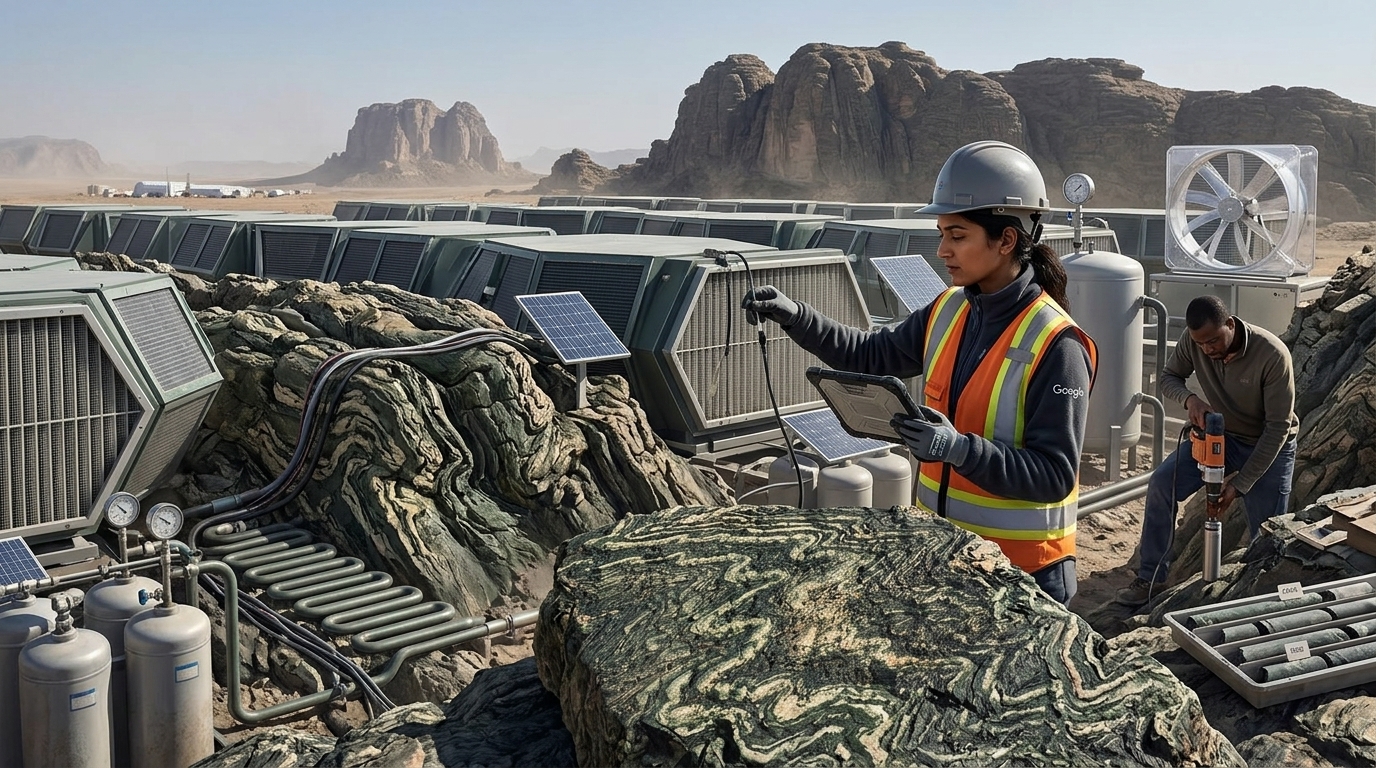
In a decisive move for global climate policy and technological advancement, Google has announced the renewal and expansion of its commitment to Frontier, a coalition of companies aimed at accelerating carbon dioxide removal (CDR) technologies. This move is not merely an act of corporate social responsibility but a strategic necessity, as the explosion of Artificial Intelligence (AI) threatens to derail the environmental goals of major tech giants.
The Philosophy of Advance Market Commitment (AMC)
The Frontier initiative operates on a model known as Advance Market Commitment (AMC). This is a financial structure borrowed from vaccine development: companies commit to purchasing a specific amount of a future technology, providing inventors and investors with the certainty that a market will exist for their product. In the case of carbon removal, this is vital, as most current solutions—such as Direct Air Capture (DAC)—remain prohibitively expensive and difficult to scale.
Google, alongside Meta, Stripe, and Shopify, is sending a powerful signal to the market: carbon removal is not optional. To reach the goal of "net-zero" by 2030, emission reductions alone are not enough. The Intergovernmental Panel on Climate Change (IPCC) has made it clear that removing billions of tons of CO2 from the atmosphere is essential to limiting global warming to 1.5°C.
The AI Paradox
It is impossible to examine Google’s environmental strategy without mentioning AI. Training large language models (LLMs) and operating the data centers that support Gemini and other services require massive amounts of energy and water for cooling. While Google promotes AI as a tool for solving the climate crisis (e.g., through grid optimization), the technology itself places a significant burden on the system.
The investment in Frontier represents an attempt to "offset" this paradox. By investing in technologies like enhanced rock weathering and bioenergy with carbon capture and storage (BECCS), Google is attempting to build an industry that can "clean up" the emissions that its own AI progress makes inevitable. According to the company, the renewed commitment will focus on solutions capable of storing carbon safely for over 1,000 years.
"Scaling carbon removal requires more than just goodwill; it requires a functioning market that rewards innovation and proven efficacy," says a Google executive.
Technologies Under the Microscope
Frontier’s portfolio includes some of the most promising yet risky technologies of our time:
- Direct Air Capture (DAC): Massive installations that act as "mechanical trees," filtering CO2 directly from the atmosphere.
- Enhanced Weathering: Spreading crushed rocks (like basalt) on farmland, which accelerates the natural process of carbon absorption by minerals.
- Ocean-Based Removal: Techniques that increase the alkalinity of oceans so they can absorb more CO2 without increasing acidity.
The challenge remains cost. Today, removing one ton of CO2 via DAC can cost over $600. Frontier’s goal is to drive this cost below $100 through economies of scale. Google, acting as a guarantor, gives scientists the "green light" to experiment without the fear of financial collapse.
Critique and Outlook
Despite the optimism, many environmentalists remain skeptical. There is a risk that the focus on carbon removal will be used as an excuse to continue using fossil fuels or to delay actual decarbonization. However, Google insists its strategy is twofold: drastic emission reductions at the source and simultaneous investment in removing legacy carbon.
In conclusion, Google’s move to lead Frontier’s funding in 2026 shows that the future of technology is inextricably linked to the planet's sustainability. If AI is to be the "engine" of the next industrial revolution, carbon removal technologies must be the "filter" that ensures this revolution does not self-destruct.