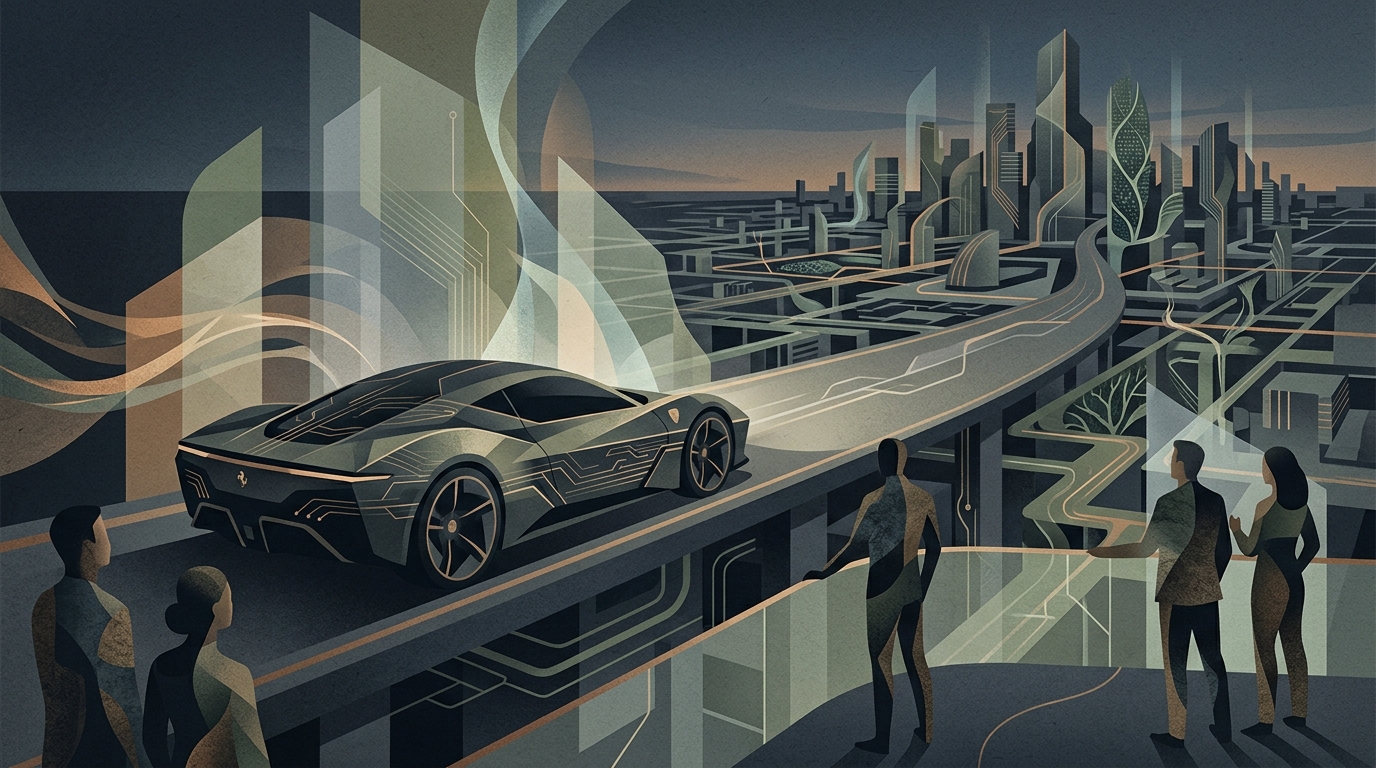
The transition to electrification is arguably the most critical juncture in Ferrari's history since its founding in 1947. With the unveiling of the Luce, its first fully electric model, Maranello has entered uncharted waters, sparking a wave of reactions ranging from excitement over technological innovation to outright rejection by traditional 'tifosi'. Gianmaria Fulgenzi, Ferrari's Chief Product Development Officer, admitted in recent statements that the Luce is a 'different kind of Ferrari' that requires time to be 'digested' or assimilated by the public and the market.
The Identity Crisis Without the Roar
For decades, the soul of a Ferrari was its internal combustion engine—the iconic V12 or the spirited V8. The sound, the vibrations, and the linear power delivery were the primary characteristics that set a car bearing the 'Prancing Horse' badge apart from any other supercar. With the Luce, Ferrari is challenged to redefine this experience without the traditional soundtrack. Fulgenzi argues that the focus has been placed on 'driving emotion,' which does not depend solely on engine sound but on responsiveness, weight distribution, and torque immediacy.
However, the market remains hesitant. Critics argue that an electric car, no matter how fast, lacks the 'romance' that accompanies old-school mechanical engineering. Ferrari, for its part, has invested billions in the new 'e-building' in Maranello, where batteries, electric motors, and chassis are manufactured, seeking to maintain full control of its technological chain. The Luce is not just an electric car with a Ferrari badge; it is a statement that Italian finesse can survive in the 21st century.
Technological Superiority and 'Digestion'
The term 'digestion' used by Fulgenzi is not accidental. It refers to the need for the public to move past the shock of change and appreciate the new possibilities offered by electric architecture. The Luce features a four-wheel steering system and torque vectoring that, according to engineers, offers levels of agility that were impossible with heavy internal combustion engines mounted in the center or front.
- The use of solid-state batteries, rumored to equip future iterations.
- The specially designed 'acoustic signature' that does not mimic a V12 but creates a new, technological sound.
- Aerodynamic efficiency reaching levels seen in Formula 1 cars.
Fulgenzi emphasized that Ferrari is not trying to copy Tesla or Chinese automakers. 'We are not making a gadget on wheels,' he stated pointedly. The Luce targets a clientele seeking exclusivity and performance, while also wanting to be compatible with new environmental mandates and urban traffic restrictions of the future.
The Strategy of Scarcity in the Electric Era
One of the biggest questions is whether the Luce will maintain the resale value that makes Ferraris a safe investment. In the world of electric cars, technology depreciates rapidly. Ferrari responds to this with a 'battery swap' program and continuous software updates, promising that the Luce will remain relevant for decades. Production will remain limited, maintaining the law of supply and demand that has made the brand dominant.
'The Luce is a Ferrari that doesn't need to scream to prove its worth. It is the quiet power of a new era,' say sources close to Maranello's management.
In conclusion, the Ferrari Luce is a multi-billion dollar gamble. If the public 'digests' it as Fulgenzi hopes, Ferrari will have achieved the impossible: carrying its passion and heritage into a world without gasoline. If not, the Luce may be recorded as a bold but misguided attempt to modernize a brand whose identity is inextricably linked to the past.