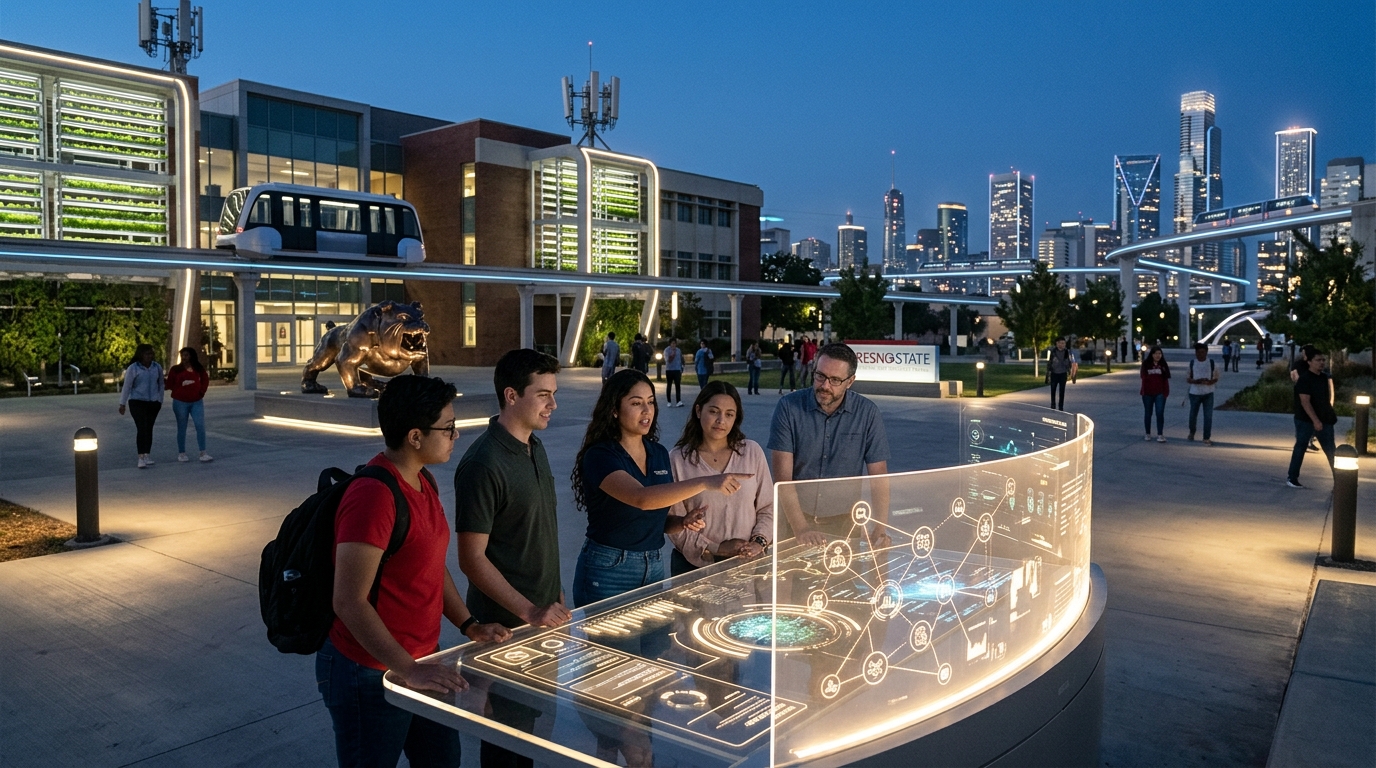
In an era where technological progress moves at a pace that often outstrips the ability of institutions to adapt, California State University, Fresno (Fresno State) is taking a step that marks a profound shift in the educational landscape. The announcement of a new minor in Artificial Intelligence (AI), open to students across all disciplines, is not merely a curriculum addition; it is a recognition that AI is no longer a niche tool for computer scientists, but a foundational skill for the 21st-century citizen and professional.
Breaking Down Academic Silos
For decades, higher education has operated within strictly defined silos. Humanities students rarely interacted with coding, while engineers often overlooked the ethical and social implications of their creations. Fresno State’s program aims to overturn this tradition. By allowing students of philosophy, agriculture, the arts, and business administration to dive deep into AI, the university is fostering a new generation of 'hybrid' thinkers.
This strategic choice reflects the reality of the labor market. A lawyer who understands how Large Language Models (LLMs) function can better navigate intellectual property issues. An agriculturalist in California's Central Valley who understands machine learning can optimize irrigation and harvesting through predictive modeling. Artificial Intelligence is ceasing to be the object of study and is becoming the lens through which all other subjects are examined.
Ethics, Governance, and Social Impact
One of the most compelling aspects of the new program is its emphasis on the ethical dimension of technology. Unlike purely technical programs, Fresno State’s interdisciplinary minor includes modules on algorithmic bias, privacy protection, and the impact of automation on social cohesion. This is particularly vital in a region like Fresno, where socioeconomic disparities are stark, and access to technology can serve as either a bridge or a new barrier.
- Democratic Access: The program aims to demystify AI for students who have traditionally felt excluded from the tech sector.
- Practical Application: Students don't just learn theory; they are tasked with applying AI tools to real-world problems within their specific majors.
- Critical Thinking: Instruction focuses on when *not* to use AI, recognizing its inherent limitations and hallucinations.
"Artificial Intelligence is the new electricity. Just as no one can imagine a business without power today, we won't be able to imagine any industry without AI in five years," say academic proponents of the initiative.
Challenges and the Future of Learning
Despite the enthusiasm, implementing such a program is not without its hurdles. The speed at which technology evolves means that a syllabus could be obsolete before the semester even ends. Furthermore, training the faculty itself represents a massive undertaking. Fresno State must prove that a public university can compete with the private giants of Silicon Valley in terms of innovation and agility.
By 2026, this move by Fresno State will likely be seen as the norm rather than the exception. Integrating AI into education is no longer a luxury but a survival necessity for academic institutions that wish to remain relevant. As students prepare for careers that may not even have been invented yet, the ability to collaborate with intelligent systems will be their most valuable asset.