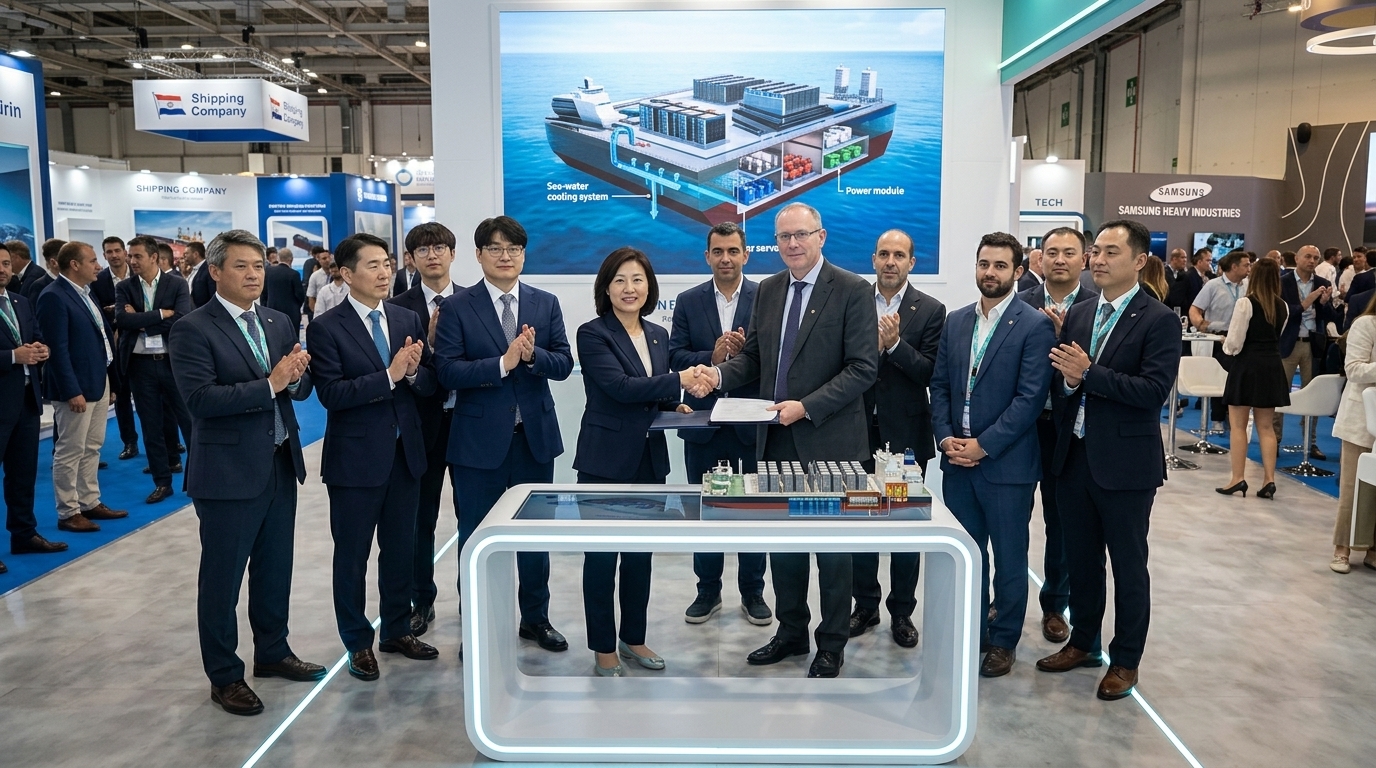
The global race for Artificial Intelligence (AI) supremacy is no longer confined to the sterile laboratories of Silicon Valley; it has moved to the high seas. In a move that underscores the convergence of heavy industry and the digital economy, Lloyd’s Register (LR), Samsung Heavy Industries (SHI), and Capital Clean Energy Carriers Corp. (CCEC) have signed a Memorandum of Understanding (MOU) to develop Floating Data Centers (FDCs). This development signals a paradigm shift in how we perceive the infrastructure of the future, effectively moving the "nervous system" of AI from solid ground to the ocean.
The Urgency for a New Architectural Blueprint
As AI models grow exponentially more complex, the demand for computational power is skyrocketing. Traditional land-based data centers are hitting a wall due to three critical constraints: the scarcity of available land near urban hubs, the immense strain on national power grids, and the colossal water consumption required for cooling high-density server racks. Floating Data Centers emerge as a sophisticated answer to these challenges.
Samsung Heavy Industries, a global leader in shipbuilding and offshore engineering, brings to the table its unparalleled expertise in constructing floating platforms and LNG carriers. Utilizing floating units allows for the direct application of seawater cooling systems, which drastically reduces operational costs and the carbon footprint. Furthermore, the ability to moor these units near coastal megacities minimizes latency, a factor that is becoming non-negotiable for real-time AI applications and autonomous systems.
A Strategic Alliance of Maritime Powerhouses
The involvement of Capital Clean Energy Carriers Corp. (CCEC), part of the Evangelos Marinakis-led Capital Group, highlights the pivotal role the maritime sector is poised to play in the tech world’s energy transition. CCEC’s focus on clean energy transportation aligns perfectly with the need for sustainable power for AI. These floating units will not merely be "ships with servers" but autonomous energy hubs, potentially powered by LNG, ammonia, or integrated with offshore renewable sources like wind and wave energy.
- Lloyd’s Register: Will lead the classification and safety certification process, a critical component for establishing trust in a completely new category of maritime assets.
- Samsung Heavy Industries: Will spearhead the design and modular construction, ensuring scalability and rapid deployment.
- CCEC: Will provide operational expertise and energy supply chain management, ensuring that these data centers remain both functional and environmentally compliant.
Geopolitical Implications and Technical Challenges
Despite the immense potential, moving data infrastructure to the sea introduces a host of new questions. The legal and regulatory framework for floating data centers in international or territorial waters is still in its infancy. Which jurisdiction’s data protection laws will apply? How will these critical assets be protected from cyber-threats or physical sabotage in a maritime environment? This alliance aims to set the first international standards, acting as a blueprint for the global industry.
"The ocean is no longer just a highway for trade; it is becoming the new repository for human knowledge and compute," industry analysts suggest.
This partnership is also a direct response to the mounting pressure on Big Tech companies to reach net-zero targets. By leveraging maritime engineering, tech giants like Microsoft, Google, and Amazon can bypass the limitations of land-based development, utilizing floating infrastructure as a flexible, scalable, and mobile solution that can be redeployed as market demands shift across the globe.
The Final Frontier of AI Infrastructure
The initiative by LR, SHI, and CCEC is more than just a business deal; it is the prologue to a new era where naval architecture meets data science. As 2026 proves to be a decisive year for the maturation of AI, the infrastructure supporting it must become more resilient and efficient. The sea offers the space and the cooling capacity that the land can no longer provide. This alliance is the first to attempt to conquer this new frontier in an organized, institutional, and commercially viable manner, bridging the gap between the digital and the physical worlds.