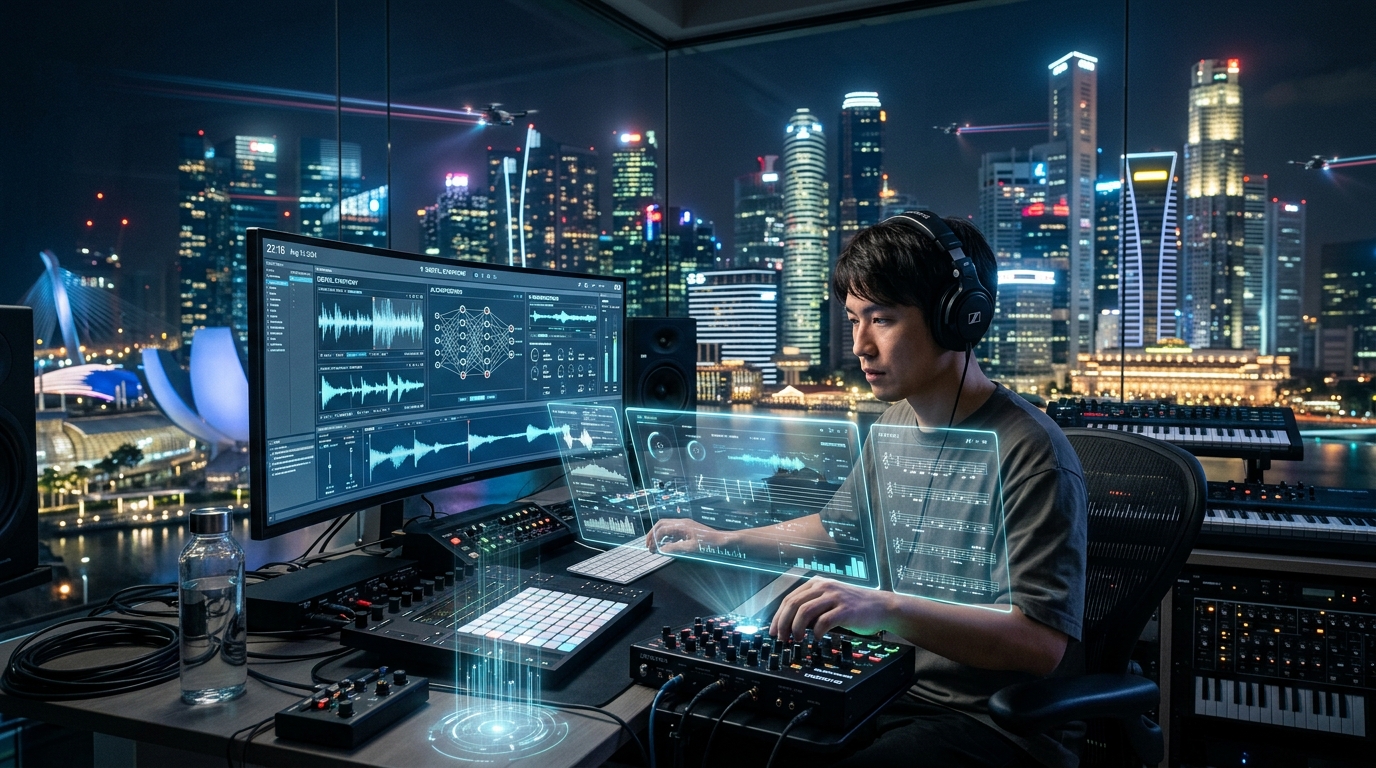
Music, the most abstract and emotional of the arts, is experiencing a seismic shift. As we approach the mid-2020s, Artificial Intelligence (AI) is no longer an experimental tool in the hands of a few technologists, but a dominant force reshaping every aspect of sonic creation. This evolution, from the early attempts of the Illiac Suite in the 1950s to today's platforms like Suno and Udio, represents one of the most radical changes in cultural history.
The Transition from Automation to Creativity
For decades, technology in music focused on facilitating production. MIDI, synthesizers, and Digital Audio Workstations (DAWs) gave artists new colors on their palette. However, Generative AI introduces something qualitatively different: the machine's ability to make creative decisions. Today, diffusion models and transformers are trained on massive datasets of music, learning not just the notes, but the texture, emotion, and structure of genres.
The current generation of tools allows anyone, regardless of musical knowledge, to create complete tracks with vocals, lyrics, and orchestration within seconds. This "democratization" of creation brings with it a crucial question: if everyone can be a composer, what happens to the value of music? The ease of production risks leading to a content inflation where a "good" musical piece becomes a low-value disposable commodity.
The Ethical and Legal Chessboard
The evolution of AI music is not just technological, but deeply political and legal. The industry is in a state of war regarding training data. Major record labels argue that using copyrighted works to train AI models constitutes intellectual property theft. On the other hand, tech companies invoke "fair use," arguing that AI does not copy but learns from style, just as a human musician is influenced by their predecessors.
- Protection of the human voice: The rise of "deepfake" voices has led to legislative initiatives, such as the ELVIS Act in Tennessee, to protect the vocal identity of artists.
- The rights issue: Who owns the copyright of a song created by AI? Current rulings in the US and EU indicate that only works with significant human intervention can receive protection.
- Economic survival: Session musicians and commercial music composers see their jobs directly threatened by cheaper, instant AI solutions.
This conflict will define the future of the creative economy. If AI is considered merely a "tool," then control remains with the human. But if it is recognized as an autonomous creator, the very concept of the artist will have to be fundamentally redefined.
The Artist as Curator
Despite the fears, many see AI as an opportunity for a new art form. The artist of the future may not be the one who plays an instrument with virtuosity, but the one who can guide the machine toward unexpected aesthetic paths. AI can function as a "collaborator" suggesting harmonies or rhythms that the human brain, limited by its habits, would never think of.
"Artificial intelligence will not replace music, but it will replace music that has no soul," industry optimists often say.
In the future, live performance and authentic connection with the audience will gain even greater value. In a world full of perfectly produced but digitally constructed sound, the imperfection of human performance will be the ultimate luxury. The evolution of AI music forces us to return to the fundamental question: why do we listen to music? If the answer is to feel a connection with another human being, then AI will always remain a means and never the end.