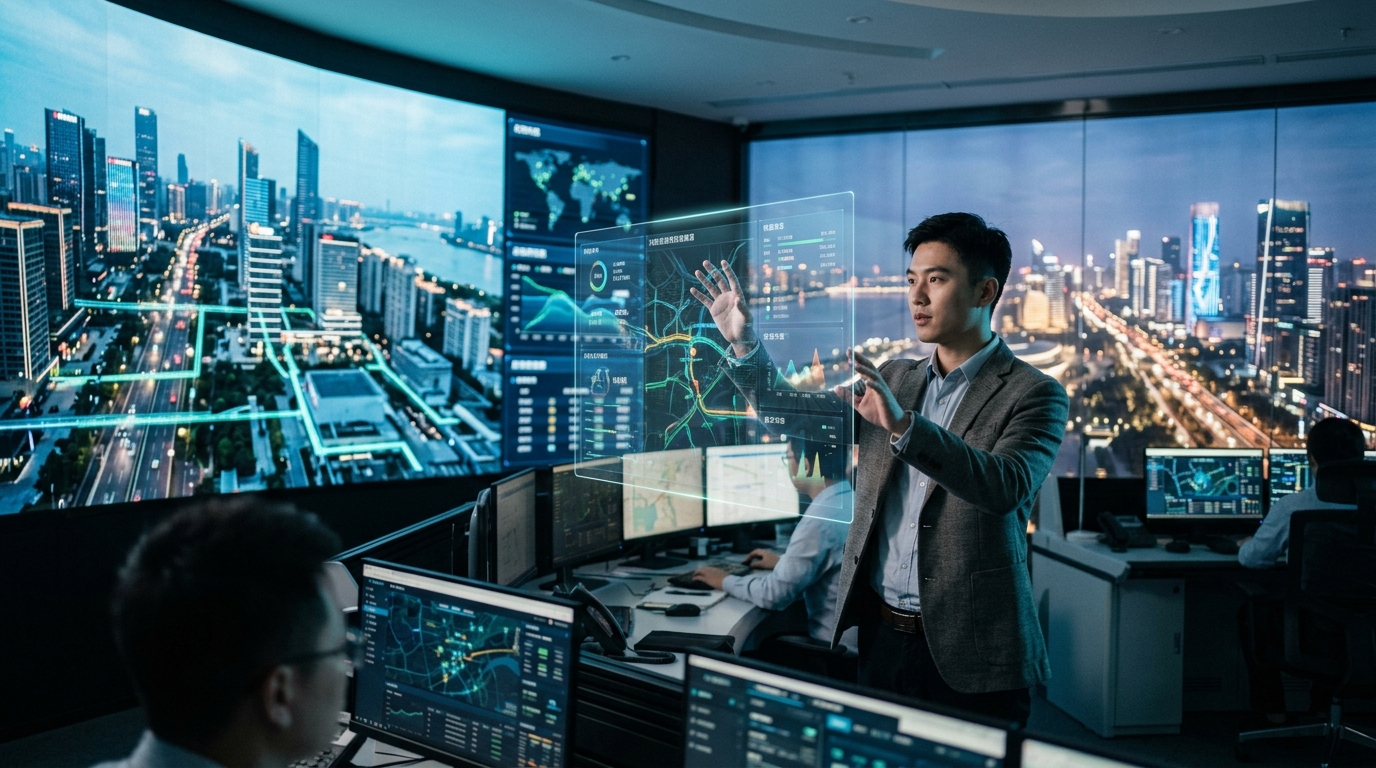
In the heart of China’s Zhejiang province, Hangzhou—the headquarters of tech titan Alibaba—is no longer just a historic cultural hub; it has become the world’s most advanced experiment in urban governance. The 'City Brain' project, launched in 2016 in collaboration with Alibaba Cloud, has evolved into a comprehensive nervous system that processes billions of data points in real-time, effectively turning the city into a living, thinking organism.
The Architecture of Digital Omniscience
The 'City Brain' is far more than simple traffic management software. It is a massive AI infrastructure utilizing thousands of cameras, motion sensors, mobile phone data, and public transport GPS systems. Through neural networks, the system analyzes traffic on every street, predicts congestion before it happens, and adjusts signal timing with millisecond precision.
Before the system’s implementation, Hangzhou ranked 5th among China’s most congested cities. Today, it has dropped below the 50th spot, despite an increase in population and vehicle ownership. This success isn't just about driver convenience. The AI prioritizes emergency vehicles, creating 'green waves' for ambulances. The results are staggering: ambulance response times have been reduced by an average of 7 minutes—a margin that, in medical terms, often translates to lives saved.
Beyond the Streets: The Social Dimension
The application of AI in Hangzhou now extends to every facet of urban life. In the tourism sector, the system allows visitors to enter attractions or check into hotels within seconds via facial recognition, eliminating queues. In waste management, sensors notify sanitation crews about bin capacity, optimizing truck routes and reducing the city's carbon footprint.
- Energy Management: AI regulates street lighting based on human presence and weather conditions.
- Public Health: During the pandemic, the 'Brain' was used for contact tracing and resource distribution with surgical precision.
- Urban Planning: Collected data helps architects understand how people move, leading to more human-centric designs for squares and parks.
The Price of Efficiency and Ethical Dilemmas
However, Hangzhou’s digital utopia is not without its critics. Constant surveillance via thousands of cameras raises serious questions regarding privacy and civil liberties. In China, the line between 'smart service' and 'total surveillance' is exceptionally thin. The 'City Brain' is fueled by data that, in many Western democracies, would be considered strictly private.
"The city of the future is not judged solely by how fast its cars move, but by how freely its citizens breathe," digital rights analysts argue.
There is also the fear of 'algorithmic determinism.' When decisions about a city’s operation are made exclusively by a black-box AI, the transparency and accountability of political authorities are called into question. Who is responsible if an algorithm decides to isolate a neighborhood or limit access to services based on potentially biased data?
Global Influence and the Vietnam Model
The Hangzhou model is not staying within Chinese borders. Countries like Vietnam, facing rapid urbanization and massive traffic issues in cities like Hanoi and Ho Chi Minh City, are seriously considering adopting similar technologies. The collaboration between governments and tech giants to create 'smart control centers' is becoming the new norm across Southeast Asia.
The challenge for other global cities will be to adopt the efficiency of the 'City Brain' without sacrificing democratic values. Hangzhou has shown us that technology can solve decades-old problems in just a few years. The question that remains is whether we are ready to live in a city that knows us better than we know ourselves.