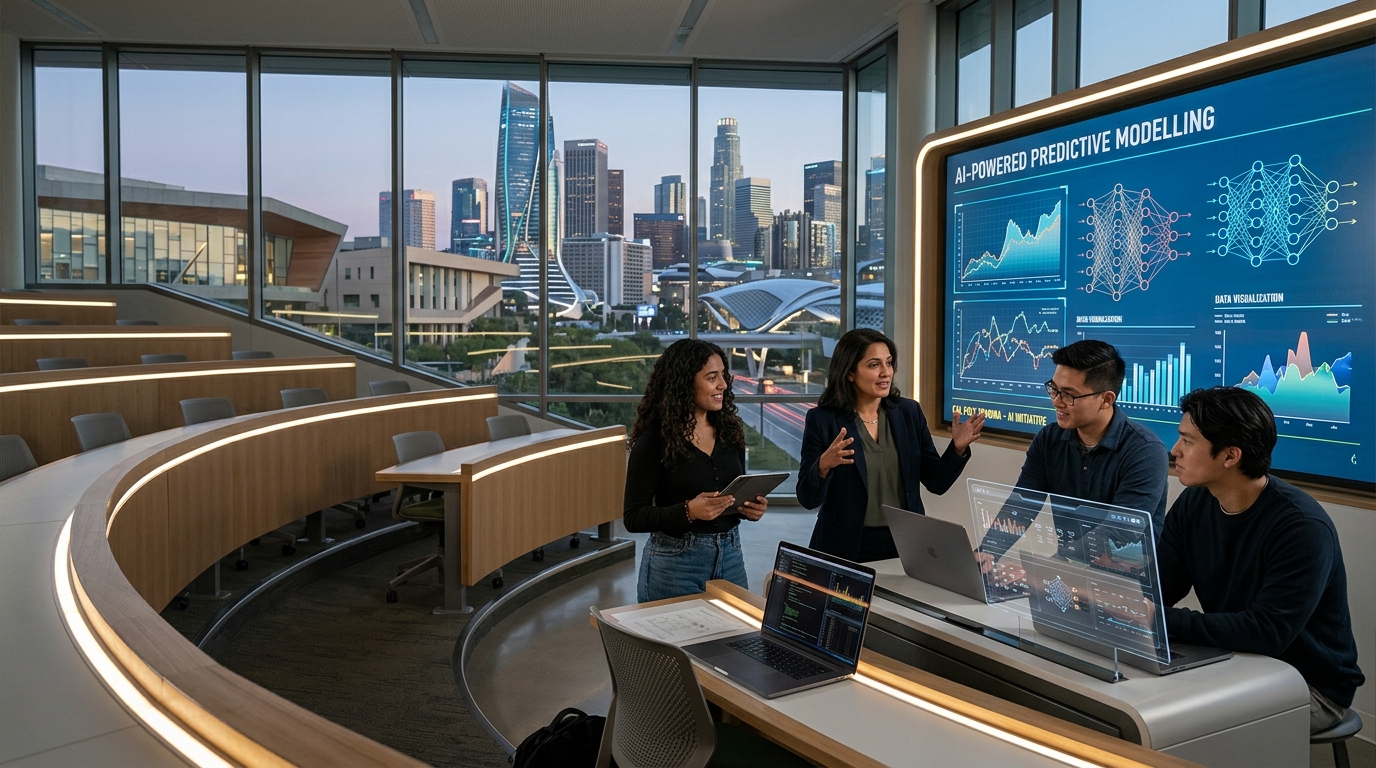
At the intersection of technological revolution and traditional pedagogy, Cal Poly Pomona (CPP) recently convened the Office of Academic Innovation (OAI) Summer Conference, placing the transformative role of Artificial Intelligence (AI) in higher education at the forefront. As we navigate mid-2026, the conversation has decisively shifted from whether AI should be allowed in the classroom to how it can be harnessed to enhance critical thinking and prepare students for an AI-dominated workforce.
From Prohibition to Integration: A Strategic Pivot
Just two years ago, many academic institutions reacted with trepidation to the rise of large language models, imposing bans and doubling down on plagiarism detection. Today, Cal Poly Pomona is leading a different charge. The conference highlighted that AI is no longer viewed as a mere automation tool, but as a "co-pilot" in the learning journey. Faculty members are now encouraged to redesign their curricula, integrating Generative AI as a medium for brainstorming, data synthesis, and personalized tutoring.
The OAI’s strategy centers on "human-centered AI." This philosophy dictates that while students learn to leverage sophisticated models, the emphasis remains on human judgment, ethics, and the ability to verify algorithmic output. This shift necessitates a radical rethinking of assessment: traditional take-home essays are being replaced by interactive presentations, oral examinations, and real-world simulations where AI acts as a collaborator rather than a substitute for student effort.
The Equity Question and Digital Divide 2.0
One of the most critical sessions of the conference focused on social justice and accessibility. As the most powerful AI tools increasingly move behind expensive subscription paywalls, there is a looming risk of a new digital divide. Students from affluent backgrounds may have access to elite "AI tutors," while those from marginalized communities are restricted to basic, free models with lower accuracy and higher bias.
CPP, staying true to its polytechnic mission, is exploring ways to provide universal access to premium AI platforms for all members of the campus community. University leadership emphasized that AI education must not be a privilege for the few but a fundamental right, akin to library or internet access. "Algorithmic literacy" is now considered an essential skill for social mobility in the 21st century.
Preparing for the 2026 Workforce
Aligning education with industry needs has always been at the heart of CPP’s mission. At the conference, industry leaders and academics discussed how employers in 2026 no longer seek individuals who merely know a subject, but those who can effectively collaborate with AI systems. What is being termed "AI Orchestration"—the ability to direct multiple AI agents to achieve a complex objective—is emerging as a top-tier professional competency.
"We are not training our students to compete with machines, but to lead them," noted one keynote speaker.
This implies a significant shift toward "soft skills" such as empathy, ethical leadership, and strategic reasoning. In a world where content generation is cheap and instantaneous, the value of the human signature and original thought increases exponentially. The conference concluded that the university of the future must be a space for continuous experimentation, where failing within an AI-assisted environment is a vital part of the learning curve.
Ethics and Academic Integrity
Finally, the issue of academic integrity remains a priority. Instead of a "witch hunt" utilizing unreliable AI detectors, Cal Poly Pomona proposes a new "social contract" between students and educators. Transparency is the key. Students are encouraged to explicitly cite where and how they used AI in their assignments, transforming its use into a documented methodology rather than a hidden shortcut.
The OAI Summer Conference was more than just a gathering of experts; it was a statement of intent. Cal Poly Pomona is embracing the challenge of the era, choosing the path of innovation over retrenchment, and shaping an educational model that aspires to be as technologically advanced as it is deeply human-centric.