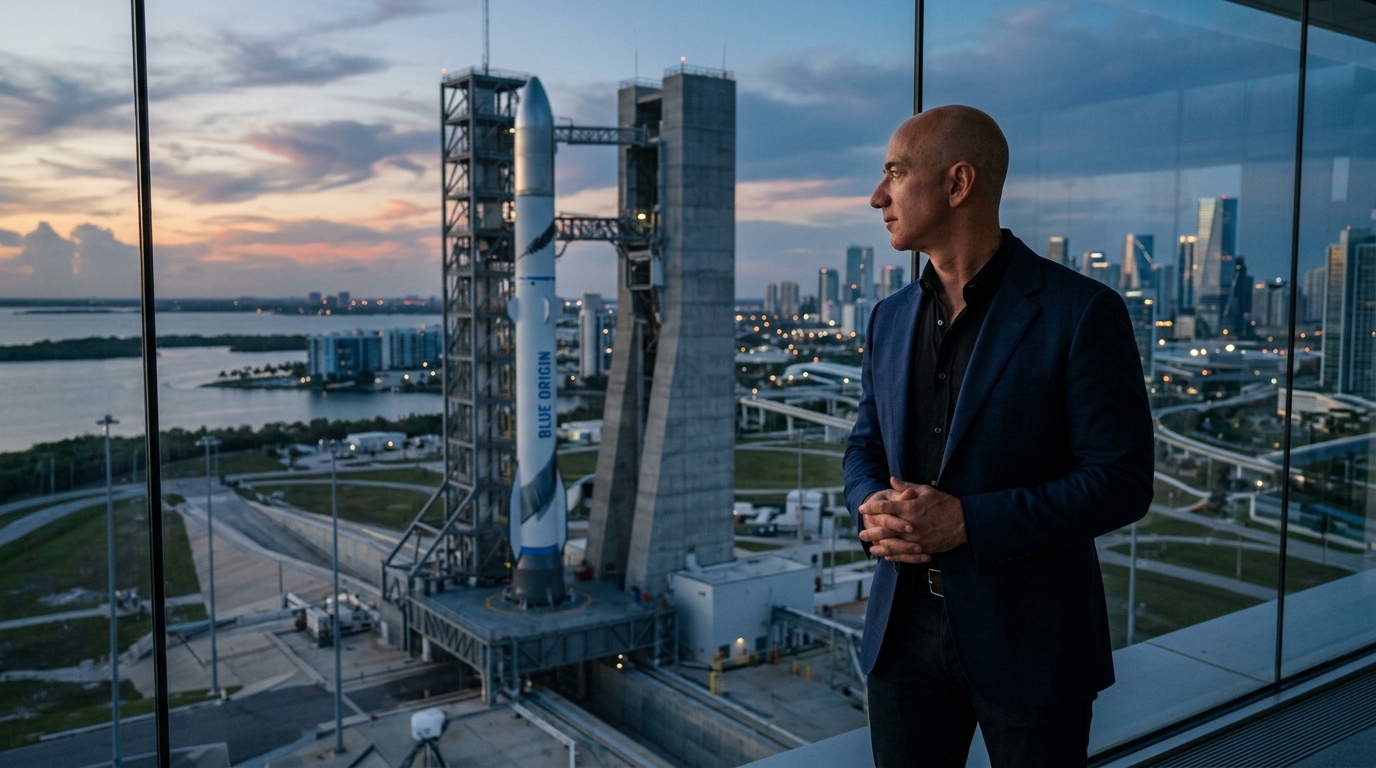
The history of space exploration has never been written with caution, but with bold leaps over the ashes of failure. For Jeff Bezos’s Blue Origin, May 2026 will be remembered as a moment of crisis, when a New Glenn rocket was engulfed in flames during testing at its Florida launch site. Yet, instead of a retreat, the company has announced an aggressive reconstruction strategy, pledging to see the 320-foot giant pierce the skies before the end of the current year. This move is not merely a technical challenge; it is an existential necessity for a company struggling to prove it can stand shoulder-to-shoulder with Elon Musk’s SpaceX.
Rising from the Ashes of Cape Canaveral
The reconstruction of Launch Complex 36 (LC-36) at Cape Canaveral is proceeding at a pace reminiscent of a wartime mobilization. Last month’s explosion caused significant damage to the support infrastructure, but Blue Origin engineers are working around the clock to restore fuel systems and umbilical towers. According to internal sources, data analysis revealed that the failure was not due to a fundamental design flaw in the rocket itself, but rather an anomaly in the second-stage pressure management system. This finding gave leadership the green light to proceed without the kind of radical redesigns that would have sidelined the program for years.
New Glenn is no ordinary rocket. Capable of carrying over 45 metric tons to Low Earth Orbit (LEO) and featuring a reusable first stage, it represents Bezos’s heavy-lift ambitions. Its success is intrinsically linked to Amazon’s Project Kuiper, which aims to deploy a constellation of satellites for global internet coverage. Without New Glenn, Amazon is forced to pay its direct competitor, SpaceX, to put its satellites into orbit—an irony Bezos is desperate to end.
Billion-Dollar Stakes and NASA’s Pressure
Beyond Amazon’s commercial interests, Blue Origin is under the thumb of government contracts. NASA has selected New Glenn for critical missions, including carrying the Blue Moon lunar lander for the Artemis program. Delays in the rocket’s development have already caused jitters in Washington, as the timeline for returning humans to the Moon remains incredibly tight. The commitment to launch in 2026 serves as a reassuring statement to taxpayers and policymakers that private enterprise remains reliable despite the inherent risks of aerospace engineering.
- Rapid restoration of the LC-36 launch complex.
- Intensified testing cycles for the BE-4 engines.
- Alignment with Project Kuiper’s strict deployment deadlines.
- Securing NASA’s confidence for the Artemis lunar missions.
The BE-4 engines, which utilize liquefied natural gas (LNG) and liquid oxygen, are the heart of New Glenn. While they have been used successfully on United Launch Alliance’s (ULA) Vulcan rocket, their application on New Glenn requires a level of reliability that facilitates the vertical landing of the first stage on a ship at sea. This technology, which SpaceX has perfected, remains the “Holy Grail” for Blue Origin.
Competition and the Future of the Space Economy
The heavy-lift launch market is transforming rapidly. While SpaceX dominates with the Falcon 9 and continues to iterate on the massive Starship, the emergence of a second strong player is essential for maintaining healthy competition and driving down the cost of access to space. Blue Origin promises that New Glenn will offer superior payload volume thanks to its massive 7-meter fairing, allowing for the launch of larger, more complex satellites that previously could not fit on any operational rocket.
“We don’t choose to go to space because it is easy, but because it is necessary for the future of humanity,” Bezos once remarked.
However, this rhetoric will be tested in the crucible of the launchpad. If the next launch attempt fails, the consequences will be catastrophic—not just for the company’s prestige, but for the financial viability of its grand designs. 2026 is emerging as the year of reckoning for Blue Origin: it will either cement its place as a pillar of the new space age or remain a secondary player in Elon Musk’s shadow.