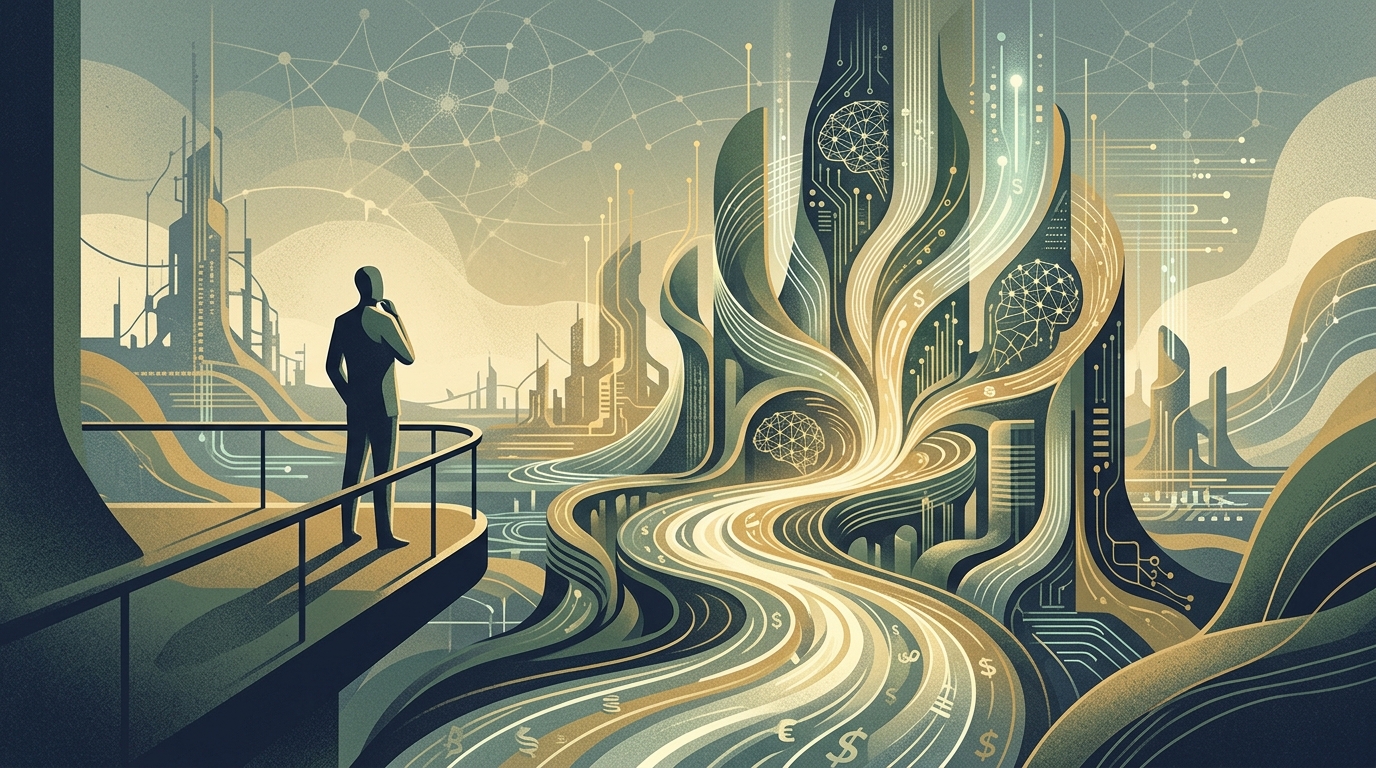
At the height of the Artificial Intelligence revolution in 2026, public opinion largely assumes that humanity's future will be forged in the laboratories of OpenAI in San Francisco or Anthropic in neighboring Palo Alto. However, a growing cohort of scientists, economists, and tech philosophers is beginning to articulate a heretical view: today's giants of Large Language Models (LLMs) might not be the architects of the future, but merely the scribes of the most sophisticated 'digital papyri' of a passing era.
The Data Wall and the Curse of Scale
For nearly five years, the AI dogma was simple: more data, more compute, larger models. This 'Scaling Law' bore fruit that once seemed impossible. But as we navigate the summer of 2026, this strategy is hitting a wall. The exhaustion of high-quality human data on the internet has forced companies to turn to synthetic data — information generated by AI itself.
The problem, as many researchers point out, is 'digital incest.' When models are trained on data produced by their predecessors, they begin to exhibit symptoms of model collapse, losing touch with human creativity and nuanced reasoning. OpenAI and Anthropic, despite investing billions, are now facing diminishing returns. Every additional billion dollars spent on GPUs yields increasingly smaller gains in intelligence, opening the door for alternative approaches.
The Open Source Revolution and Decentralization
While Silicon Valley's walled gardens attempt to maintain their monopolies, a quiet revolution is taking place in the open-source community. Models like Meta's Llama and new architectures from Mistral and independent European consortia have proven that efficiency can beat size. The idea that AI must be a centralized 'god' in the cloud is being challenged by the rise of Edge AI — artificial intelligence that runs locally on devices without needing to connect to Microsoft or Google servers.
"The history of technology teaches us that pioneers are rarely the ones who dominate the final market. IBM dominated mainframes but lost the PC. Nokia dominated mobiles but lost the smartphone. OpenAI might be the IBM of AI: indispensable today, obsolete tomorrow," notes a prominent industry analyst.
Toward a New Architecture of Intelligence
The future might not even lie in LLMs. New approaches, such as neuro-symbolic AI—which combines neural network learning with rule-based logic—or biologically inspired computing, promise results at a fraction of the energy required today. The energy crisis triggered by the data centers of OpenAI and Anthropic makes the current model unsustainable in the long run.
Furthermore, geopolitics plays its own role. The European Union, through the AI Act and the promotion of digital sovereignty, favors models that are transparent and verifiable, which directly conflicts with the 'black box' approach of the American titans. If the future of AI requires trust and local adaptation, then agile, decentralized teams may have the advantage over centralized giants.
Conclusion
OpenAI and Anthropic showed us what is possible, but assuming the journey ends with them is historically naive. The future of artificial intelligence will likely be more fragmented, more specialized, and much less dependent on who owns the most Nvidia GPUs. The era of 'digital empires' may give way to an ecosystem of thousands of intelligent agents operating quietly in the background of our daily lives.