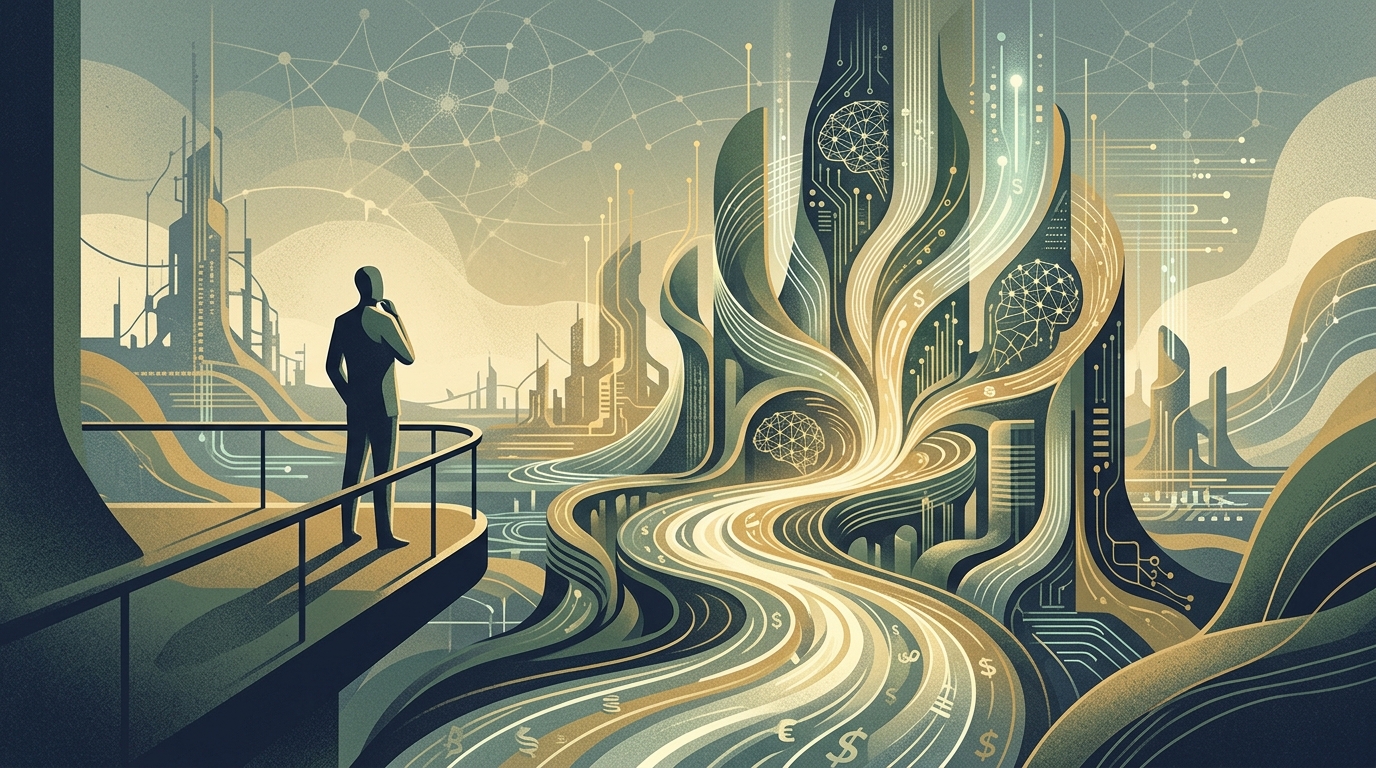
As we navigate the middle of 2026, we find ourselves at a profound paradox. Artificial Intelligence (AI) has transitioned from a speculative future technology to an omnipresent partner, generating text, code, and art with a proficiency that eclipses human speed. Yet, as algorithms approach what many call "the 90% of perfection," a new, urgent necessity is emerging: the recognition and preservation of the remaining 10%. This small margin is not a glitch in the system; it is the very essence of human existence—the capacity for empathy, moral judgment, and unpredictable creativity.
The Trap of Statistical Mediocrity
AI, in its current generative form, functions as a mirror of our collective data. Large Language Models (LLMs) are trained to predict the next likely word or pixel based on everything that has already been said or created. The result is often breathtaking but inherently "average." It is the statistical homogenization of human thought. When we ask an AI to write a poem or design a building, it provides a distillation of thousands of examples, yet it lacks the "spark" that arises from lived experience and the labor of creation.
The "10% difference" highlighted by the Nebraska Examiner represents the deviation from the mean. It is the moment a painter chooses to distort perspective or a leader makes a decision based on intuition rather than data points. In a world saturated with "perfect" but soulless AI products, the human touch—with all its imperfections—suddenly gains premium value. Authenticity is becoming the new currency in a market suffering from the inflation of synthetic content.
Education in the Age of Automated Thought
This shift has deep implications for how we prepare future generations. If AI can cover 90% of technical execution, then education must pivot to focus exclusively on the critical 10%. It is no longer enough to teach students how to write an essay or solve an equation; these have become commodities. The new challenge lies in cultivating critical thinking, the ability to ask the right questions, and the moral intuition required to direct AI’s power.
- Critical Analysis: The ability to discern truth within an ocean of algorithmically generated misinformation.
- Emotional Intelligence: Understanding the subtle nuances of human communication that AI can mimic but never truly feel.
- Ethical Leadership: Making decisions that prioritize social well-being over mere algorithmic optimization.
We are witnessing the rise of the "Human-in-the-Loop" economy. Professionals who thrive will not be those who compete with AI on speed, but those who can refine AI's 90% output with the 10% of human nuance that makes it resonate with a real audience. This is the difference between a generic marketing copy and a campaign that moves a nation.
Ethics and Responsibility: The Final Frontier
Perhaps the most vital part of this 10% is responsibility. An AI can suggest a medical diagnosis or a judicial sentence, but it cannot carry the weight of the consequences. Moral accountability is inseparable from the human condition. The more tasks we delegate to machines, the more we must strengthen human oversight mechanisms. The "10%" is the guarantor that technology remains a servant to humanity rather than an autonomous generator of social inequality.
"Artificial intelligence is the tool that will allow us to become more human by freeing us from mechanical labor, provided we do not forget how to use our hearts for the rest of the journey."
In conclusion, appreciating the 10% difference is not an act of technophobia but an act of self-awareness. In an era where technology can simulate almost everything, real value will reside in what cannot be encoded. Our challenge in 2026 is to ensure that as AI takes over 90% of the burden, we do not atrophy intellectually. Instead, we must use our newfound resources to explore the depths of the human experience that no machine can ever reach.