In the heart of rural Vietnam, where the rhythmic sound of bamboo and rattan weaving has defined the pace of life for centuries, a new technological revolution is beginning to unfold. The news that three students clinched the first prize in a national innovation competition by using Artificial Intelligence (AI) to "paint" the future of this ancient craft is more than just a success story. It is a manifesto for how high technology can serve as a bridge, shielding cultural heritage from the oblivion of industrial uniformity.
The Collision of Old and New
The art of rattan and bamboo weaving in Vietnam is not merely an economic activity; it is a living organism carrying the history of entire communities. However, in recent years, this craft has faced an existential threat. Younger generations are gravitating toward urban centers and digital careers, viewing the manual labor of their ancestors as obsolete and economically unviable. At the same time, traditional designs, though exquisite, often struggle to compete with the minimalist and functional aesthetics of the global design market.
This is precisely where the project of the three students intervenes. Instead of attempting to replace the artisan with robots, they utilized generative AI models to create a new design language. The AI analyzed thousands of traditional patterns, blending them with modern architectural forms and ergonomic requirements. The result was a series of designs that retain the "soul" of the bamboo while offering an aesthetic that could easily grace a luxury apartment in Paris or New York.
AI as a Co-Creator
The students' innovation was based on an algorithm capable of predicting the structural integrity of materials in complex geometric shapes. Bamboo and rattan are materials with specific quirks: they possess unique elasticity and breaking points. Traditionally, an artisan would learn these limits through decades of trial and error. The AI system developed by the students allows the designer to experiment with bold curves and asymmetric structures, ensuring beforehand that the final product will be stable and durable.
- Material Optimization: AI calculates the exact amount of raw material needed, reducing waste by 30%.
- Customization: The ability to produce unique designs for each client at the touch of a button.
- Pattern Preservation: Digitizing and reinterpreting forgotten local weaving techniques.
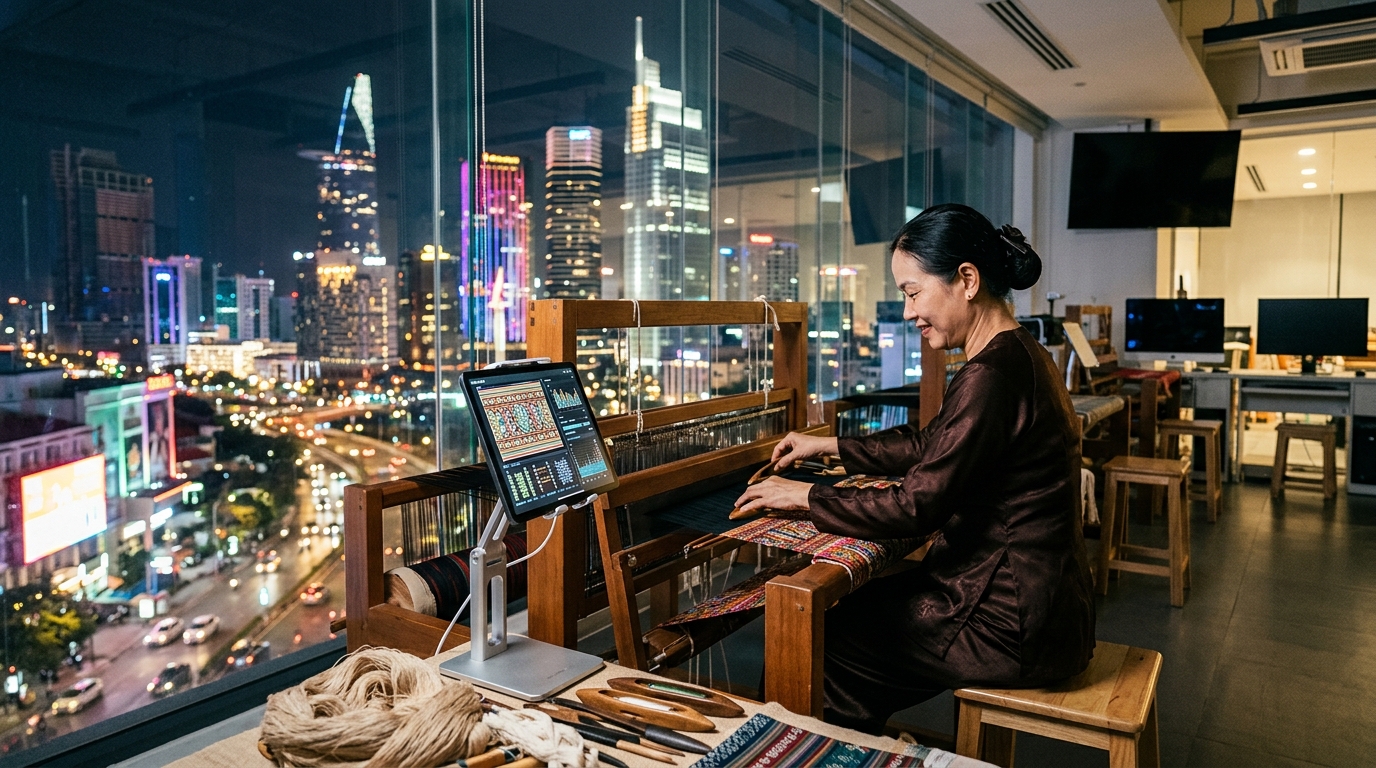
This approach transforms the traditional artisan into a "digital artist." Manual skill remains essential for execution, but the vision is expanded thanks to algorithms. This creates a new professional pathway for Vietnamese youth, who can now combine their passion for technology with their family heritage.
Sustainability and the Global Market
In an era where the climate crisis demands the use of sustainable materials, bamboo is emerging as "green gold." It grows rapidly, absorbs vast amounts of carbon dioxide, and is fully biodegradable. The students' project won not only for its technological excellence but also for its socio-economic footprint. It points the way toward a "green" industry that relies not on plastic, but on renewable nature.
"Artificial Intelligence is not the enemy of tradition, but its most powerful ally. It allows us to see bamboo not as a material of the past, but as the material of the future," said one of the award-winning students.
This success has piqued the interest of international investors and design houses. The ability of AI to bridge the gap between local production and global demand is the key to the survival of many traditional sectors worldwide. From textile weaving in Greece to pottery in Mexico, the Vietnamese model could serve as a beacon of hope.
Conclusion: Toward a Digital Humanism
The example of these three students from Vietnam reminds us that technology is a tool, and like any tool, its value depends on the hand that holds it. When AI is used to enhance human creativity and preserve cultural identity, the result is a form of "digital humanism." The future of weaving is no longer just in the hands of the old masters, but also on the screens of young visionaries who dare to imagine a world where tradition and innovation are inextricably interwoven.